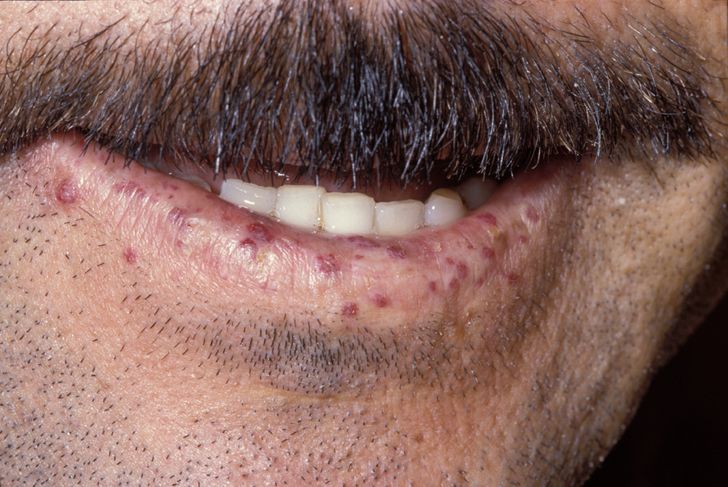
Hereditary hemorrhagic telangiectasia (HHT), also known as Osler–Weber–Rendu disease and Osler–Weber–Rendu syndrome, is an autosomal dominant genetic disorder that leads to abnormal blood vessel formation in the skin, mucous membranes, and often in organs such as the lungs, liver, and brain.
It may lead to nosebleeds, acute and chronic digestive tract bleeding, and various problems due to the involvement of other organs. Treatment focuses on reducing bleeding from blood vessel lesions, and sometimes surgery or other targeted interventions to remove arteriovenous malformations in organs. Chronic bleeding often requires iron supplements and sometimes blood transfusions. HHT is transmitted in an autosomal dominant fashion, and occurs in one in 5,000 people. SSTattler: and sometime a stroke e.g.Dan Zimmerman - Spokes Fighting Strokes.
The disease carries the names of Sir William Osler, Henri Jules Louis Marie Rendu, and Frederick Parkes Weber, who described it in the late 19th and early 20th centuries.
Hereditary Hemorrhagic Telangiectasia (HHT) is a genetic condition affecting up to 1 in 5000 Americans. It is treatable, but no cure is yet available. Watch this video to learn about HHT and what you can do to help. Visit http://www.hht.org for more information.
Low levels of iron in the blood are associated with an increased risk of dangerous blood clots that form in a vein, according to the results of a new study that included patients with an inherited blood vessel disease.
The findings suggest that treating iron deficiency may help prevent the condition known as deep vein thrombosis (DVT), according to the researchers at Imperial College London in England.
DVT typically occurs in the legs and can cause pain and swelling, and can be fatal if a blood clot dislodges and travels into the blood vessels of the lungs. Major surgery, immobility and cancer are recognized risk factors for blood clots, but there is no clear cause in many cases.
The new study included 609 patients with hereditary hemorrhagic telangiectasia (HHT), a genetic disease of the blood vessels that causes excessive bleeding from the nose and gut. Many HHT patients have low iron levels due to the loss of iron through bleeding.
Patients in the study with low iron levels were at increased risk for blood clots, but those who took iron supplements did not have a higher risk. This suggests that treating iron deficiency may help prevent DVT in the general population, the researchers said in a news release from the college.
"Our study shows that in people with HHT, low levels of iron in the blood is a potentially treatable risk factor for blood clots," lead author Dr. Claire Shovlin, from the National Heart and Lung Institute at Imperial College London and an honorary consultant at Imperial College Healthcare NHS Trust, said in the news release.
"There are small studies in the general population which would support these findings, but more studies are needed to confirm this. If the finding does apply to the general population, it would have important implications in almost every area of medicine," Shovlin added.
The study is published in the Dec. 14 issue of the journal Thorax.
About one billion people worldwide are believed to have iron deficiency anemia, according to the researchers.
The Stroke Association is building a digital self-management tool to support people in their recovery following a stroke.
My Stroke Guide has been designed by stroke survivors and carers, who have been involved in every step of its development. This ensures that their needs are at the heart of what it does.
Benefits for commissioners:
My Stroke Guide will help stroke survivors with self-management after a stroke, enabling them to monitor and improve their own health and well-being, as well as support others to do the same. Ultimately, we foresee that My Stroke Guide will reduce numbers of GP visits for stroke survivors, and contribute to the prevention of secondary strokes.
The personalised care that My Stroke Guide offers will mean users receive the right information, at the right time, in the right format for them. All of this information will be streamlined so that it is relevant to the user, their stroke, their local area and their support network.
My Stroke Guide can also act as a communication channel between user, carer, health care professional and community.
It will enable the capture of data and information which could give service providers and commissioning bodies valuable information about the care and services that they provide.
Benefits for stroke survivors:
We are creating My Stroke Guide to help make sure that stroke survivors are never alone in their recovery. My Stroke Guide will provide the practical tools to help them understand stroke and deal with its effects alongside peer support to combat isolation.
Most importantly, My Stroke Guide will be available online to users 24 hours a day.
My Stroke Guide’skey features:
Information tailored to the individual’s needs and local area
Peer-to-peer support, including an extensive video library and an online forum
Goal-setting tools and graphs which reflect the individual’s progress
Advice and signposting on the various issues people can face after stroke.
My Stroke Guide is currently in development and is undergoing on-going user testing to create the best possible product, which will be ready for launch in October 2014.
For more information on cost, availability, features and functionality or user-led design, or to register for updates, please email mystrokeguide@stroke.org.uk.
Stroke Association would like to thank Nominet Trust for their generous grant enabling us to develop the content for the My Stroke Guide self-management tool. Nominet Trust is a social investor which funds new and innovative ideas that have the potential to make a big impact.
Since I published my book, Stroke After Stroke: A Rower’s Pilgrimage, on Amazon in September, I have checked the sales numbers every day – to one site for the number of Kindle editions, and a second site for the number of printed copies. I made it easy to do so by bookmarking the sites on the pages I needed. It eventually dawned on me that perhaps checking hourly was a little overkill, so I asked my older sister if she had done the same after publishing 2 novels the same way. Beth replied that she had at first, but then had shifted to closely watching for new Amazon reviews.
So I started checking the reviews. The first three were, not surprisingly, five-star reviews – one each by Beth, an old (sorry, Roland!) friend /former co-worker, and a stroke survivor I frequently correspond with who has been a staunch cheerleader. Then a new 5-star review appeared – by a stroke survivor who is a total stranger. Now, I love my sister and friends, but a 5-star review from a stranger who called my book a “must read” for other survivors, was precious to me.
Peter Levine (whom I’ve mentioned before as a well-respected stroke recovery guru in the stroke survivor community,) is the author of Stronger After Stroke: Your Roadmap to Recovery, a virtual bible for stroke survivors, and the blogger at recoverfromstroke.blogspot.com. In addition, Levine teaches seminars for physical/occupational therapists and anyone else interested in his topics.
I was watching On the Waterfront the other day when Marlon Brando laments and, dare I say, whines, "You don't understand. I coulda had class. I coulda been a contender."
Coulda been a contender. Huh. Brando's lines were about boxing, but my brain works funny now. I started to think about marathons (I was a runner, but never ran in any races) and that started me thinking, why not? My brain was going into hyper speed with the thought of being in a marathon and I missed the rest of the movie.
Anyway, I had a new physical therapist who used to be a fitness trainer and wasn't used to my weird questions, so I asked: "I want to be a contender," borrowing that line from Brando, "so could you train me to run in a marathon?"
If I live long enough I may need to go to a nursing home. Nursing home residents who constantly complain or who are hostile find themselves medicated so they are less "anxious." I do not want the aggravation of seeing my favorite sweater on another resident or being told "we do not do it that way here." Treating my volunteers with kindness makes it more likely they will continue to help so I can stay in my home longer. I use 7 strategies to keep my volunteers from burning out (11 years and counting).
1. Prioritize. I cut down on the number of requests by identifying need versus want. I need someone to get on a ladder to change the batteries in my smoke detectors. These detectors are connected to my electrical system that maintains an ear-splitting screech when the battery dies.
2. Build trust. People do not need special rehab training to know when they are being taken advantage of. When I ask for help I let my volunteers know I always do everything I can before I contact them. For example, when I asked Peggy to tape a bag shut so I could return a coat, I explained I had affixed the return label but did not trust my good hand to tape the end of the bag securely. People feel good about helping when they know they are really needed. This strategy builds trust.
Sandra Bond Chapman, PhD, founder and leader of the Center for BrainHealth at UT Dallas relates new scientific evidence that you literally can think your brain smarter and healthier. She debunks long-standing beliefs about what smart is and shares proven strategies to expand your brain span to more closely match the ever-increasing human lifespan. Whether you are young or old, Dr. Chapman will inspire you to test the limits of your own brain potential.
Your brain is your greatest asset and natural resource. It is the most changeable part of your entire body. However, vastly more personal attention and effort are directed at improving physical health than at strengthening and regaining the highest level of brain performance. Dr. Chapman's research taps into the secret of making your brain smarter, harnessing the CEO of your brain performance - your frontal lobes. Her techniques show how to engage your frontal lobes, ignite your passion and learn to be strategic about the way you expend precious brain energy.
From teens to corporate executives to warriors to healthy agers, as well as individuals with brain disease or injury, Dr. Chapman and her team at the Center for BrainHealth have created strategies to increase creativity, energy and focus for people of all ages. In the junior high school classroom, these strategies take a new approach to education and have improved teen reasoning ability, showing 30% gains in critical thinking across socioeconomic status. Business leaders who have embraced these healthy brain habits report increased innovation and their employees demonstrate greater productivity and efficiency. Former military service personnel have used these brain-training techniques to bridge barriers to returning to civilian society, making home life and work life markedly better. One veteran described his transformational experience as "cognitive resurrection". Healthy agers and individuals debilitated by mild cognitive impairment, which is often the pre-cursor to Alzheimer's disease, showed increases in memory and other cognitive functions. Individuals with concussions or traumatic brain injury (TBI) exhibited brain repair and improved cognitive performance, even years after injury.
Dr. Chapman's dream is that you will act now to make an investment in your brain potential and build the cognitive reserves today to ensure that your best brain years are ahead of you, not behind you.
I don’t care who you are or where you came from, going downstairs and downhill is harder than going upstairs or uphill. This is because the muscles that control that motion are working very differently. The same muscles control the action of ascending and descending something, but descending is harder. Ever hear the expression “same shit, different day?” Well, here it’s “same muscles, different action.”
It’s kinda blurry but I really like that picture. It’s from here.
My mom says when her knee is hurting it hurts worse going downstairs. That’s because she using the quadriceps muscle eccentrically. When I climb stairs, it’s much harder and feels much less stable descending stairs. That’s because I’m using the quadriceps muscle eccentrically. If you don’t have a brain injury and tore your ACL or something, going downstairs will be harder. If you have perfectly uncompromised muscular and neurological systems, going downstairs and downhill will be harder. It might seem like it should be easier to walk or run downhill because of the momentum but you have to control the motion with eccentric contractions and they’re hard.
I always have loved to read in bed. I was the kid who hid under the covers with a flashlight reading long after “lights out.” In marriage, my tired husband complained: “How much longer are you going to have that light on?”
After the stroke I tried to read in bed but, with one hand, I couldn’t position the pillows comfortably behind my back; I got tired holding the book open single-handed, and frustrated trying to turn the pages. I gave up on physical books and started listening to audio books. After a year of buying audio books through Audible.com, I discovered I can borrow them free over the Internet from my local library. When I’m uncomfortable and can’t sleep, listening to an audio book is a good distraction. The major drawback is that many books I want to read aren’t available in audio format.
Recently, my husband and I went shopping for a new mattress. I was lolling on one when the salesman pushed a button that raised my head and knees. “Hey,” I thought. “This is comfortable. I could read an actual book in this position!”
We bought the adjustable frame in addition to a new mattress. The first night at home with it, my husband came into the bedroom and said, “It’s good to see you reading again.” It’s a piece of our old life rediscovered. He hasn’t even complained about the light being on when he goes to sleep.
Ever since I was an infant, I loved the sensitivity and tactile pleasures of things in my mouth. Fingers, toes, pencils and a few other things. This is one of the problems with my weight being so out of sorts. But since my stroke this love relationship has taken a turn, into a living need to get things done. My love affair has diminished over the last two years to become a semi pleasurable experience of living a life with one functioning arm and hand. My mouth has been my other hand.
This one is full of clothes
The UGLY SIDE...
It's the only way I've found to tie full trash bags tight. UGH! I use the cinch, drawstring bags. Holding it against my leg to tie it never ties it tight enough and getting them unfolded after they come out of the box is challenging at best because of the heat crimping that holds it together. Luckily due to recycling and composting it's only three bags a week.
The BAD SIDE...
Using my teeth to twist off stubborn caps like on toothpaste. Somehow, anything mechanically screwed on, that is supposed to be twisted off gets harder and harder to twist off. While I could position the tube at my waist, hold it tight with my belly, and twist it off that way, sometimes the tube just twists instead of the cap. Only five more tube in my pantry like this because the rest have flip tops.
Date | Start ✔︎ = DONE ----------------+------------------------------ Jun 29 Stage 1 | Anacortes, WA; 462 miles ✔︎
Jul 16 Stage 2 | Sandpoint, ID; 342 miles✔︎
Aug 03 Stage 3 | Cutbank, MT; 544 miles✔︎
Aug 17 Stage 4 | Dickinson, ND; 413 miles ✔︎
Aug 30 Stage 5 | Pierre, SD; 485 miles - ✔︎
Sep 13 Stage 6| Council Bluffs, IA; 559 miles ✔︎
Sep 28 Stage 7| St. Louis, MO; 570 miles ✔︎
Oct 12 Stage 8| Tishomingo, MS; 454 miles ✔︎
Oct 25 Stage 9| Mobile, AL; 570 miles ✔︎
Nov 08 Stage 10 |St. Augustine, FL; 533 miles✔︎
Nov 23 Stage 11| Ft. Lauderdale, FL; 189 miles ✔︎
Nov 29 End 12| Key West, FL; End of Ride ✔︎ Saturday the last day - Big Pine Key to Key West and then the job is done, finished, ended, concluded, complete, accomplished, achieved, fulfilled, discharged, executed,... Yay, Yay, Yay!!! Thanks specially for Dan and David for daily updates.
Sandy & I rode 22 miles & back to eat Turkey at Hideaway Café. Thank you John Gress, we took every one out for Tommy Turkey Day!! Beautiful day in Florida Key Marathon. Check out David click on journal my website www.Spokesfightingstrokes.org.
Attitude is 90% of life, think positive! "Fins Up" DanTrikeMan
Thursday Nov 27, 2014, 22 miles (35 km) - Total so far: 5,329 miles (8,576 km)
All ready to ride the final miles into Key West.
A day off here at Knights Key and it's Thanksgiving. So a Happy Turkey Day to everyone. Hope your day was as much fun as ours.
Our day started off with clear skies and mild temperatures. The wind blew all night but had settled down a little by sunrise. Dana fixed a nice breakfast for us but some of the group didn't want to eat too much in order to eat more at our luncheon later.
After a lot of discussion last night and again this morning, Catherine had decided to ride on into Key West today. She was going to try to connect with a group from a TV station although it was a long shot. She had found a place to stay tonight and Dana helped her pack a minimum of stuff for the ride. Just a few clothing items, personal items and a jacket. And with some snacks and a full water bladder, she left a bit before 10 AM.
He grasped me firmly, but gently, just above my elbow and guided me into a room, his room. Then he quietly shut the door and we were alone. He approached me soundlessly from behind, and spoke in a low, reassuring voice close to my ear, "Just relax.”
Without warning, he reached down and I felt his strong, calloused hands start at my ankles, gently probing and moving upward along my calves, slowly but steadily, My breath caught in my throat.
I knew I should be afraid, but somehow I didn't care. His touch was so experienced, so sure. When his hands moved up onto my thighs, I gave a slight shudder, and partly closed my eyes. My pulse was pounding.
I felt his knowing fingers caress my abdomen, my ribcage. And then, as he cupped my firm, full breasts in his hands, I inhaled sharply. Probing, searching, knowing what he wanted, he brought his hands to my shoulders, slid them down my tingling spine.
Although I knew nothing about this man, I felt oddly trusting and expectant. This is a man, I thought, a man used to taking charge. A man not used to taking 'No' for an answer. A man who would tell me what he wanted.
Forget stitches — there's a better way to close wounds. In this talk, TED Fellow Joe Landolina talks about his invention — a medical gel that can instantly stop traumatic bleeding without the need to apply pressure. (Contains medical images.)