Showing posts with label ▷ 2013 Dec 28. Show all posts

Saturday, December 28, 2013

Saturday News


Contents:

Def'n: Cerebral Angiography

SSTattler: We will show on Wikipedia Angiography and Cerebral Angiography.  See more information about Computed Tomography Angiography, Magnetic Resonance Angiography, and Digital Subtraction Angiography on Wikipedia.


Angiography From Wikipedia, the free encyclopedia


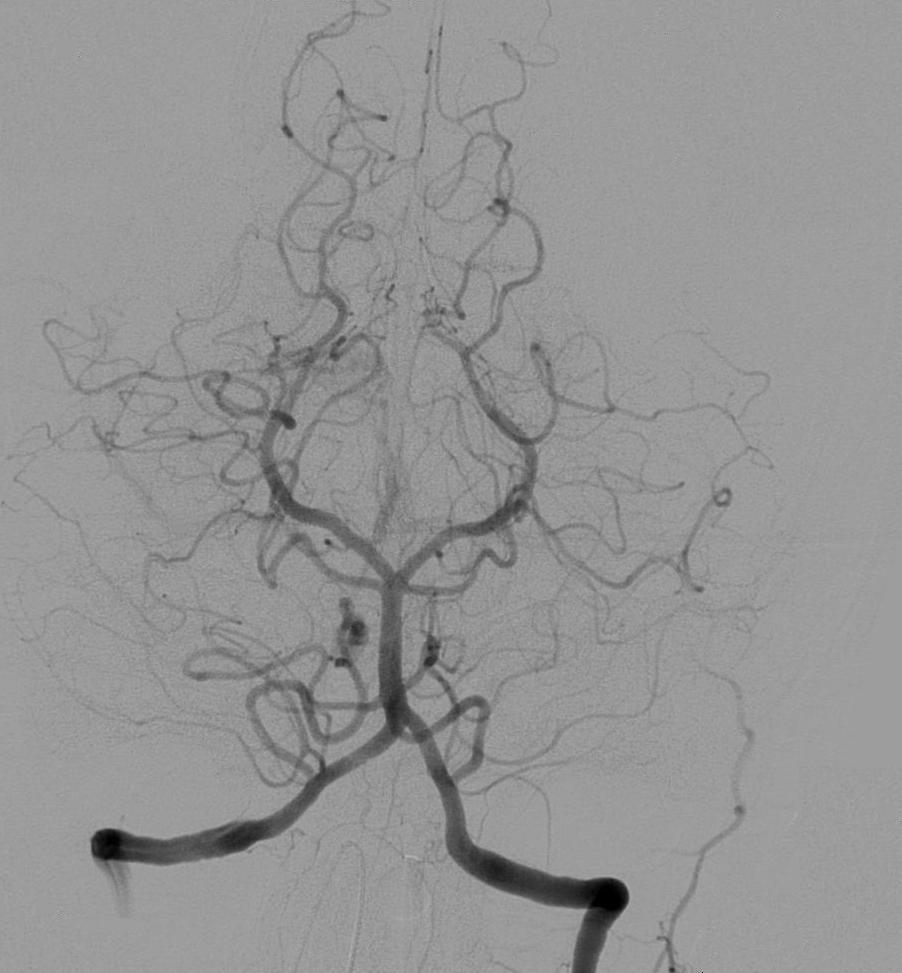
Angiogram showing a transverse  projection of 
the vertebrobasilar  and posterior cerebral circulation.
Angiography or arteriography is a medical imaging technique used to visualize the inside, or lumen, of blood vessels and organs of the body, with particular interest in the arteries, veins and the heart chambers. This is traditionally done by injecting a radio-opaque contrast agent into the blood vessel and imaging using X-ray based techniques such as fluoroscopy.

The word itself comes from the Greek words angeion, "vessel", and graphein, "to write" or "record". The film or image of the blood vessels is called an angiograph, or more commonly, an angiogram. Though the word itself can describe both an arteriogram and a venogram, in its everyday usage, the terms angiogram and arteriogram are often used synonymously, whereas the term venogram is used more precisely.

The term angiography is strictly defined as based on projectional radiography; however, the term has been applied to newer vascular imaging techniques such as CT angiography and MR angiography. The term isotope angiography has also been used, although this more correctly is referred to as isotope perfusion scanning.

Video: Cerebral Angiography

Diagnostic Cerebral Angiography 

Published on Oct 10, 2012

A comprehensive iPad application developed and shown to our patients before their angiograms. The video describes diagnostic cerebral angiography as performed in Interventional Neuroradiology.


Standard YouTube License @ JohnsHopkinsMedicine 


Saturday Comics


For Better and For Worse
Lynn Johnston - 2013/12/25

"POW! KA-BLAM!! Whaddaya think of the neat gun..."
Dilbert
Scott Adams - 2013/12/27

"I hired an engineer from Google. He is so smart..."

Garfield
Jim Davis - 2013/12/23

"The hog has bronchitis..."

Betty
Delainey & Rasmussen - 2013/12/27

"Good crop of presents..."


** I tried to get low or free price at the people http://www.UniversalUclick.com/ for the images for the cartoons. It was too high for Stroke Survivors Tattler i.e. we are not a regular newspaper and our budget is very low. Fortunately, you will have to do only 1-click more to see the cartoon image, it is legit and it is free using GoComics.com and Dilbert.com.
*** Changed from "Pickles" to "Betty" -- "Betty" is a excellent cartoon and Gary Delainey & Gerry Rasmussen are authors/artists/cartoon-strips and they live in Edmonton.

Eclectic Stuff

Definition: Eclectic(noun) a person who derives ideas, style, or taste from a broad and diverse range of sources.


Early CT Angiography Identifies Recurrent Stroke Risk

Dean Reinke
Deans' Stroke Musing
Monday, February 13, 2012

So ask your doctor for this. Diagnostic Imaging - Early CT Angiography Identifies Recurrent Stroke Risk Use of CT/CT angiography (CTA) as soon as possible in patients presenting with transient ischemic attacks (TIA) or minor stroke predicts risk of recurrent stroke and clinical outcome, according to a study published online in Stroke: Journal of the American Heart Association.

Although MRIs are frequently used for early assessment, CT scanners are usually more readily available to the emergency department, said the study authors. The median waiting time for diffusion-weighted MRI was 17.5 hours, but for CTA imaging, the wait was only 5.5 hours. In addition, CTA does not take much time, adding only five minutes to the standard CT brain scan.

It is estimated that there is a 10 percent risk of recurrent stroke within 90 days of a patient experiencing a TIA or minor stroke, with the majority recurrent strokes occurring within 48 hours of TIA or mild stroke onset. CTA, which uses contrast media to image the vasculature, can identify large artery disease, allowing physicians to determine risk. “A symptomatic intracranial or extracranial severe arterial stenosis or occlusion was predictive of recurrent stroke,” wrote the authors.

In the study, 491 patients with either TIA or minor stroke underwent CT/CTA within 24 hours of onset and most had subsequent MRI. Results showed there were 36 recurrent strokes, with a median time to the event of one day, and a positive CT/CTA scan was a predictor of recurrent stroke.

The authors concluded, “Adoption of CT/CTA into clinical practice for the assessment of patients with TIA and minor stroke identifies a high risk group suitable for aggressive acute stroke prevention treatment.”


See the original article:
in

No Closing Times for Strokes

Jeff Porter
Stroke of Faith
Thursday, December 19, 2013

Ever been in a hospital over a weekend? Hospitals are famous for making people show up before dawn during weekdays for a medical procedure so they can sit and wait for hours - and virtually shutting down on Saturdays and Sundays.

Now, from England, is a story on how an elderly man was turned away from King’s Mill Hospital because stroke unit shut at 6 p.m.:
  • Elderly stroke victim John Mallalieu was turned away by a Nottinghamshire hospital because it was too late on a Friday afternoon.
  • The ambulance carrying the 89-year-old from Caunton to King’s Mill Hospital in Sutton-in-Ashfield was diverted to City Hospital in Nottingham, where he remains in intensive care.
  • The incident was a timely reminder of the additional problems facing patients who need attention at weekends.

Did this patient choose to have a stroke so close to 6 p.m.? Certainly not.


See the original article:
in

Tick, Tock Time Runs a Marathon

Jo Murphey
The Murphey Saga
Monday, December 23, 2013

Ever notice when you walk away from something for a bit and the time flies by without a second glance? It runs by like some super fast marathon.

What did I actually accomplish this month. I mean tomorrow is Christmas Eve already and I haven't posted since the 4th. Now looking back absolutely nothing! Well almost nothing. No it doesn't seem like Christmas either. The 70+ temperatures do nothing to enhance it. Even with the lights and decorations up, the Grim Reaper is overshadowing all the merriment sucking it dry.

Have I done anything towards my stroke recovery. Nope just trying to do too many things at once. It's become a dull routine now. I haven't recovered a lick. In fact, I've regressed back into diapers and barely able to walk...more on that in a bit.  It's more to do with having so much to do than actual regression. I've had my own version of locked in syndrome with my husband so ill.  I have no desire or money to go or do anything except play games on the computer. Yes that does help build my mind up some but not the rest of me.

At this point I'm not achieving much in a recovery sense, but just am. The things I'm trying, I'm failing miserably at...like spinning all this nice wool from Buddy. I just can't hold the tension right one handed on the wheel. I tried using the hand held spindle and wound up with a tangled mess. I did achieve some measure of success with knitting one handed. It is s-o-o-o slow tucking one needle up under my bum arm but at least I've got that and I am knitting just what...I dunno. I'm still practicing stitches. Casting on is a real headache.


Creative Commons Attribution License @ Stella Lange

The Orthopedic Card

Peter G. Levine
Stronger After Stroke Blog 
Saturday, December 21, 2013

I'm about sick of what I'm starting to call "movement elitism." The idea is that, unless you move perfectly, you shouldn't move. Because… you'll ingrain "pathological movement patterns." I've railed against this before. And here it goes again...

Curious Person (CP)
Clinical Movement Elitist (CME)

CP: Why should a stroke survivor not move when they're alone?
CME: Because they move wrong.
CP: What will moving wrong do?
CME: Make it so they'll never move right.
CP: So what should the survivor do to practice movement?
CME: Wait until there's a clinician around to tell them how to move.
CP: Won't the survivor run out of money eventually?
CME: It’s worth every penny because bad movement is bad. It will make moving right harder.
CP: Don't we all learn to move by correcting mistakes?
CME: Yes but survivors need guidance.
CP: Couldn't they sit in front of a mirror and model the movement of the "good" side?

Hospital Visit

Jackie Poff
Stroke Survivors Tattler
A 54 year old woman had a heart attack and was taken to the hospital. While on the operating table she had a near death experience.
Seeing God she asked "Is my time up?"  
God said, "No, you have another 43 years, 2 months and 8 days to live." 
Upon recovery, the woman decided to stay in the hospital and have a face-lift, liposuction, breast implants and a tummy tuck.  She even had someone come in and change her hair color and brighten her teeth!  Since she had so much more time to live, she figured she might as well make the most of it.

After her last operation, she was released from the hospital.  While crossing the street on her way home, she was killed by an ambulance.
Arriving in front of God, she demanded, "I thought you said I had another 43 years?  Why didn't you pull me from out of the path of the ambulance?"
(You'll love this)
God replied: "I didn't recognize you!" 
Moral of the story: God loves you the way you are!

The End of an Era

Diane
The Pink House On The Corner
Sunday, December 22, 2013

Those of you who know me well, might want to read this post sitting down. Then take care not to fall off your chair.

For others, let me fill you in on some background material.

I, personally, have not owned a television set for nearly 30 years. TV-less by choice, I called it. And I was hard core, a proud member of the 1% of Americans who ban television from their homes--often lending my dog-eared copy of Jerry Mander's book, Four Arguments for the Elimination of Television out to would-be converts. That book delves deeply into the psycho-social effects of television on individuals and society as a whole. The author describes the conscious state a person enters into while watching television as a state of "wakeful dreaming" that is close to hypnotism.  My own personal belief was that TV was not only a big time waster, but a brain numbing addiction, a social isolator and a way to miss out on "real life".

When Bob moved in with me in 1994, he owned a television set. I told him, in no uncertain terms, would I allow it in my apartment. We argued. I think that was our first argument. Then, we compromised. He could be bring the TV if he put it in the closet.

Temporary and Elective Mutism

December 20, 2013

This is an interesting speech disturbance that is seen as a result of many different types of events.  I saw a gentleman this week who had a Stroke that weakened the extremities, but no paralysis.

Upon evaluation I noticed that it would often take him what seemed to be a long time (30-60 seconds) to answer a question.  He did not respond to any kind of questions from a formal screening or evaluative instrument.

I found that to be strange, since there are few if any people I have evaluated who were so mute, so silent!  I then asked him questions about himself.  His name, age, marital status, and he started answering some of them in single words.  I then asked him about his interests.  He then conveyed "travel."  I then ascertained he had a 36' travel trailer and a Ford 250 towing vehicle.  His 5th wheel travel trailer has been at his brothers residence in Louisiana.

Interestingly, getting more sociable or conversational with a client or patient, esp. about topics of interest may get verbal responses, when impersonal, formal measurements may leave a person who is being evaluated or screened, rather cold and non-responsive.  It's always good to break the ice with small talk.  Think about what you like to talk about.  Think about what others are interested in and ask away! You'll be surprised at the  potential for more speaking!  Find out more about helping others speak with clarity, whether you are a therapist, parent, or caregiver and please visit and like us at teachingoftalking (facebook) and our website at teachingoftalking.com.


E-mail from Mark A. Ittleman

What a Pain

December 16, 2013

Once again,
Amy e-mail has set me off on a riff … about empathy this time. See this for details: My Cerebellar Stroke Recovery - Empathy-vs-Sympathy.

You know the pain scale in some doctors’ offices - the ones that have a ruler with zero to 10?  Zero means “no pain,” and 10 means “the worst pain possible.” Zero shows a smiling face, while 10 is writhing in pain. My guess is that the goal of having the scale is to quantify pain, as though that’s possible. Give it a number and it’s scientific, right? Or is it to minimize the patient’s pain really – to communicate that it’s bearable? For example, a woman with appendicitis looks at the scale and thinks, “this really isn’t so bad – not like childbirth.”

What does quantification do? Even if it’s quantified, the number is still subjective, an evaluation by the patient. But is my 10 the same as your 10? There’s no way of telling.

Changing Landscapes—My New Normal

Dec 22, 2013

A friend of mine wrote a book that you can buy here.  Her name is Sarah Krenk and she’s a young stroke survivor like me.  She had her stroke a year after I did and she wrote a book, that’s impressive.  So what, you may ask, is different about this story from every other stroke survivor book out there.  Every single book that I’ve read written by a stroke survivor was written years and years after having a stroke.  This book was written in the middle of all the crap.  She never wanted to forget what it was like then and what she felt like so she wrote a book about it!  That’s pretty ambitious of you, Sarah.  :)  She wrote about the care that she received in the hospital and quite frankly it horrified me to my very core.   Unfortunately, I think almost everyone reading this can tell me a story like that.  And cognition was 100% intact the entire time even though of course everyone around her treated her like she was mentally screwed up because of the way she was on the outside.  Sigh.  Another thing about this book that I like is that Sarah is pretty well off and she knows it.  Then this happened.  She was living on easy street and now her life is anything but easy.  She’s surely not taking anything for granted anymore.  A stroke can attack ANYONE, ANY AGE, ANYTIME, ANYWHERE, ANY…..  Strokes don’t discriminate.


See the original article:
in

Thomas Suarez: A 12-Year-Old App Developer

Published on Oct 24, 2012

Most 12-year-olds love playing videogames -- Thomas Suarez taught himself how to create them. After developing iPhone apps like "Bustin Jeiber," a whack-a-mole game, he is now using his skills to help other kids become developers. (Filmed at TEDxManhattanBeach.)

SSTattler: I want to hire him (younger is better and he is soon to be a CEO!)


Standard YouTube License @ TED

RMR: Rick and Ice Sailing

Uploaded on Jan 13, 2010

Rick braves the frozen Bay of Quinte in Trenton, ON.

SSTattler: Great ice sailing in Ghost Lake near Calgary and it is free!


Standard YouTube License @ The Rick Mercer Report

---------