Saturday, November 09, 2013

Video Games + Tennis Balls + Anger = Recovery

Peter G. Levine
Stronger After Stroke Blog
Friday, May 4, 2012

Recovery Badass
A great article in the British newspaper The Telegraph. The article is by a stroke survivor who recovered well after an ischemic (block) stroke. He's hit on some very core ideas. Here are the most important points (comments in red are mine):

  • "...nobody in the hospital was going to tell me how to get better ..."
  • "I had to get out of hospital and cure myself."
  • "...found that major strides had been made in America in treating stroke victims." (USA! USA! USA!)

Sunday Stroke Survivor ~ Video Games?

Jo Murphey
The Murphey Saga
Sunday, November 3, 2013

A new research study out of Canada is using video games for stroke rehab. I thought "Wow, that will be a challenge!" My second thought was, "How could I do it one handed?" My third thought was, "Doh! You old timer you."

The reasons my thought processes worked like this is I've long been a supporter of making rehab fun no matter what your age is. If something is fun then you are more apt to do it. In fact I've mentioned the computer/internet games that I "play" to rebuild my cognitive deficits. Those are easy with a click of the mouse, but video games?

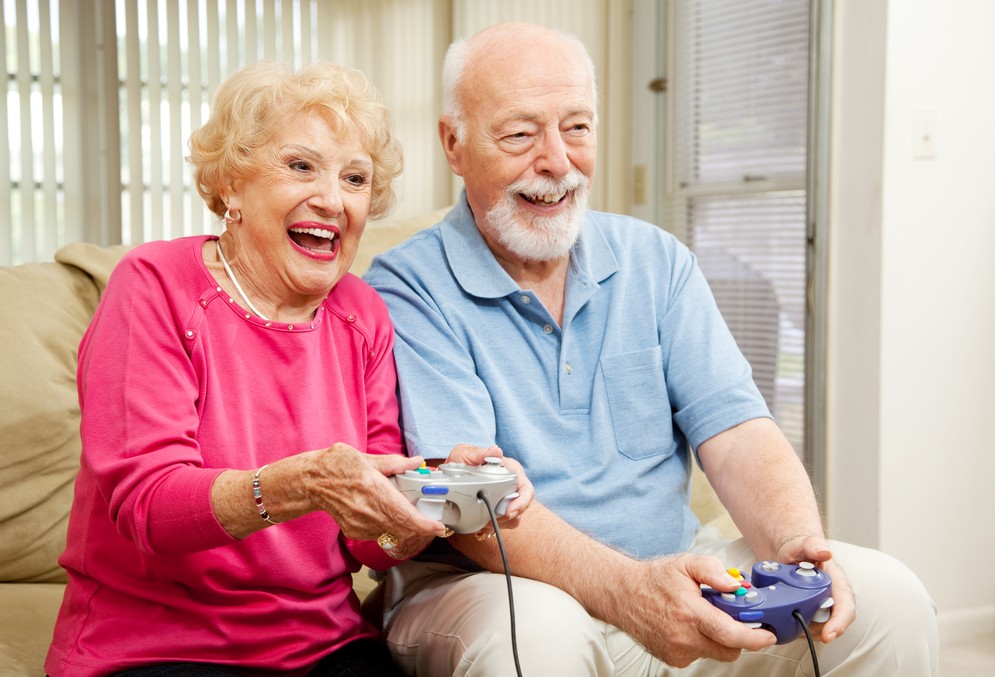
Video Games Prove Best Therapy for Stroke Rehabilitation

Dean Reinke
Deans' Stroke Musing
Saturday, July 6, 2013

Is your doctor, therapist and clinic going to accept this research? Or are you going to be stuck with boring repetitive exercises? Unless YOU tell your clinic you want this stuff it will take years to trickle down your leg. http://israel21c.org/news/video-games-prove-best-therapy-for-stroke-rehabilitation/

Stroke victims play video games as an alternative
to traditional therapy because they’re more fun.
Photo via Shutterstock


New research from a Tel Aviv University study shows that people recovering from a stroke are more physically active during rehabilitation sessions when they play video games than those who rely on traditional motor therapy.

Occupational therapist Dr. Debbie Rand of Tel Aviv University’s Stanley Steyer School of Health Professions at the Sackler Faculty of Medicine, says her research shows that stroke victims who play video games in therapy make more movements overall than those in traditional motor therapy. In her study, players performed double the number of arm movements during each session compared to patients in traditional therapy, and all of their movements were purposeful or “goal-directed” and not just repetitive exercises.

Playing Games in Stroke Recovery?

Jeff Porter
Stroke of Faith
Friday, November 30, 2012

More potential tools for home recovery for stroke survivors. A Patient-Centered Outcomes Research Institute grant funds Ohio State researchers using Kinect for at-home stroke rehabilitation:
Lynne Gauthier, an assistant professor of physical medicine and rehabilitation, is leading the team creating a video game for the Microsoft Kinect that the team hopes could expand access to a specific kind of rehabilitation called constraint-induced movement therapy. The game would allow patients with mild-to-moderate upper-limb impairment to perform guided CI therapy in their homes. 
The game uses Microsoft Kinect’s motion capture technology to guide patients through a series of therapeutic exercises set in a river adventure theme, Gauthier said. Patients would visit a clinic for initial consultation and the game would act as a consultant to guide them through exercises at home. Patients would also be given a restraint mitt to encourage them to use their affected side more often in daily activities. 
“A lot of these kinds of rehab games are basically about just getting the person to move a lot,” she said. “But we’re trying to make it so that the game would stimulate what the therapist would do. Just as a therapist would make a task harder when the person improves, the game would do the same thing.”

See the original article:
in

Wiihab Revolution

Pamela Hsieh
Rehab Revolution
15 June 2010

I originally wanted to post about the yogic principle of mudita today, but since things often don't go as planned (at least in my reality), I thought I should speak a bit about something that came up today: an alternative, and usually a supplement, to the daily workout: the (in?)famous Wii. I'm beefing it up today with plenty of info, feedback, and suggestions, so get out your reading glasses and preferably your excitement.

Now, surely you have heard of the Wii. Revolutionary both to video games and rehabilitation, Wii's innovative adaptations to the gaming world has swept the world over, if not only out of curiosity.

But it doesn't come without its complaints. Gamers used to the solitary quality of previous and alternative consoles, like the Xbox360, often prefer the old-school solitude in single-user games (i.e., the stereotypical blow-everyone's-head-off war games like Call of Duty) or in any case, traditional multiplayer blow-everyone's-head-off games (Halo).

Wiihabilitation

Amy Shissler
My Cerebellar Stroke Recovery
Jul 24, 2012

When I was in the hospital, I used a Wii in occupational therapy.  You know the Wii, the video game?  I did bowling.  At the time, I was absolutely hating everything and everyone and didn’t appreciate the fact that I was playing a video game at all.  But now I do.  You can find almost any activity on a Wii.  It can be really helpful.  At first I could barely even hold the controller let alone play a game.  But I got better.  Now I can play the Wii normally.  Well I guess it’s not “normal” but it’s a ton better.  I like this article.  And this one.


See the original article:
in

How to Change Your Own Mind, Literally

Joyce Huffman
The Tales of a Stroke Patient
Sep 15, 2013

"You can't be too skinny or too rich," said my old college buddy back in the 60s. But now you know the truth. Skinniness sometimes is related to anorexia or bulimia. And you've heard stories about the deaths of lottery winners who blew their money on drugs or died from being poisoned. My friend got it wrong. She should have said, "You can't be too brainy."

The brain controls everything, like our emotional outbursts to pain, our nervous eating, our ability to pee regularly, our resistance to confront people, our neurotic tastes. But what was thought prior to the 1970s--that the brain was fixed and couldn't be changed after early childhood--was wrong. The brain can process new experiences, like having a stroke, by creating neural pathways to accommodate them. Welcome to neuroplasticity, the game changer.

There are four key truths about neuroplasticity:

Brain Plasticity Will Blow Your Mind

Rebecca Dutton
Home After a Stroke
February 6, 2013

SSTattler: Good article - you have to read it!

New research on brain plasticity will blow your mind.  One amazing finding is that new stem cells are produced in the lateral ventricals of the adult brain (1).  What is even more amazing is how these stem cells migrate from the back of the brain to the olfactory bulb in the front of the brain (2).  Using time lapse imaging scientists have been able to watch stem cells latch onto a blood vessel highway and drag themselves to their destination.  First, brain chemicals push stem cells away from their birth place.  Additional chemicals stop the stem cells from getting off track along the way.  As the cells approach their destination more chemicals pull them in the right direction.

Good News & Bad News

Diane
The Pink House On The Corner
Monday, November 4, 2013

The bad news first --

My mom and dad who have been coming to visit us every year at this time for the past 15 years, are not here.

This because my father is not feeling well enough to travel.

And I do miss them dearly.

Now the good news --

My sister came instead! And yesterday, she (along with her travel companion) took me out to brunch where we sat across the street from the blue bay waters and sipped mimosas (a first for me) and ate goat cheese stuffed omelettes under an umbrella at an outdoor cafe. Afterwards, we toured the city and popped into a few open houses, just to check out the real estate market. And of course, I had to show them one of our more hokey tourist attractions:

My sister & friend at, yes, The Fountain of Youth!


Anyway, I cannot remember the last time I laughed so much and so hard. Chris sat with Bob and told me that she would come as often as I needed her so that I can get out of the house, because, after this visit "it's back to jail" for me. (Her words.)

And my sister will be able to attend our mediation next week, so I wont have to do that alone.

So if this blog is quiet, you know why!

See the original article:
in

Weird Mind Games

Robin
Rocky Mountain Stroke Survivor
July 19, 2013

Sometimes I start to wonder if maybe I’ve always been like this.  Most of the time, I am reasonable about it and know that it just started in January.  But sometimes, like tonight, I find myself thinking…”Maybe I’ve always been like this…”

We’ve been really working to pare down my life to something manageable (hence the silence here on my blog).  We’ve discovered that I can manage about two hours of productivity twice a day.  We’ve had almost two weeks now of gradually cutting back my activities and I was just starting to feel human.  Then today an exceptional amount of work that could not wait meant that I pushed myself to my limit…which is a frustratingly short four hours of work.

Healthcare

Thursday, October 31, 2013
Andrea
A Year of Living In My Head

I am do for a divorce soon.  We were working on filing the papers when I hit a rough medical patch (stroke! tumor! an overabundance of intoxicatingly fun life happenings! I am being so sarcastic here...)  He did not finalize the divorce and leave me in the lurch, instead, he kept me on his insurance and waited.  As did I.

We are gearing up the paperwork again, and I am taking care of medical stuff I was procrastinating on.

My story is this:

Enough, Already?

Barb Polan
Barb's Recovery
October 29 / 2013

Stroke survivors go to hundreds of medical appointments: physiatrist (to “manage” our rehab), PT, OT, seizure clinic, blood tests, MRI’s, speech therapists, psychotherapists, alternative medical treatments, ad nauseam.

The last thing we need is more appointments.

But my PCP is conscientious. His attitude is that I and my physiatrist are responsible for my stroke-related issues, but HE’s responsible for the rest of me, so his office harasses me about other health issues. In fact, Sally called me last week and “reminded” me that my mammogram was overdue.

It's a Frickin' Elephant

Jackie Poff
Stroke Survivors Tattler
Out of the mouths of Babes. We who have taught, or love children who have been taught, know this is funny! From the diary of a Pre-School Teacher:

My five-year old students are learning to read. Yesterday one of them pointed at a picture in a zoo book and said,
"Look at this! It's a frickin' elephant!"
I took a deep breath, then asked...
"What did you call it?"
 And he says...
"It's a frickin' elephant! It says so on the picture!"
And so it does...


"A f r i c a n Elephant"


Hooked on phonics! Ain't it wonderful? 
Now that's funny, I don't care who you are!

The Difference Between Sympathy & Empathy. #Stroke

Katie Allatt
A Rocky Stroke Recovery
November 2, 2013

This blog was inspired by Chris Evans’s BBC radio 2 show ‘pause for thought’ on Friday 18th October 2013.

An individual suffers a huge trauma, pain or loss.

So their friend either offers them,

Sympathy ie,
‘O that’s awful, terrible, dreadful… Shall I get you a cheese sandwich?’
Or

Empathy ie,
‘That’s awful, I do (or usually), I don’t understand what you are going through, but I’m here for you, in every sense if the word, through your up’s and downs.’

Hydration

Amy Shissler
My Cerebellar Stroke Recovery
Nov 4, 2013

Ok Dean, here’s where you and I need to have a duel.  For a duel you only need one functional hand right?  You need to drink a lot of water.  If you let the brain get dehydrated, that’s bad.  I drink Kangen water.  Dean once said that this water is pseudoscience because it only has anecdotal evidence to support it.  Well, take a look at this Dean.  None of that is anecdotal.  Alkaline, ionized water is more hydrating and acts as an antioxidant.  Lots of people eat an alkaline diet in an attempt to alkalize the body.  Well, you don’t have to be so strict when you drink this water, it makes alkalizing the body super easy.  There’s a lot of websites out there that try to discredit this water.  Well, there’s a lot of doctors that will tell you to do unbelievably harmful things.  Disease cannot live in an alkaline environment.  Don’t knock it `til you’ve tried it.

See the original article:
in

The World is Mine...

Carrie Lewis
Stroke Survivors Tattler
Author "Unknown"

Today, upon a bus, I saw a very beautiful woman
        and wished I were as beautiful.
When suddenly she rose to leave,
       I saw her hobble down the aisle.
She had one leg and used a crutch. But as she passed,
       she passed a smile.
Please forgive me when I whine. I have two legs; the world is mine.

I stopped to buy some candy. The lad who sold it had such charm.
I talked with him, he seemed so glad. If I were late, it'd do no harm.
And as I left, he said to me, "I thank you, you've been so kind.
It's nice to talk with folks like you. You see," he said, "I'm blind."
Please forgive me when I whine. I have two eyes; the world is mine.

Later while walking down the street, I saw a child I knew.
He stood and watched the others play, but he did not know what to do.
I stopped a moment and then I said, "Why don't you join them, Dear?"
He looked ahead without a word. I forgot, he couldn't hear.
Please forgive me when I whine. I have two ears; the world is mine.

With feet to take me where I'd go.  With eyes to see the sunset's glow.
With ears to hear what I'd know. Oh, God, forgive me when I whine.
I've been blessed indeed, the world is mine.

What Does Your Father Do?

Monty Becker
Stroke Survivors Tattler
A fourth-grade teacher asked the children what their fathers did for a living. All the typical answers came up - fireman, mechanic, businessman, car salesman... and so forth. However, little Justin was being uncharacteristically quiet, so when the teacher prodded him about his father.  He replied,
"My father's an exotic dancer in a gay cabaret and takes off all his clothes to music in front of other men and they put money in his underwear. Sometimes, if the offer is really good, he will go home with some guy and stay with him all night for money."
The teacher, obviously shaken by this statement, hurriedly set the other children to work on some exercises and took little Justin aside.
"Is that really true about your father?"
"No," the boy said. "He actually plays for the Edmonton Oilers but it's too embarrassing to say that in front of the other kids."

Daphne Bavelier: Your Brain on Video Games

Published on Nov 19, 2012

How do fast-paced video games affect the brain? Step into the lab with cognitive researcher Daphne Bavelier to hear surprising news about how video games, even action-packed shooter games, can help us learn, focus and, fascinatingly, multitask.

Daphne Bavelier studies how humans learn -- in particular, how the brain adapts to changes in experience, either by nature (for example, deafness) or by training (for example, playing video games). At her lab, her work shows that playing fast-paced, action-packed entertainment video games typically thought to be mind-numbing actually benefits several aspects of behavior.  Exploiting this counterintuitive finding, her lab now investigates how new media, such as video games, can be leveraged to foster learning and brain plasticity.


Standard YouTube License @ TED

RMR: Rick and RCMP Training

Uploaded on Mar 17, 2010

Rick trains to be a Mountie.
(originally aired: October 10, 2006)


Standard YouTube License @ The Rick Mercer Report

---------

Saturday, November 02, 2013

Saturday News


Contents:

Eye Tracking

Eye Tracking

      From Wikipedia, the free encyclopedia


Eye tracking is the process of measuring either the point of gaze (where one is looking) or the motion of an eye relative to the head. An eye tracker is a device for measuring eye positions and eye movement. Eye trackers are used in research on the visual system, in psychology, in cognitive linguistics and in product design. There are a number of methods for measuring eye movement. The most popular variant uses video images from which the eye position is extracted. Other methods use search coils or are based on the electrooculogram.


Eye Tracking - Video

SSTattler
   We show videos of 3 products among about ten products for Eye Tracking
       1 - The Eye Tribe
       2 - Tobii - Gaze-Interaction
       3 - Eyegaze Edge

1 - The Eye Tribe 


The Eye Tribe Tracker - The World's First Affordable Eye Tracker 

Published on Sep 5, 2013

SSTattler: Approximate < $100 +/-; right now it is for developer but soon for the public consumer...

Introducing The Eye Tribe Tracker, the first truly affordable eye tracker that precisely determines the on-screen gaze position.

The Eye Tribe Tracker comes with a software development kit (SDK) that allows you to integrate our eye tracking technology into applications and games.

Find more information on http://theeyetribe.com and follow us on http://facebook.com/theeyetribe and http://twitter.com/theeyetribe.


Standard YouTube License @ TheEyeTribe 

Saturday Comics


For Better and For Worse
Lynn Johnston - 2008-08-27

"Iris! We came as fast as we could!"
Dilbert
Scott Adams - 2013-10-30

"I hired a desiccated crone to teach..."

Garfield
Jim Davis - 2013/11/01

"Do you believe in ghosts?"

Betty
Delainey & Rasmussen - 2013/11/01

"...and modern special effects, any sick disgusting..."


*For Better and For Worse" is a serious topic of stroke but with a very nice cartoons. It is all about Grandpa Jim had a stroke and 88 further cartoon "strips" that happened to Grandpa Jim. See as well 
 the cartoonist Lynn Johnston.
** I tried to get low or free price at the people http://www.UniversalUclick.com/ for the images for the cartoons. It was too high for Stroke Survivors Tattler i.e. we are not a regular newspaper and our budget is very low. Fortunately, you will have to do only 1-click more to see the cartoon image, it is legit and it is free using GoComics.com and Dilbert.com.
*** Changed from "Pickles" to "Betty" -- "Betty" is a excellent cartoon and Gary Delainey & Gerry Rasmussen are authors/artists/cartoon-strips and they live in Edmonton.

Eclectic Stuff

Definition: Eclectic(noun) a person who derives ideas, style, or taste from a broad and diverse range of sources.


Sunday Stroke Survivor ~ Follow My Finger

Jo Murphey
The Murphey Saga
Sunday, October 27, 2013

No, I said follow my finger not pull my finger. Yep, I'm back on track again. Today's discussion is on eye tracking. We have all had this mini focus type thing run by doctors where they move their finger up, down, and every which way.

What I didn't realize until I recently asked my neurologist was I couldn't do it right after my stroke. I thought I was following her finger but I wasn't really. Every time I had to close my eyes to regain focus or turned my head were counted against me performing the activity. Even now when watching this video, I have to blink my eyes...15 months later. That shows I still have a problem.

DOH! I didn't appear to have a problem reading or so I thought. I started paying attention on how many times I had to go back and read a line of text or use my finger to read to keep my eyes focused on where I needed to be. I didn't notice it while driving because my head is always turning to get a clear picture of what is going or coming and measuring distances.

I can look straight ahead and see fine. For the first six months I couldn't look up or down without getting dizzy or disorientated. Yes, I could quickly resolve these issues with the none impaired executive function part of my brain. Now I can look down with no problem, but I can't look up the change a light bulb in the ceiling fan or snag cobwebs without feeling like I'm falling.

Eye-Tracking Tool Might Quickly Spot Stroke

Dean Reinke
Deans' Stroke Musing
Tuesday, March 5, 2013

Another tool to be compared against these fifteen for easy diagnosis.
http://www.doctorslounge.com/index.php/news/hd/36236
The key to correctly diagnosing when a case of dizziness is just vertigo or a life-threatening stroke may be surprisingly simple: a pair of goggles that measures eye movement at the bedside in as little as one minute, a new study contends.
"This is the first study demonstrating that we can accurately discriminate strokes and non-strokes using this device," said Dr. David Newman-Toker, lead author of a paper on the technique that is published in the April issue of the journal Stroke. 
Some 100,000 strokes are misdiagnosed as something else each year in the United States, resulting in 20,000 to 30,000 deaths or severe physical and speech impairments, the researchers said.

We Made It on Wikipedia!

Kate Allatt
A Rocky Stroke Recovery
October 26, 2013


Hey, our claim to fame?

We made it on:
Wikipedia - Locked-In Syndrome !!!


(…Under notable cases!)

Jean-Dominique Bauby
Parisian journalist Jean-Dominique Bauby suffered a stroke in December 1995, and, when he awoke 20 days later, he found his body was almost completely paralyzed; he could control only his left eyelid. By blinking this eye, he slowly dictated one alphabetic character at a time and, in so doing, was able over a great deal of time to write his memoir, The Diving Bell and the Butterfly. Three days after it was published in March 1997, Bauby died of pneumonia. The 2007 film The Diving Bell and the Butterfly is a screen adaptation of Bauby’s memoir. Jean-Dominique was instrumental in forming the Association du Locked-In Syndrome (ALIS) in France.

Kate Allatt
Kate Allatt is a mother-of-three from Sheffield, South Yorkshire. She has successfully recovered from locked-in syndrome. Now she runs Fighting Strokes, and devotes her life to assisting those with locked-in syndrome.

Therapists Are Not Like Oncologists.

Peter G. Levine
Stronger After  Stroke Blog
Tuesday, October 29, 2013

Imagine an oncologist who has no idea what the latest treatment is. Imagine now that they are trying to cover their butts. "You have cancer, but I have something that works in my patients." "Something that works in your patients?" Even in your distress something seems odd about that statement. "Does it work in all patients or just in yours?" Its one of those questions you think twice about asking an MD because it smacks of sarcasm and hints a possible incompetence. But it is exactly the most rational question.


Of course, of an oncologist you'd not have to ask this question because oncologists are required by law to use the most effective treatment. If they do not do the latest and greatest they can get sued. Into oblivion.

People die of cancer. People generally don't die of bad therapy.

Muscle Action

Amy Shissler
My Cerebellar Stroke Recovery
Oct 27, 2013

A muscle has to complete its full action.  Everyone thinks of the biceps as the muscle that bends the elbow. But part of its job is also to supinate the hand(turn the palm upward).  If you turn the palm down and bend the elbow, you’re shutting off the biceps and using a muscle called the brachioradialis.  This is because you’re not allowing the biceps to complete its full action so it doesn’t do anything.  This is why doing a pull-up is easier with your palms facing you.  With muscles, it’s all or nothing.  Muscles don’t compromise with you.  Another example of this are the glutes(butt muscles).  When you’re lying prone on your stomach and do a press up, not a push-up, a press-up (lifting up your upper body with your arms keeping your lower body on the ground), your butt is probably contracted.  Part of the job of the gluteus maximus is to externally rotate the hip(point the toe out).   So, when lying prone(on your stomach), if you point your toes in, this shuts off the glutes and they will not be recruited at all when doing a press up.  After a stroke, I have no idea.  This would still be the case for some muscles but maybe not for all because all the wires are different as a result of us having to rewire the brain.

See the original article:
in

Rehab From Rehab

Marcelle Greene
Up Stroke
Saturday, October 26, 2013

I'm learning to walk all over again — again. This time, my privately hired therapist and I have the same goal: to get me walking normally.

My therapist at the insurance-provided rehab hospital where I spent 21 days in the weeks after my stroke had a different goal: to get me functional. That meant walking however I could manage it. It didn't matter that I was locking my knee; didn't matter that I contorted my torso; didn't matter that I balanced all my weight on one strong hip. Didn't matter. What mattered was getting me functional enough to send home.

Today it matters. I don't want to erode the cartilage in my knee, or develop spinal and hip problems. As I work to undo the bad habits formed over the past three years, I think about the whole post-stroke rehab industry and wonder what could be done to improve it? Why didn't someone take the time to help me recover my muscle function correctly from the beginning? Was I incapable? Would that have taken too long and cost too much? Isn't cutting corners going to cost my insurance company more later — when improper function leads to knee surgery? When drugs used to control spasticity cause complicating side effects?

One way to improve stroke recovery is to avoid permanent brain damage in the first place … climb on the Dean bandwagon and demand a stop to the neuronal cascade of death. But how do we help those for whom that’s too late? How do we align the goals of rehabilitation providers with rehabilitation patients? Because yes, after 21 days of insurance-covered room and board at rehab, I wanted nothing more than to go home — except to someday again be normal.

See the original article:
in

Food for Thought

Pamela Hsieh
Rehab Revolution
25 October 2013

I’ve had requests for articles on food, but I’ve put off writing them because over the years, I’ve realized some truths among all the confusion. Not only this, but I wasn’t really ready to tackle it until recently, as I’ve made some major lifestyle changes (thanks to Tony Robbins, of course).

Red quinoa salad -- yum!
Without further ado -- here are five discoveries I’ve made about food, nutrition, and the industry.

1. There’s a lot of controversy and contradiction even among experts. Do you eat meat? Drink milk? Like peanut butter? Want to snack? Drink coffee? I’ve heard opposing stances from food/nutrition authorities coming from every angle for each of these things. Which brings me to . . .

Does It Add Up?

Barb Polan
Barb's Recovery
October 24 / 2013

Nota Bene: I do not have any kind of medical qualifications. I am simply a disabled stroke survivor.

To other stroke survivors and PT’s: I have a problem with numbers …

All of us know that it takes AT LEAST tens of thousands of reps to make a new neural connection. Yet we, stroke survivors, continue to get, upon discharge (from inpatient and outpatient rehab), pages of instructions about daily exercises we should do, with 3 sets of 12 reps being the standard instructions.

Survivors think that THAT’S our work; if we “work really hard,” we conscientiously do the exercises twice, maybe three times, a day.

Worldwide, Strokes Hit More People, Many Younger

Jeff Porter
Stroke of Faith
Thursday, October 24, 2013

One of the missions of this blog is to highlight stroke prevention. Every stroke prevented is a win. However, recent numbers show that stroke prevention has actually lost some ground - in the global perspective, at least.

A recent report shows that stroke numbers are up worldwide:
  • In 2010, there were 16.9 million people who had a first stroke, 33 million stroke survivors, and 5.9 million people who died from a stroke -- increases of 68%, 84%, and 26% respectively since 1990, according to Valery Feigin, MD, of the Auckland University of Technology in New Zealand, and colleagues. ...
  • What's more, there was a 25% ... increased incidence of stroke in those ages 20 to 64. At the end of the study period, 31% of first strokes occurred in people younger than 65, up from 25% in 1990. ...
  • Feigin and colleagues wrote that "these findings suggest that stroke should no longer be regarded as a disease of old age."
Read the entire article for more details. One comment especially touches on good common sense: reduce hypertension and unhealthy lifestyle.

See the original article:
in

Cord of Wood - Nicely Stack!

Jackie Poff
Stroke Survivors Tattle
r

Hmmm,
I think I will stack wood
same as below:


And We Have a Date...

Diane
The Pink House On The Corner
Thursday, October 24, 2013

For mediation! Next month, Nov. 11. Though the defense argued against it, saying they are not ready, the judge ruled in our favor and ordered a mediation.

And it's "court ordered" so everyone has to show up. Including me. Bob is excused because of his medical condition. So, I have to find someone to take care of Bob from 8:30 a.m. until ??? Maybe all day. Because he needs peg tube administered meds at noon, I will have hire a freaking registered nurse! jeepers... Our attorney says they will pay the bill... but... I guess it will ultimately come out of our pocket--

Nice to know, I can only be replaced by an RN! Wow. Guess I'm worth more than I think.

I just hope the defense will come to the table with some serious offers and a willingness to negotiate...

See the original article:

Emmanuel Kelly The X Factor

Monty Becker
Stroke Survivors Tattler
Uploaded on Aug 29, 2011

Emmanuel Kelly full including judges comments "Sings, Imagine" from John Lennon.

The song everyone is asking about is "Kings and Queens , 30 Seconds to Mars".

English Closed Captions added, the timing may be a bit off but I did the best I could. Press the CC on the bottom right of the video.


Standard YouTube License @ DrReaps

TEDxCambridge - Sara Lazar On how Meditation Can Reshape Our Brains

Uploaded on Jan 23, 2012

Neuroscientist Sara Lazar's amazing brain scans show meditation can actually change the size of key regions of our brain, improving our memory and making us more empathetic, compassionate, and resilient under stress.


Standard YouTube License @ TEDxTalks

RMR: Rick at Pet Funfest

Uploaded on Feb 23, 2011

Rick joins dogs of all shapes and sizes flying through the air at the DockDogs world qualifying event in Toronto.


Standard YouTube License @ The Rick Mercer Report

---------