Showing posts with label ▷ 2016 Mar 19. Show all posts

Saturday, March 19, 2016

Saturday News

Anomic aphasia (also known as dysnomia, nominal aphasia, and amnesic aphasia) is a type of aphasia where an individual has consistent inability to produce words for things that they want to talk about (particularly nouns and verbs). Anomia is a deficit of expressive language. The most pervasive deficit in the aphasias is anomia. Some level of anomia is seen in all of the aphasias. A longer definition comes from Wikipedia
    • Video: Anomic Aphasia
      • Update: Sarah Scott teenage stroke, Broca's Aphasia. 
      • Sarah Scott - 6 Years After a Stroke at 18 - Aphasia
      • Young Person with Aphasia -- Sarah's story
      • Sarah -- Anomic Aphasia
      • Grace: Stroke Survivor With Broca's Aphasia, 5 Weeks After Stroke
      • Broca's Aphasia
      • Challenges in Anomic Aphasia
      • Ken: Anomic Aphasia Progress
      • Anomic Aphasia Caregiver Stories -- Stephanie
      • Stephanie Testimonial -- Intensive Aphasia Treatment for Anomic Aphasia
      • The Effect of Broca's aphasia on a Family
      • Mom and I: Anomic Aphasia Take Two (Training)
         Saturday News | Future Topic
         --------------+---------------------------------------------

         Apr/09/2016   | Weekly Index from Jan/01/2011 to Apr/2016/02
         Apr/02/2016   | Mixed Transcortical Aphasia
         Mar/26/2016   | Environmental Enrichment (Neural)
         Mar/19/2016   | Anomic Aphasia

    Definition: Anomic Aphasia

    Anomic Aphasia From Wikipedia,
          the free encyclopedia


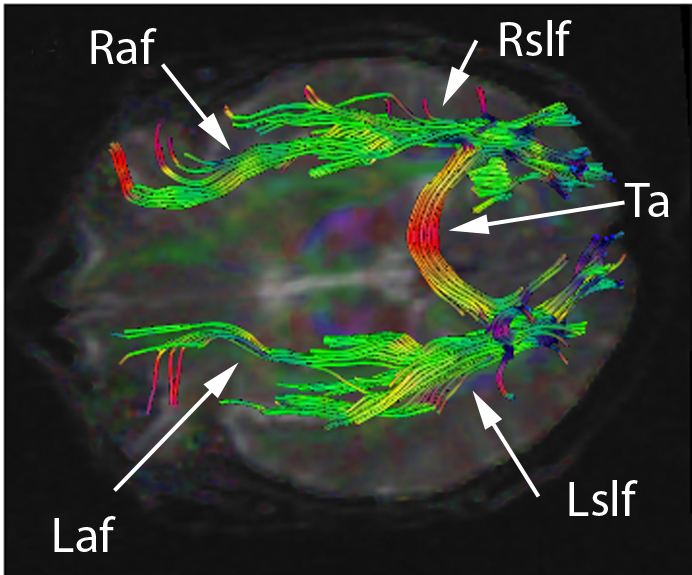
    Anomic aphasia - Diffusion tensor imaging image of the brain
    showing the right and left arcuate fasciculus (Raf & Laf).
    Also shown are the right and left superior longitudinal
    fascicles (Rslf & Lslf), and tapetum of corpus callosum (Ta).
    Damage to the Laf is known to cause anomic aphasia.
    Anomic aphasia (also known as dysnomia, nominal aphasia, and amnesic aphasia) is a type of aphasia where an individual has consistent inability to produce words for things that they want to talk about (particularly nouns and verbs). Anomia is a deficit of expressive language. The most pervasive deficit in the aphasias is anomia. Some level of anomia is seen in all of the aphasias.

    Overview


    Anomic aphasia (anomia) is a type of aphasia characterized by problems recalling words, names, and numbers. Speech is fluent and receptive language is not impaired in someone with anomic aphasia. Subjects often use circumlocutions (speaking in a roundabout way) in order to avoid a name they cannot recall or to express a certain word they cannot remember. Sometimes the subject can recall the name when given clues. Additionally, patients are able to speak with correct grammar; the main problem is finding the appropriate word to identify an object or person.

    Sometimes subjects may know what to do with an object, but still not be able to give a name to the object. For example, if a subject is shown an orange and asked what it is called, the subject may be well aware that the object can be peeled and eaten, and may even be able to demonstrate this by actions or even verbal responses – however, they cannot recall that the object is called an "orange." Sometimes, when a person with this condition is multilingual, they might confuse the language they are speaking in trying to find the right word.

    Types


    Video: Anomic Aphasia

    Update: Sarah Scott teenage stroke, Broca's Aphasia. 

    Uploaded on Sep 7, 2010

    http://www.gofundme.com/5iajbw

    Second video showing Sarah's progress after having a stroke at the age of 18. She still has problems with numbers, reading and writing, as well as speech.


    Standard YouTube License @ SymphUK


    Headline Blog: Anomic Aphasia

    Definition: Blog (noun). Add new material to or regularly update to a blog. (≃1990s: blog shortening of weblog)

    Decay Occurs in Speech Therapy: Aphasia

    Mark A. Ittleman
    Teaching of Talking
    November 19, 2015

    There is an interesting word in our language that is not commonly used by lay people.

    Decay is a deterioration and occurs with teeth, roads, super highways, buildings, homes, and  objects that we own.  In fact, maintenance is one of the most costly financial outlays for our teeth, health, and what we own.

    Decay also occurs with speech, language, and aphasia.  Some people with aphasia learn new words and concepts readily, but may actually have that word, or concept decay with time.  If a word or a concept is not repeated often, it may become “forgotten” or fall out of consciousness or automatic speech.

    My friend who has speech therapy with me twice a week online has a mild aphasia.  He has rather functional speaking but he has difficulty expressing himself and may have occasional confusion comprehending what is said to him and may also have periodic anomia or difficulty recalling a word that he wants to express.  He practices the words of difficulty.  He writes them down, he practices saying them each day on his commute to work (self-employed).  His wife also stimulates those words intermittently when they are together.

    Singing

    Amy Shissler
    My Cerebellar Stroke Recovery
    July 5, 2013

    My speech therapist wasn’t there when I told my student clinician (I do speech therapy at a university) that I’m taking singing lessons. She was so thrilled when she found that out that she wrote me an email. Here it is…….

    Hi Amy,

    Sorry I missed you last week; however, I was on vacation with my family in Hilton Head. I spoke with Emily regarding your session and she informed me that you are now taking voice lessons. This is great news!!!! I am so interested to hear how you like them and if you notice any changes in your voice as a result. There is some research on the use of music / rhythm / Melodic Intonation Therapy in the success with patients who have expressive language deficits as a result of a CVA (aphasia). As Emily probably discussed with you, music engages the right side of the brain in the production of speech (as language and speech are primarily left brain). This is also why we utilize “chant therapy” to engage the right brain. This has been noticed in individuals who stutter (these individuals can sing fine; however, when they speak they may still stutter). I look forward to discuss this with you further next week, enjoy your holiday!!!!!

    We may have to do a session of Karaoke :0)

    ~Annette

    Now, a couple of my thoughts.First of all, I will NEVER do karaoke, ever.Second, it’s a good thing I chant all the time in yoga.Third, ok…………. I LOVE, LOVE, LOVE my speech therapist. She’s awesome and amazing! Love her. However, I’m confused about something. In a year and a half of going to this speech therapy I have never been challenged to raise my voice high and use a higher pitch. The reason for this is because I have a lot more control, as does everyone, at lower pitches. My first day of the singing lessons he had me go as high as my voice could go. But this is speech therapy it’s not singing therapy.

    As Dean said once “The problem I have with Peter is that he is constrained with staying within the approved therapy guidelines. That silo is not where the breakthroughs in stroke will occur.” No, it’s not. You have to think outside the box, and try things that you never thought you’d try.


    See the original article:
    in

    50 Shades of Stroke – Aphasia

    Sas Freeman
    March 15, 2015

    Another complication stroke survivor’s are faced with is Aphasia. This is a terribly frustrating complication, we can hear conversations as before, know how we would wish to respond or join in, yet we are unable to participate, the words we would like to say just wont come out. People often then begin to do one of two things they believe will help, yet truly they don’t. They talk to us in baby speak as if we have rewound our intellect back to toddler days; or they speak or answer questions for us by guessing what we are attempting to say. Don’t get me wrong , I’m not blaming them, none of us know how to handle the situation. Its just that although we appear to be displaying difficulty and are slow, we wish to get there unaided and finally get the words out. We can use pictures to illustrate things we are trying to say and help conversation this way.

    5o-shades
    One way to help improve the situation is music and singing. Somehow when we try to sing we tap into a different part of the brain plus we relax and we are able to participate in song. Yet when attempting simple sentences of normal speech, we concentrate so hard, it’s almost as though the breaks go on and speech becomes impossible.

    One thing that helps me when I am having difficulty communicating with someone new is to focus with my eyes on something else other than who I am talking to.  I apologise and explain that I am not being rude but need to use the focus to concentrate on my response,  it works.

    Music, song, practice, patience and self belief #50shadesofaphasia


    See the original article:
    in

    I'm not Drunk, "Retarded", or Mentally Unstable

    Peter G. Levine
    Stronger After Stroke
    Friday, September 20, 2013

    Its a pretty simple calculus: If you don't use it you lose it. But there's a corollary: If you don't try it you can't possibly gain it. For example, if you use an AFO to walk during the early days after stroke, you'll not easily not use the thing again.

    And if I choose not to play violin- an instrument I've never played- I'll not get better at violin. So, both learning for anyone and relearning after stroke involves taking your brain (where learning happens) out of your brain's comfort zone.

    Which leads me to spouses. I've met a ton of 'em. The wife is aphasic, the husband loves her, knows what she's trying to say and finishes the sentence for her. (When its men I always get the feeling they're saying to themselves, "Finally, I get to do the talking!") The spouse can become the exact thing they don't need.

    I always liked talking to folks who are aphasic. I usually get trampled by conversations because I'm slow in the think department. Aphasic folks give me a chance to ruminate a bit. Try it. Slow the conversation.

    But "I've gotta get on with my life. How is it good to have my wife talk slowly when we're trying to check out (or ask directions, or talk to the gas station attendant)?"

    Aphasia Basics

    Jeff Porter
    Stroke of Faith
    Tuesday, June 26, 2012

    Traditionally, in the United States, June is, among other things, Aphasia Awareness Month.

    And those involved have a lot of work to do to generate awareness. I'd be willing to guess - maybe even a small wager - that most people have no idea what aphasia is.

    As someone whose stroke floored me - temporarily - with aphasia, I offer this basic information for you to pass along to people you know:
    Aphasia is a disorder caused by damage to the parts of the brain that control language. It can make it hard for you to read, write and say what you mean to say. It is most common in adults who have had a stroke. Brain tumors, infections, injuries and dementia can also cause it. The type of problem you have and how bad it is depends on which part of your brain is damaged and how much damage there is.
    There are four main types:
    • Expressive aphasia - you know what you want to say, but you have trouble saying or writing what you mean
    • Receptive aphasia - you hear the voice or see the print, but you can't make sense of the words
    • Anomic aphasia - you have trouble using the correct word for objects, places or events
    • Global aphasia - you can't speak, understand speech, read or write
    Some people recover from aphasia without treatment. Most, however, need language therapy as soon as possible.

    Read the entire article linked above. Lots of other links for good resources about aphasia.


    See the original article:
    in

    Coming Soon: "After Words," a Film about Aphasia

    Grace Carpenter
    My Happy Stroke
    Wednesday, January 30, 2013

    If you're reading my blog, you probably know what aphasia is, and how devastating it can be. But so many people have never heard the word. Raising awareness of aphasia--what it is, and how it can radically change a person's life--is important. It will help more people to get the support they need to lead a productive life.

    So I'm really happy that After Words, a film about living with aphasia, is airing on many PBS stations, including WGBH in Boston. It will air in Boston on February 3 (Super Bowl Sunday) at 3pm. If  your local PBS station isn't on the schedule that the National Aphasia Association has published here, ask your station to air it.

    Please watch it, talk about it with friends, and use the word "aphasia." Talk about how Gabby Giffords has it. Or how common it is: more than 1 million Americans are estimated to have it, and countless family members are affected, too.

    In addition to the PBS showings, there are two special screenings in Boston (March 3) and New York (April 10). The screenings include conversations with cast members, the directors, producer, and (in New York only), Oliver Sacks.

    Full disclosure: I'm in it; my kids are in it; many of my friends from the Aphasia Community Group of Boston are in the film; and one of my former speech pathologists, the amazing Jerry Kaplan, is one of the directors.

    Amazing Grace

    Barb Polan
    Barb's Recovery
    Posted 12th March 2012

    Corny and predictable - People have probably referred to Grace Carpenter as "amazing" her whole life. Yesterday I had the experience of meeting her for the first time, after interacting with her online for more than a year. She and her lovely family - devoted husband, her son and her daughter - visited Tom, Turbo and me in Gloucester. While Lucy is afraid of dogs and we had sent Trouble off with a friend, Grace "had" to meet the little brat. Meeting another stroke survivor, in particular, one who is significantly younger than I am, rather than the elderly ones in the local stroke support group, pleased me. Grace had a stroke three months after I did, which means that she too recently passed the second anniversary. We briefly compared arm/hand capabilities - hers are better - she can hold the bottom of her jacket to zip it, and she can raise her arm gracefully above her head, while I am unable to do either. Our legs appeared to function about the same, although she stepped down a very tall step out the library door, when I find it much too tall to lower myself on my strong leg so the my weak can hit the step first. She has aphasia, but speaks very well, while I have been talking non-stop since having the stroke. But it was interesting that we had exactly the same delay starting to reply to someone else's comment during a conversation. And we both dropped our canes about the same number of times. Similarity: Pre-stroke, we were both writers. Difference: I have gone back to work, although many of my attempts at work have been unsuccessful. Similarity: We both have two children - an older son and a younger daughter. Difference: Mine were grown up - 25 and 22 - and living away from home when I had the stroke, while Grace's were young - they are about 11 and 7 now. That made my post-stroke life much easier, I think. Bottom line: Meeting another stroke survivor made me even more aware that we are all members of a group that faces more than our fair share of challenges, and we have a lot in common. And we can laugh at our deficits in a way no one else can.


    See the original article:
    in

    Pictures Can Explain What OTs Are Doing

    Rebecca Dutton
    Home After a Stroke
    April 4, 2014

    Aphasia is the inability to understand the spoken word and/or to express oneself verbally.  It is easy for PTs to communicate with aphasic clients because everything they do is aimed at walking.  PTs explain this without saying a word.  I went to PT and exercised, walked, and rested.  When I came down after lunch I exercised, walked, and rested.  This routine repeated every day so I did not need to ask why my PT had me slide a towel on the floor with my paralyzed foot.  OTs have a harder time telling clients what we are doing because we work on so many different ADL goals.

    Fortunately aphasic clients may retain procedural knowledge.  This is the ability to execute the steps of a task that often requires visual information.  We do not talk ourselves through the steps of tying shoelaces.  We remember what the steps look like and what our hands are supposed to do.  Visual information is stored in a different location than language so procedural knowledge may be spared after a stroke.  Printing out clip art or photos found on the Internet may help OTs explain what they are doing to help their clients.  Here is an example.

    A towel sliding exercise may strengthen the arm which makes it easier to put on a shirt so the client can join the family for dinner.

    If clients want to go home to eat a home cooked meal I am pretty sure they are not picturing themselves eating in bed wearing sweaty pajamas while the family eats at the dinning room table.

    To close the deal salesmen have to offer customers something they want.  Guessing what a person wants is risky.  Better to show a client a notebook with pictures of hugging a child, petting a cat, sitting on the patio, etc.  It would be ideal if the family could bring in photos of activities the client enjoys.  Good salesmen watch a customer's face to see what makes his or her face light up.


    See the original article:
    in

    Weekly Columnists

    Definition: Columnist |ˈkäləmnist| (noun). A blogger or a journalist contributing regularly to a blog or newspaper

    Musing: Insulin Nasal Spray Shows Promise as Treatment for Adults With Dementia and Alzheimer'S

    Dean Rienke
    Deans' Stroke Musing
    Thursday, January 8, 2015

    Would this be useful for cognitive problems post-stroke? What is your doctor doing to determine how to solve your cognitive problems? ANYTHING AT ALL?

    Insulin Nasal Spray Shows Promise as Treatment for Adults With Dementia and Alzheimer'S


    A man-made form of insulin delivered by nasal spray may improve working memory and other mental capabilities in adults with mild cognitive impairment and Alzheimer's disease dementia, according to a pilot study led by researchers at Wake Forest Baptist Medical Center.

    The study's subjects were 60 adults diagnosed with amnesic mild cognitive impairment (MCI) or mild to moderate Alzheimer's dementia (AD). Those who received nasally-administered 40 international unit (IU) doses of insulin detemir, a manufactured form of the hormone, for 21 days showed significant improvement in their short-term ability to retain and process verbal and visual information compared with those who received 20 IU does or a placebo.

    Additionally, the recipients of 40 IU doses carrying the APOE-e4 gene - which is known to increase the risk for Alzheimer's - recorded significantly higher memory scores than those who received the loser dosage or placebo, while non-carriers across all three groups posted significantly lower scores.

    Previous trials had shown promising effects of nasally-administered insulin for adults with AD and MCI, but this study was the first to use insulin detemir, whose effects are longer-lasting than those of "regular" insulin.

    More at link.


    See the original article:
    in

    Sunday Stroke Survival:
          Even More on Putting Words in my Mouth

    Jo Murphey
    The Murphey Saga
    Sunday, March 13, 2016

    Back in April 2015, I wrote on my expressive aphasia. My goodness! Has it been that long ago? Then again January 31, 2016 and heck, even last Sunday. For someone who has aphasia, I write quite a bit about it. This will be my 78th article.  In case anybody is counting. I'm raising an eyebrow at John over at the Stroke Tattler because he always counts when he searches my blogs for articles. "Beat you to it." :oP He usually sends me a note.

    Why you may wonder...because my readers keep asking questions about it. Who are these readers?

    Well, stroke or brain injury survivors like me, caregivers, even a few research study type people, and speech therapy students. But I'm no expert, but I'm living through it like others like me. The only difference is I can talk about it and even sound knowledgeable. Yes, I did stay at a Holiday Inn Express...see below.

    The fact is, many folks suffering with aphasia do not have my gift of gab. This stems from my background of being medically trained and an author. Although this blog and emails are about the only things I write these days. My brain just can't handle the workload involved with public speaking and creation of stories. I suppose, one day, I could compile all these blogs into a book, but honestly who would pay for something than can get for free. I write about aphasia because I can. Lord knows, I write better than I speak. That's only because of the delete key and ability to edit.

    Jester: Ponderisms

    Jackie Poff
    Stroke Survivors Tattler
    • Can you cry under water? 
    • How important does a person have to be before they are considered assassinated instead of just murdered? 
    • Why do you have to "put your two cents in".. But it's only a "penny for your thoughts"? Where's that extra penny going to? 
    • Once you're in heaven, do you get stuck wearing the clothes you were buried in for eternity? 
    • Why does a round pizza come in a square box? 
    • What disease did cured ham actually have? 
    • How is it that we put man on the moon before we figured out it would be a good idea to put wheels on luggage? 
    • Why is it that people say they "slept like a baby" when babies wake up like every two hours? 
    • If a deaf person has to go to court, is it still called a hearing? 
    • Why are you IN a movie, but you're ON TV?
    • Why do people pay to go up tall buildings and then put money in binoculars to look at things on the ground? 
    • Why do doctors leave the room while you change? They're going to see you naked anyway. 
    • Why is "bra" singular and "panties" plural? 
    • Why do toasters always have a setting that burns the toast to a horrible crisp, which no decent human being would eat? 
    • If Jimmy cracks corn and no one cares, why is there a stupid song about him? 
    • Can a hearse carrying a corpse drive in the carpool lane ? 
    • If the professor on Gilligan's Island can make a radio out of a coconut, why can't he fix a hole in a boat? 
    • Why does Goofy stand erect while Pluto remains on all fours? They're both dogs! 
    • If Wile E. Coyote had enough money to buy all that ACME STUFF, why didn't he just buy dinner? 
    • If corn oil is made from corn, and vegetable oil is made from vegetables, what is baby oil made from? 
    • If electricity comes from electrons, does morality come from morons? 
    • Why Do the Alphabet song and Twinkle, Twinkle Little Star have the same tune? 
    • Why did you just try singing the two songs above? 
    • Why do they call it an asteroid when it's outside the hemisphere, but call it a hemorrhoid when it's in your butt? 
    • Did you ever notice that when you blow in a dog's face, he gets mad at you, but when you take him for a car ride, he sticks his head out the window? 
    • Do you ever wonder why you gave me your e-mail address in the first place?

    TED Talks - Caleb Harper:
          This Computer Will Grow Your Food in the Future

    Filmed December 2015

    What if we could grow delicious, nutrient-dense food, indoors anywhere in the world? Caleb Harper, director of the Open Agriculture Initiative at the MIT Media Lab, wants to change the food system by connecting growers with technology. Get to know Harper's "food computers" and catch a glimpse of what the future of farming might look like.


    Filmed December 2015 at TEDGlobal>Geneva

    Friday, March 18, 2016

    Laid-Back Admin(1):
          Apple vs FBI and the Cybersecurity Implications

    John C. Anderson
    Stroke Survivors Tattler


    SSTattler: This is special topic for engineers, Comp.Sc., and many geeks watch the battle between Apple vs FBI...


    Debate - Apple vs FBI and the Cybersecurity Implications of the Encryption Controversy

    Published on Mar 17, 2016

    This year our focus is on shaping the cybersecurity of the future. How will cyberspace evolve? What does that mean for cybersecurity? And what can we do to ensure that security gets better not worse? In a series of traditional panel discussions, interview-style keynotes from government and the private sector, and 'pop-up' presentations we will explore a diverse range of topics looking at cybersecurity of the future. How will we secure growing networks of cars, health devices and other "things"? What can we do to ensure that our cyber workforce is more diverse and representative? How can complex networks of actors work together to mitigate the next Heartbleed-scale software vulnerability? How will global trends affect the cybersecurity challenges that will threaten the United States?

    Panelists:
    • Peter Swire - Professor of Law and Ethics, Georgia Institute of Technology
    • Michael Vatis - Partner, Steptoe and Johnson LLP

    http://cyberconference.newamerica.org/
    =============================

    New America is dedicated to the renewal of American politics, prosperity, and purpose in the digital age through big ideas, technological innovation, next generation politics, and creative engagement with broad audiences.


    Creative Commons Attribution license (reuse allowed) @ New America

    Laid-Back Admin(2): Good Cartoons about Cybersecurity

    SSTattler: Good or bad but at least you can laugh about a serious subject...!!


    Wednesday, March 16, 2016

    Eclectic Stuff on Wednesday

    Definition: Eclectic (noun). A person who derives ideas, style, or taste from a broad and diverse range of sources