

Showing posts with label ▷ 2014 May 10. Show all posts
Showing posts with label ▷ 2014 May 10. Show all posts
Saturday, May 10, 2014

Def'n: Fatigue
Fatigue (medical) From Wikipedia, the free encyclopedia
SSTattler: A fatigue syndrome and very common after a stroke...
.png) |
| Minor dark circles, in addition to a hint of eye bags, a combination mainly suggestive of minor sleep deprivation. |
Medically, fatigue is a non-specific symptom, which means that it has many possible causes. Fatigue is considered a symptom, rather than a sign because it is a subjective feeling reported by the patient, rather than an objective one that can be observed by others. Fatigue and ‘feelings of fatigue’ are often confused.
Classification
Video: Fatigue
I. Fatigue after a Stroke
Stroke: What the Eyes Tell Us
Published on Oct 20, 2013Stroke is sudden and comes as a big shock to the body. In the first few days after stroke, many patients report feeling drowsy and unable to concentrate. While this drowsiness usually resolves within the first week or two, many stroke patients struggle with ongoing fatigue. This fatigue often persists despite good recovery in other stroke-related symptoms, such as weakness.
What I want to understand is whether the drowsiness that we see early after stroke is related to fatigue in the longer term. The major obstacle in answering this important question is that we don't have an accurate and objective way to measure drowsiness in acute stroke.
Pledge your support on our Pozible page: http://www.pozible.com/strokealert and Follow Toby on twitter: https://twitter.com/CummingToby
Standard YouTube License @ AtThe Florey
Saturday Comics

| For Better and For Worse Lynn Johnston - 2014/05/04  "OK! All right! Who folded up my typing paper?!!" | Dilbert Scott Adams - 2014/05/04  "Does anyone have any billion-dollar product ideas?" |
Peanuts Charles Schulz - 2014/05/04 
"He thinks he's going to build a nest on top of my stomach..."
| Doonesbury Garry Trudeau - 2014/05/04  "Wow! Major fail ! What's your home page headline?" |
** I tried to get low or free price at the people http://www.UniversalUclick.com/ for the images for the cartoons. It was too high for Stroke Survivors Tattler i.e. we are not a regular newspaper and our budget is very low. Fortunately, you will have to do only 1-click more to see the cartoon image, it is legit and it is free using GoComics.com and Dilbert.com.
Note: Now SSTattler are running cartoons starting on the previous Sunday.
Eclectic Stuff
 |
Definition: Eclectic(noun) a person who derives ideas, style, or taste from a broad and diverse range of sources.
|
Are you Down in the Dumps in Stroke Month?
 |
| Kate Allatt A Rocky Stroke Recovery |
 I was thinking, which is dangerous, about my own progress over the last 3 years and I realised how much more had improved than I thought. So it made me think you might need a little positivity and encouragement yourself!
So ask yourself, which of these have IMPROVED since your stroke...
- Speaking & continence
- Self-confidence & self-esteem
- Balance & hypersensitivity
- Aphasia
- The way you cope with your Aphasia
- Dysarthria
- Spasticity
- Sleeping
- Post traumatic stress disorder
- Depression and managing it.
- Social withdrawal & interaction
- Fatigue
- Irritability
- Parenting skills
- Your relationship
- Sex life
- Foot drop
- Headaches
- Vision
- Restless legs
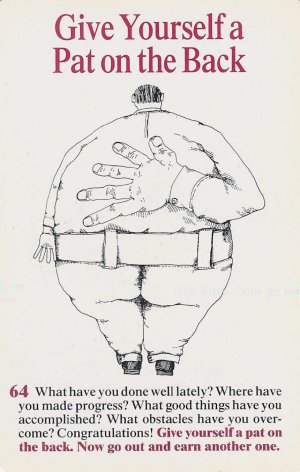
Well don’t you (and me) deserve a big pat on the back!!
:0
See the original article:
in
E=Recovery
 |
| Peter G. Levine Stronger After a Stroke |
 Banking energy is essential to recovery. Muscle strengthening (even on the unaffected side) and cardio work, i.e. walking, recumbent steppers, upper-body ergometers) are essential to provide the underlying "banking" of energy. The banked energy is needed to provide the fuel needed to do the hard work of recovery. The average stroke survivor has half the amount of cardiovascular strength as age-matched "couch potatoes." But most ADLs (walking is what is usually measured) take twice as much energy. In other words, stroke survivors have half the energy to do twice the work.
The foundation of all recovery from stroke involves neuroplastic "rewiring" of the brain. And while the energy needed to drive neuroplastic change has not been measured, one thing is for sure-neuroplasticity takes a lot of energy. The buzz word in rehab research is intensity. But how can you do intensive without enough energy?
Up to 70 percent of stroke survivors suffer from severe fatigue. Many survivors consider fatigue the worst aspect of post- stroke life. Banking energy goes a long way toward fighting fatigue.
See the original article:
in
Challenge 5: Walking Barefoot
 |
| Grace Carpenter My Happy Stroke |
Sometimes I think of my right foot as a patient who has been forgotten in a back ward of an old hospital for years.
In the first summer after the stroke, my PT encouraged me to walk on the beach without my brace and without shoes every so often to stimulate my feet. I tried it one or two times, but I gave up after realizing how many challenges I would have to overcome: the weakness in my ankle; the crushing fatigue; getting my shoes and brace off and on with one hand; etc. I also experimented briefly with walking barefoot in the house, until I had a few near misses with cans and knives in the kitchen.
Now my feet are usually are hidden away in thick shoes every day, except for bedtime and naps, and also for leg exercises on the living room rug (my yoga teacher has tried to coax sensation and movement, with some success, from my right toes).
So this was my challenge last week: to putter around the house barefoot for more than an hour. With bare feet, I unloaded the dishwasher; made lunch; sorted papers between the pile in the kitchen and the pile in the dining room.
It was tiring. Partly because spasticity can make feel as if I will topple over without the steadying influence of my shoes. But mostly, my right foot and toes seem to be terribly disoriented and confused. They ask: is the floor really cold? Or is that pain? Are all the toes pointing up or lying flat? And where, exactly, am I?
I know I have to walk barefoot more often to stimulate my foot. But right now, it feels like an act of faith, rather than an exercise.
See the original article:
in
New Journal: Fatigue: Biomedicine, Health and Behavior
 |
| Dean Reinke Deans' Stroke Musing |
Your doctor is going to have to subscribe to this journal. With a substantial percentage of stroke patients having fatigue, maybe someone will determine why it occurs after stroke. A Great stroke association would solve this.
You do expect your doctor to solve your fatigue? Don't you?
See the original article: New Journal: Fatigue: Biomedicine, Health and Behavior
With peer-reviewed articles on fatigue having increased 90% over the past decade – and nearly 1,000 papers on the topic published in 2011 alone – the time is right for Routledge’s new journal, Fatigue: Biomedicine, Health & Behavior.
Sunday Stroke Survival ~ Tired to the Bone
 |
| Jo Murphey The Murphey Saga |
Chronic fatigue is my added devil from my stroke. Paralysis being #1. All in all if I wasn't so tired all the time, I could actually do more towards recovery and a lot of other things. Compounding my stroke is a bum ticker which also causes fatigue.
 I'll admit my fatigue is not as bad as when I had my first stroke almost two years ago, but it is still my Achilles heel in productivity. Just after my stroke, it was a hour long nap, at least, after two hours awake. After month post stroke it was an hour nap after three hours awake. I gradually progressed to five hours awake with one hour nap. All of that is with 6-8 hours of sleep at night.
My progress with wakefulness and energy was set back in December with another small stroke, but not bad. I was at four hours awake and one one hour nap. Thirty minute or twenty minute power naps are like nothing and don't help. Not like they used to. I used to be able to take a power nap, awake refreshed and conquer another eight hours of work. Now I'm back again up to six hours awake and a two hour nap. That almost two naps a day!
STROKE Education Suppliment In Canadian-Health Magazine
 |
| Gary Gray PEI Stroke Recovery |
Hello to all my PEI Stroke Recovery readers,
While I was at the Lawtons Drugs next door this evening I noticed a magazine rack in the waiting room filled with the latest edition of the Canadian Medical Association quarterly magazine "Canadian Health" As I leafed through it I noticed an article on Fatigue that I thought I would like to read. I picked up the couple of items that I had come for and then took a copy of the magazine as I noticed the large "FREE" sign that dominated the very top of the magazine rack. The price was right as Lawtons Drugs was providing the magazines at no charge.
 |
| Canadian Health Spring 2011 |
Two pages of "STROKE Education Supplement" that spoke of the importance of Awareness and Education in reducing the occurrence of stroke in Canada. (50,000 new strokes in Canada each year) The supplement spoke of methods for health care professionals, stroke survivors, caregivers and families. These methods are being developed through the "Organized Stroke Care Model" and are being promoted as ways to support the 315,000 Canadians living with the after effects of stroke.
It was great to see this two page "stroke education supplement" in this high profile health magazine.
Please pick up a copy if you are near a Lawtons Drugs. You can also check it out by clicking the links in this blog post. Please pass on this link "stroke education supplement" in order to make others aware and educate them that together we can "STOP STROKE!"
I will post again soon,...
See the original article:
in
The Audacity of Hope
 |
| Pamela Hsieh Rehab Revolution |
Call me metaphysical, but I am a strong believer in the way the spirit affects its energy system. What does that mean?
The entire body is an energy system made of macroscopic attributes (arms, shoulders, legs, what have you), containing ever-smaller components that all work in harmony (or disharmony, which creates our physical maladies) and run the whole picture of our health. This much is obvious, and we fuel our body systems with food, rest, etc., and yes, stress, too.
Stress is probably the number one cause of physical disease. Arguably, it’s necessary to life and to be sure, there are good and bad forms of it. But we definitely need to cut back on the excessive sources of stress, whether internal or external.
 Stress, though, is not just physiologically damaging but spiritually destructive. When our emotions are predominantly negative, this results in negative bodily responses as well. That’s why clinical depression can lead to aches and pains, obesity, chronic fatigue. I often hear stories of former cancer patients having received devastating prognoses and somehow surviving years post their supposed predicted “death sentence,” rising above their physical disease with genuine spiritual uplifting.
Remnants of the Past
 |
| Robin Rocky Mountain Stroke Survivor |
This morning, after a good night’s sleep, I see the other side of fatigue... the reality of the life I lost and am trying desperately to regain.
I see my knitting bag still hanging at the end of the sofa; it holds a little wine-colored silk hat I was knitting for my baby. I don’t have the heart to put it away until I can rip it out and re-knit it to fit my toddler; at the same time, it is a small, painful reminder of my old life, when a day wasn’t complete without a few minutes of knitting.
I see our worn wood floors that we were about to refinish and our backyard in complete disarray. We bought our house, a cute little fixer-upper, with the knowledge that we would work together to manage all the necessary work. We’ve lived in a continual renovation project ever since. Now I not only can’t help with the projects, I can’t care for my kids alone for a day so my husband can do the work. So we carve out a brief hour here and there for him to make progress and otherwise wait until the kids are older.
I just recently went through a couple huge boxes of papers my officemate packed up for me after I resigned. I was tired of seeing them: big vague, messy reminders that I had left behind my previous life so suddenly that someone else had packed up all my stuff for me. So last week, I took armload after armload from the big boxes by the front door and shoved them out the kitchen window into the recycling bin. Thumps and flutters as the papers fell. I kept a small stack of what I still need from my old life to reassemble my new life.
Fatigue
 |
| Amy Shissler My Cerebellar Stroke Recovery |
People that don’t have a brain injury DO NOT, CANNOT, NEVER WILL even come close to understanding the fatigue that has resulted from this. You might be a doctor or a therapist, or have 10 PhDs, unless you have experienced this you don’t get it, trust me. And from what I’ve learned, the fatigue will be an issue for the rest of my life. It’s a heck of a lot better than it used to be but I kinda feel like it’s plateaued, the fatigue is unchanging now. I have an entirely different brain now than I had before the stroke. Luckily, my personality and cognition were not affected but even though I may seem like the same person as before, I’m not. I went out Saturday at 5 o’clock, was in bed by 10:30 and it completely wiped me out for 2 days. So if someone says they’re tired, BELIEVE THEM. By the way, in my opinion, don’t bother going to a “sleep doctor” and having a sleep study. That was an absolute waste of time for me. Just figure out for yourself how to deal with this and what works best for you.
See the original article:
in
Fatigue is a Deal Breaker
 |
| Rebecca Dutton Home After a Stroke |
The fatigue I felt the first year after my stroke was unlike anything I had ever experienced. I repeatedly felt a crushing fatigue I couldn't push through. Using a timer to force myself to rest was annoying because the timer would go off at the worst time. I tried to rest by watching TV, but that turned me into a zombie who couldn't stop clicking the remote because nothing good was on at the moment. I tried reading and going on the Internet, but got so absorbed in these activities that I ended up being more tired. When I did not rest I could barely hold my head up after dinner.
I found two strategies that work for me. (1) Lying on top of the bedspread with a towel under my shoes and a small blanket covering me doesn't feel like I'm going back to bed. I can lie down for fifteen minutes without having to get undressed. (2) When I listen to a CD I can stop after a few tracks and come back to it later. Instead of staring at the clock and resenting having to rest I enjoy the music. Even seven years after my stroke I make sure to get enough rest when I have an outing planned for the day. I don't want to start wishing I could go home a few minutes after I arrive. A stroke survivor I met resents having to rest but I think preventing fatigue lets me do more rather than less.
See the original article:
in
Combo Therapy May Ease Fatigue After Stroke
 |
| Jeff Porter Stroke of Faith |
I certainly relate to the chronic fatigue that happens after a stroke. It seemed to sap energy for quite some time. I was convinced at the time that going back to running helped greatly to help get past chronic fatigue.
And now, researchers have found that combo therapy may ease fatigue after stroke, as reported by Reuters Health:
The researchers recruited 83 patients who were suffering from chronic fatigue an average of four years after having a stroke.
Half were randomly assigned to 12 weeks of cognitive therapy alone, and half had cognitive therapy plus the exercise training. ...
 |
| Photo from the National Institutes of Health |
After 12 weeks, the study found, 58 percent of patients receiving both therapies had a "clinically relevant" improvement in their fatigue, based on questionnaires. That compared with 24 percent of patients who'd had only cognitive therapy.
A clinically relevant improvement meant that patients had noticeable changes in their daily activities, [lead researcher Aglaia] Zedlitz said.
The findings, reported in the journal Stroke, suggest that a combination of cognitive therapy and exercise might help post-stroke fatigue.
See the original article:
in
STROKE REHABILITATION - Emotional Disturbances
 |
| Richard Burns Live or Die: A Stroke of Good Luck |
Many stroke survivors feal fear, anxiety, frustration, anger, sadness, even grief at their physical and mental losses. These feelings are a natural reponse to the trauma of a stroke. Some emotional disturbances and personality changes are caused by the physical effects of brain damage. Clinical depression, a sense of hopelessness that disrupts the ability to function, is the most common emotional disorder. Signs of this depression may include sleep disturbances, a change in eating habits and routine that may lead to weight loss or gain, lethargy, social withdrawal, irritability, fatigue, self-loathing, even suicidal thoughts. This post--stroke depression can be treated with medication and phsycological counseling.
Stroke's not for sissys and that's why one should do everything they can to avoid it. That's prevention and the subject of a future series.
Previous blogs talk about the problems you, as a stroke survivor, must face. It's not easy. Neither is life.
I'm a stroke survivor. Been there. Done that. It's taken 40-plus years to accumulate the facts and knowledge to make useful and hopefully helpful comments. If I can do it, so can you. It just takes guts and God (or whomever, whatever, you choose) and a good caregiver.
And, that's where we're going next.
See the original article:
in
Let's Chat about Dysarthria

Received by SSTattler
I just don't get it sometimes. Why there are family members and loved ones of those with dysarthria who have no clue about what to do to help their loved ones with this problem, other than to remind them over and over again, to just "Slow Down."
Those with dysarthria and their loved ones are still not realizing what methods really work with for dysarthria. It's rather simple, really, and for some reason many are quickly put on a computer program, or worksheets when in reality these people really need a Superior Speech Model.
Case in Point. I visited with a family today who have a son who was in a severe accident 23 years ago. His speech is about 20% intelligible, and has been to therapist after therapist and even moved to Houston to find a speech pathologist for him. They do not know what to do for their son other than to find a therapist, and in over 23 years of therapy know virtually nothing regarding how to get their son speaking with clarity.

They must model the exact speed and latency which this gentleman needs. They must learn to speak with him by doing so very slowly with almost a 1 second pause between each word. It's not rocket science. We will speak like those we are around. If one with dysarthria communicates with those continually who speak at a very rapid speech rate of normal speech, they will model that. If we can find someone at home who can model the speech we desire for the person with dysarthria we are one step closer to speech with clarity.
There are no magic "programs, or devices" that will help those with dysarthria. They must be required to speak in a very specific way following a very specific model. We are training parents, caregivers and loved ones to do so. There are no short cuts, and the myth that so many people believe is, that going to speech therapy a couple times a week will remediate this problem. I don't think so. In most cases a speech model is required who will stimulate the desired speaking rate, cadence, and rhythm, continually. We instruct people how to help their loved ones with the Teaching of Talking Method (c) which is a way to help develop almost any new speaking behavior or habit. Find out more by becoming our friend on facebook at Teaching of Talking or by visiting our website at http://www.teachingoftalking.com You can also contact me personally through our website or Facebook. You can learn how to really take your loved ones speech therapy to a new level. Ask your speech therapist about The Teaching of Talking Method, and that you are interested in learning it. We will be available to come to your city, hospital, school, or college to share with you the fundamentals of this method.
Best.
Mark A. Ittleman, M.S., CCC/SLP
Taking a Stand for Speaking Clarity Around the Globe.
Mark A. Ittleman, M.S. CCC/SlP has been a speech language pathologist for over 40 years and has specialized in neurological speech, voice, and language difficulties with children and adults. He is the author of The Teaching of Talking, a book which he wrote for caregivers, loved ones and speech pathologists. In Teaching of Talking Mark discusses the fundamentals of speech therapy and presents a fun and entertaining way to stimulate others to speak. He believes expert methods can be taught to anyone who is interested and committed to helping their loved ones speak.
From Mark A. Ittleman E-Mail: Let's Chat about Dysarthria.
The Dentist
 |
| Jackie Poff Stroke Survivors Tattler |
"No way, no needles! I hate needles!" the man exclaimed.
So she started to hook up the nitrous oxide tank, and the man said, "I can't do the gas thing. Just the thought of having a mask on my face suffocates me!"
The dentist then asked the patient if he had any objections to taking a pill. "No," he says, "I'm fine with pills."
So the dentist gave him two little blue pills and he swallowed them. "What are those?" he asked.
"Viagra," she replied.
"I'll be damned," said the patient, "I didn't know Viagra worked as a pain killer."
"It doesn't," said the dentist, "But it will give you something to hold on to when I pull your tooth."
Starting From Scratch, Again
 |
| Diane The Pink House On The Corner |
So, we are back at Outpatient Rehab working on standing. And I tell you, it's an all too familiar scene, as it seems no matter how far he gets with therapy, he always ends up back here:
 |
Bob standing with therapist
|
I guess, I should be proud that at least, this time, it didn't take three therapists to hold him up! After standing up four times, for less than 1 minute each, the PT worked with stretching Bob's neck muscles then on "stand and pivot" to transfer Bob from wheelchair to a bed.
The "stand and pivot" was more like a "stand sort of weirdly crouched and have therapist lift Bob onto the bed" but, at least Bob was able to push up from the chair with his hand on the armrest. As the PT said, "you have to start somewhere!" So we'll see what happens. It would be great if Bob could do a "stand and pivot" as that would make my job much easier.
And I am glad Bob is motivated again and really trying hard!
See the original article:
in
Subscribe to:
Posts (Atom)