

Showing posts with label ▷ 2014 Mar 08. Show all posts
Showing posts with label ▷ 2014 Mar 08. Show all posts
Saturday, March 08, 2014

Def'n: Neuroplasticity
Neuroplasticity From Wikipedia, the free encyclopedia
See also: Synaptic Plasticity From Wikipedia, the free encyclopedia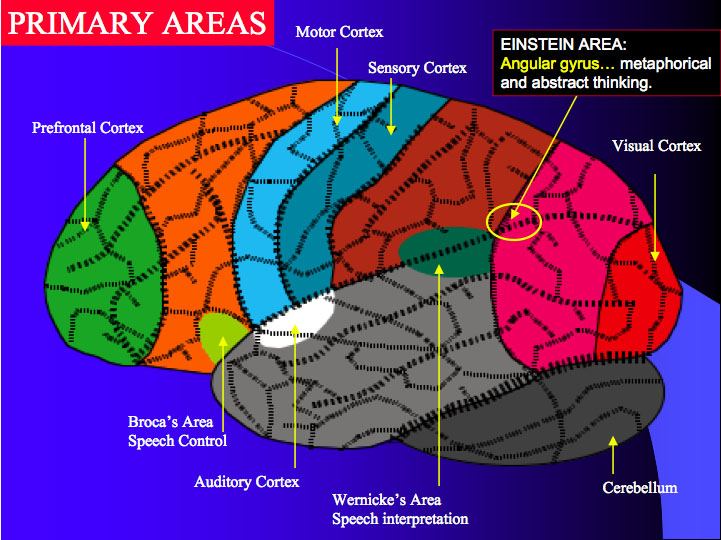 |
Contrary to conventional thought as expressed in this diagram,
brain functions are not confined to certain fixed locations.
|
Neuroplasticity occurs on a variety of levels, ranging from cellular changes due to learning, to large-scale changes involved in cortical remapping in response to injury. The role of neuroplasticity is widely recognized in healthy development, learning, memory, and recovery from brain damage. During most of the 20th century, the consensus among neuroscientists was that brain structure is relatively immutable after a critical period during early childhood. This belief has been challenged by findings revealing that many aspects of the brain remain plastic even into adulthood.
Video: Neuroplasticity
Max Cynader: Enhancing the Plasticity of the Brain
Published on Apr 26, 2013Dr. Max Cynader is Director of the Brain Research Centre, and the Djavad Mowafaghian Centre for Brain Health at Vancouver Coastal Health and The University of British Columbia (UBC). In addition, he holds the Canada Research Chair in Brain Development at UBC and is Professor of Ophthalmology. He is also a Member of the Order of Canada (CM), Member of the Order of British Columbia (OBC), Fellow of The Royal Society of Canada (FRSC), Fellow of The Canadian Academy for Health Sciences (FCAHS), and a Principal Investigator in Canada's Network of Excellence in Stroke.
Dr. Cynader was born in Berlin, Germany in 1947 and obtained his B.Sc. at McGill University in 1967, and his Ph.D. from the Massachusetts Institute of Technology in 1972. Following postdoctoral training at the Max Planck Institute, Dr. Cynader held positions at Dalhousie University in Halifax, and in 1979 was awarded the E.W.R. Steacie Fellowship of the Natural Sciences and Engineering Research Council as one of Canada's outstanding young scientists. He attained the rank of Professor of Psychology in 1981 and Professor of Physiology in 1984, and held the position of Killam Research Professor from 1984 to 1988. On arriving at UBC in 1988, Dr. Cynader headed the Ophthalmology Research Group at UBC until 1998, at which time he was appointed Founding Director of the Brain Research Centre.
Standard YouTube License @ TED
Saturday Comics

| For Better and For Worse Lynn Johnston - 2014/03/02  "I can't make anyfing outa dis stuff...." | Dilbert Scott Adams - 2014/03/02  "Thats like asking a chipmunk to judge algebra..." |
Peanuts Charles Schulz - 2014/03/02 
"The World War I flying ace walks onto the field..."
| Doonesbury Garry Trudeau - 2014/03/02  "... when I say we're tired of being demonized !!" |
** I tried to get low or free price at the people http://www.UniversalUclick.com/ for the images for the cartoons. It was too high for Stroke Survivors Tattler i.e. we are not a regular newspaper and our budget is very low. Fortunately, you will have to do only 1-click more to see the cartoon image, it is legit and it is free using GoComics.com and Dilbert.com.
Note: Now SSTattler are running cartoons starting on previous Sunday.
Eclectic Stuff
 |
Definition: Eclectic(noun) a person who derives ideas, style, or taste from a broad and diverse range of sources.
|
Sunday Stroke Survival ~ Neuro What?
 |
| Jo Murphey The Murphey Saga |
The first I heard about neuroplasticity was through a television commercial. Like most non strokees, I always looked for ways to utilize my brain to the utmost capacity. More than likely the same was true for you. I had no idea what neuroplasticity meant. I sort of assumed it meant some form of brain power training.
Standard YouTube License @ Lumosity
After my stroke, I heard the term again. Not from my rehab team, but from other stroke survivors. I still lived under the assumption that what you got back in the first six months was it and I needed to learn to live with the adjustments.
Synaptic Listening - How Neuroplasticity Might Work
 |
| Dean Reinke Deans' Stroke Musing |
The Cellular Scale blog writes about how to listen in on neuronal synapses. This sounds extremely important if we are ever to know how neurons recruit neighbors and how neuroplasticity works. My theory on that is here:The Good, the Bad and the Ugly - neurons.
We absolutely need to find the answer if we ever are to make neuroplasticity truly repeatable. That would allow us to get a lot closer to 100% recovery. A Hop, Skip, and a Pre-synaptic Patch from The Cellular Scale.
Does your doctor or your stroke association have any idea how neuroplasticity really works?
See the original article:
in
Face-Off
 |
| Pamela Hsieh Rehab Revolution |
I’ve been a bit MIA this month for a variety of reasons, and I suppose this is what Motivation To Move’s head spokesperson, Scott Smith, is always talking about: when “life gets in the way.”
I have realized over these past years that rehab goes through waves, stages of intense purpose and drive, and then waning stages that take the backseat to whatever else you’ve got going on.
Yes, even I, the sole driving force of this website, have my uninspired periods, and unfortunately I’ve just had one. However, the important part is to recognize that and reignite the flame. Refer to my older post on energy renewal, if you’d like to (re?)read the basic principles of the phenomenon — but I’ll go on.
In this period I’ve hosted a couple of CouchSurfers (members of an international traveling organization that fosters cultural exchange for hospitality in all its forms), both of whom challenged a lot of things that during my growth have sort of defined me and my beliefs, and while sometimes uncomfortable and foreign, it was fine. And ultimately, beneficial, because oftentimes we can get set in our ways and habits until we are forced out of our own comfort zones.
Stroke Recovery, Stroke Rehabilitation: A Message to Therapists
 |
| Peter G. Levine Stronger After Stroke |
 There you sit, face to face with a stroke survivor. Only a few days ago he was a vibrant, energetic community member... employee... family member and now is sitting in front of you…. aphasic… hemiparetic …scared. The family sits anxiously behind him. They’re eager to get their loved one back and now they look to you. “When?” they ask. “How?” they inquire. And make no mistake, no matter who has talked to them before and no matter how blunt other health professionals have been, they hold hope for full recovery. Between their expectations and their slowly materializing nightmares, you are the last line of defense.
This is not a good time to ask, “Are my skills up to this?”
What if you simply want to do what is the best neurological therapy available? What if you want to treat based on the best available scientific evidence. What if you don't want to be influenced by the wide variety of competing schools of neurorehabilitation, each with their own books and seminars and cult of personality leaders?
Want to scrape all the BS away? Go here: meta-analysis.
Rewiring the Post-Stroke Brain
 |
| Jeff Porter Stroke of Faith |
A summary of a study done in the town where I live. Sometimes, you read about a report that mirrors your own experience. Like those studied in research on pushing the brain to find new pathways, I felt my brain rewiring itself for far longer than six months:
- Until recently, scientists believed that, following a stroke, a patient had about six months to regain any lost function. After that, patients would be forced to compensate for the lost function by focusing on their remaining abilities. Although this belief has been refuted, a University of Missouri occupational therapy professor believes that the current health system is still not giving patients enough time to recover and underestimating what the human brain can do given the right conditions.
- In a recent article for OT Practice Magazine, Guy McCormack, clinical professor and chair of the occupational therapy and occupational science department at the MU School of Health Professions, argues that health practitioners believe their clients need more time and motivation to reclaim lost functions, such as the use of an arm, hand or leg. With today's therapies, it is possible for patients to regain more function than ever thought possible, McCormack said.
- "Patients are able to regain function due to the principle of neuroplasticity, or the brain's ability to change, especially when patients continue therapy long after their injuries," McCormack said. "Therapists once believed the brain doesn't develop new neurons; but, now they know neurons change their shape and create new branches to connect with other neurons, rewiring the brain following an injury or trauma."
On some days, I could even feel that I my brain had moved up one more notch. One in particular was very close to home. I was in much (St. James United Methodist, in Little Rock) and was during a hymn. I had felt like I could no longer carry a tune. But on that day, suddenly I gained some ground; I could have sworn that I felt it.
So in a house of worship, I lifted up my own little prayer.
Patience is hard sometimes. But this study gives some hope that even months and months post-stroke, rewiring is possible.
See the original article:
in
A New Hypothesis
 |
| Barb Polan Barb's Recovery |
I generally don't start the day with a crying jag, but this morning was an exception: Yesterday I had a brilliant (I thought) idea ... since aerobic exercise creates an environment in the brain that enables neuroplasticity (the generation of new brain cells and function), and mirror therapy causes neurons connecting brain to motion so that I can recruit that a new area of my brain to control particular muscles, it made sense that I should do some aerobic exercise, THEN do mirror therapy. I was VERY excited about trying that this morning, and planned to row my typical two miles, then go downstairs to do my finger opening/closing mirror therapy. Unfortunately, I had rowed only a half-mile when I couldn't keep my hand/wrist attached to the rowing machine handle. Remember how I had trouble using the quick release gadget Tom had attached to the handle? Well, this morning I had the opposite problem - I couldn't PREVENT my hand from being released. So Tom sat next to me, re-attaching the gadget every 30 seconds or so; I knew that he wanted to be out on the back porch grouting the tile he had just installed, so we were both trying to deal with increasing frustration. Then Turbo brought his tennis ball over, dropped it next to me, sat, and started whining. I told myself that he was just trying to be empathetic because I was crying, but I could not convince myself and could only think,"Poor Tom. Here he is with 2 crying beasts, when all he wants to do is be outside grouting.What a way to start the day." I told Tom that I would postpone the attempt, that I would do better having my hand Ace bandaged to the machine (the old way) TOMORROW, and I would try out my theory again after that. So he went downstairs to grout, and I sat on the window seat feeling sorry for myself. Even if my approach ends up being flawed, I'll certainly be no worse off: I'll still get in my rowing and my mirror therapy, just in a different order than usual. Yes, I will try again tomorrow.
See the original article:
in
Stroke Rehabilitation - Neuroplasticity
 |
| Richard Burns Live or Die: A Stroke of Good Luck |
Next up on the list of medical professioinals specializing in post-stroke rehabilitation are the Physical Therapists. Physical Therapists specialize in treating the disabilities that stroke survivors may have related to motor and ensory problems. They are trained in all aspects of of anatomy and physiology related to normal bodily function, normal bodily movement. They assess strength, they assess endurance, range of motion, abnormalities in function and design programs of rehabilitation aimed at regaining those lost motor functions.
Physical Therapists help the stroke survivor to regain the use of stroke-impaired limbs, teach strategies to reduce problems of function and develop and practice exercise programs to help retrain the brain function....they call it neuroplasticity. I call it rewiring the brain and the body to work and communicate together once again. It takes time. It takes hard work. But the end result is worth it. Because it works.
Physical therapy emphasizes practicing movements repeatedly, changing, rehearsing and planning movements, rehearsing complex movements that require coordination and balance. Those who are weak or impaired can practice movements in hydro-therapy (water provides weight support and sensory stimulation). And, perhaps the most telling new development is the therapist's ability to apply sensory stimulation to encourage the use of impaired limbs on those parts of the body that have been previously neglected.
Where there's a will, there's a way. There's help. It's a continuing fight...and it's worth it.
See the original article:
in
Brain Plasticity Will Blow Your Mind
 |
| Rebecca Dutton Home After a Stroke |
SSTattler: Good article - you have to read it!
New research on brain plasticity will blow your mind. One amazing finding is that new stem cells are produced in the lateral ventricals of the adult brain (1). What is even more amazing is how these stem cells migrate from the back of the brain to the olfactory bulb in the front of the brain (2). Using time lapse imaging scientists have been able to watch stem cells latch onto a blood vessel highway and drag themselves to their destination. First, brain chemicals push stem cells away from their birth place. Additional chemicals stop the stem cells from getting off track along the way. As the cells approach their destination more chemicals pull them in the right direction.
Will Smith's Mobile Home
 |
| Monty Becker Stroke Survivors Tattler |
That's a great motorhome, it was built 2012 in Salmon Arm by Valid Manufacturing owner Gerald Clancy grew up in the north Shuswap and was an electrical contractor.
Standard YouTube License @ Channel8ent
Stress, Stress and More Stress...
 |
| Diane The Pink House On The Corner |
The other day, I find myself, tears rolling down my cheeks, on my knees, in the bathroom, mopping up water. This because, when the washing machine (in the laundry room) drained, the water backed up the sewer pipe and poured out the base of the toilet and flooded the bathroom. And I really did not need this...
This was also the second plumbing problem in February. The first being the kitchen faucet which would no longer shut off. I knew it just needed new washers, but the kitchen sink does not have a shut off valve and the water would need to be turned off at the meter on the boulevard and I knew you need a special tool to do this. Which I don't have. So I called a plumber, figuring, how much could a couple of washers and 30 minutes of labor cost? And I nearly fell over dead when the plumber tried to charge me $291.00! But, after 20 minutes of arguing with this guy, I got the price down to $171.00 -- but still, jeepers!
And now I was dealing with a new plumbing problem, which appeared much more severe.
I tell you, they say money can't buy happiness, and it can't buy love, but it certainly can buy the services of plumber. Which can make a person, if not happy, at least less stressed out.
And what do you do when you just don't have the cash? or the credit?
Some ‘Mistakes’ Are Bigger Than Others! #Pistorius # Oscarpistorius #Stroke
 |
| Kate Allatt A Rocky Stroke Recovery |
 I make mistakes.
Even Amy Winehouse made mistakes, amongst her many good achievements.
Like easily losing my ‘stroke’ temper now (not that I can control this, nor does this verbal irritability ever manifest into any physical violence I hasten to add!!)
 Or like expecting too much from other people just because my own work rate is so high, obsessive and intense.
Or being too overly task-focused. I’m often clumsy (or seemingly inconsiderate to other peoples feelings), as I steam roller ahead in pursuit of my personal and professional goals, where I am often blinkered to the bigger picture.
Or unreasonably expecting ‘normal’ people to be able to understand me, and others like me, more than they actually ever possibly can.
But I’m not a bad person, I mean some people make mistakes – deliberate or not – that are very serious, lifelong and with HUGE repercussions.
In Oscars Pistorius own words recently:


Helen Keller: “Life is Either a Daring Adventure or Nothing at All!”
 |
| Mark A. Ittleman The Teaching of Talking |
 |
Helen Keller (8 years old)
and Anne Sullivan in 1888
|
Here was this deaf, blind person who could not speak. She had an excellent model, Ann Sullivan. Somehow the chemistry between the two enabled Helen to become one of the most revered women in America and around the world. Ann Sullivan studied how to teach deaf children in college, and when she graduated found a job with the Keller family. The relationship that started when Helen was just a girl lasted for years, and not only was Annie Sullivan Helens’s mentor, but she also became a life-long friend. Imagine what it must have been like to teach a blind, deaf and mute girl to talk, read, and write. I’d say it was quite daring, and adventuresome! Back in those days parents would send their children off to private schools if they had difficulty hearing, speaking or learning. Somehow the Keller’s hired Annie Sullivan.
Snowshoes Race Result
 |
| Carrie Lewis Stroke Survivors Tattler |
Saturday, February, 22 9:30am until 10:15am in the main pavilion at Hawrelak Park, beside the lake.
Snowshoe running is the fastest growing winter sport, and the Sliver Skate Festival is excited to add a snowshoe race to the events in 2014. Come see what snowshoe running is all about in our first annual snowshoe race of the festival. To host an amazing race, the Silver Skate Festival has partnered with Snowshoe Canada, the national organization that promotes the sport, as well as Monika Owczarek, Canadian snowshoe running Champion and 4-time World Championships qualifier.
 |
| John C. Anderson Stroke Survivors Tattler |
Monika Owczarek set the course with little flags about 25m apart so the route is clear. Other admin people was in route to tell you to stay on the course and yell at you to "go faster, go faster,...".
Monika started the race. At the very start you have to 1) go up the hill & then down, 2) relatively flat most the way, 3) approximately 180º degrees back to start, 4) go down the hill and up, 5) cross the line to end of the course.
It is very obvious, I was not in the medals! but I claim my task is the anchor (anyway, I was last but had lots a fun) - young pre-teens boy was the first at approximately less 12 minutes and many people clapped to me to finish. Carrie took pictures and the video below. They had lots coco/tea/coffee and snacks at the end.
From Monika Owczarek, Canadian snowshoe running Champion:
2014 was the first annual snowshoe race at the Silver Skate Festival as an addition to the current sports events (winter triathlon and marathon skate races). There was a 1km and a 5km distance. As next year is the 25th anniversary of the Silver Skate Festival, the snowshoe race will be even bigger, with a larger launch. The event in 2015 may have a 10km distance in addition to this year's distances. Expect another great event for the whole family. Looking forward to it!
(Plasticity) Barbara Arrowsmith-Young:
The Woman Who Changed Her Brain

Barbara Arrowsmith-Young is the Creator and Director of Arrowsmith School and Arrowsmith Program, and the author of the international best-selling book The Woman Who Changed Her Brain (www.barbaraarrowsmithyoung.com/book). She holds a B.A.Sc. in Child Studies from the University of Guelph, and a Master's degree in School Psychology from the University of Toronto (Ontario Institute for Studies in Education). Arrowsmith-Young is recognized as the creator of one of the first practical applications of the principles of neuroplasticity to the treatment of learning disorders. Her program is implemented in 54 schools internationally.
Standard YouTube License @ TED
Subscribe to:
Posts (Atom)