Showing posts with label ▷ 2013 Jun 01. Show all posts

Saturday, June 01, 2013

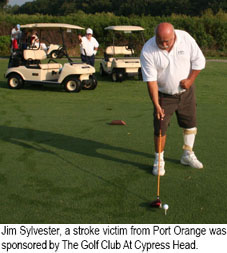
Golfers with Disabilities & Golf Carts


SSTattler: Golf courses (links) in most of cities in Canada, USA, UK, ... understand and serve "Golfers with Disabilities" (i.e. stroke) and "Adaptive Golf Carts" -- see below.

See A Modification of the Rules of Golf for Golfers with Disabilities .


Golf From Wikipedia, the free encyclopedia. 
Golf is a precision club and ball sport in which competing players (or golfers) use many types of clubs to hit balls into a series of holes on a course using the fewest number of strokes. Golf is defined, in the rules of golf, as "playing a ball with a club from the teeing ground into the hole by a stroke or successive strokes in accordance with the Rules."

It is one of the few ball games that does not require a standardized playing area. Instead, the game is played on a golf course, generally consisting of an arranged progression of either 9 or 18 "holes". Each hole on the course must contain a "tee box" to start from and a "putting green" with the actual hole, and there are various other standardized forms of terrain in between such as the fairway, rough, and hazards, but each hole on a course and indeed among virtually all courses is unique in its specific layout and arrangement.

Golf competition is generally played for the lowest number of strokes by an individual, known simply as stroke play, or the lowest score on the most individual holes during a complete round by an individual or team, known as match play. Stroke play is the most commonly seen format at virtually all levels of play, although variations of match play such as "skins" games are also seen in televised events. Other forms of scoring also exist.

Origin

While the modern game of golf originated in 15th century Scotland, the game's ancient origins are unclear and much debated. Some historians trace the sport back to the Roman game of paganica, in which participants used a bent stick to hit a stuffed leather ball. One theory asserts that paganica spread throughout Europe as the Romans conquered most of the continent, during the first century BC, and eventually evolved into the modern game. Others cite chuiwan ("chui" means striking and "wan" means small ball) as the progenitor, a Chinese game played between the eighth and 14th centuries. A Ming Dynasty scroll dating back to 1368 entitled "The Autumn Banquet" shows a member of the Chinese Imperial court swinging what appears to be a golf club at a small ball with the aim of sinking it into a hole. The game is thought to have been introduced into Europe during the Middle Ages. Another early game that resembled modern golf was known as cambuca in England and chambot in France. This game was, in turn, exported to the Low Countries, Germany, and England (where it was called pall-mall, pronounced “pell mell”). Some observers, however, believe that golf descended from the Persian game, chaugán. In addition, kolven (a game involving a ball and curved bats) was played annually in Loenen, Netherlands, beginning in 1297, to commemorate the capture of the assassin of Floris V, a year earlier.

The modern game originated in Scotland, where the first written record of golf is James II's banning of the game in 1457, as an unwelcome distraction to learning archery. To many golfers, the Old Course at St Andrews, a links course dating to before 1574, is considered to be a site of pilgrimage. Golf is documented as being played on Musselburgh Links, East Lothian, Scotland as early as 2 March 1672, which is certified as the oldest golf course in the world by Guinness World Records. The oldest surviving rules of golf were compiled in March 1744 for the Company of Gentlemen Golfers, later renamed The Honourable Company of Edinburgh Golfers, which was played at Leith, Scotland. The world's oldest golf tournament in existence, and golf's first major, is The Open Championship, which was first played on 17 October 1860 at Prestwick Golf Club, in Ayrshire, Scotland.

Golf Course

A golf course consists of a series of holes, each with a teeing ground that is set off by two markers showing the bounds of the legal tee area, fairway, rough and other hazards, and the putting green surrounded by the fringe with the pin (normally a flagstick) and cup.

The levels of grass are varied to increase difficulty, or to allow for putting in the case of the green. While many holes are designed with a direct line-of-sight from the teeing area to the green, some holes may bend either to the left or to the right. This is commonly called a "dogleg", in reference to a dog's knee. The hole is called a "dogleg left" if the hole angles leftwards and "dogleg right" if it bends right. Sometimes, a hole's direction may bend twice; this is called a "double dogleg".

A typical golf course consists of 18 holes, but nine-hole courses are common and can be played twice through for a full round of 18 holes.

Early Scottish golf courses were primarily laid out on links land, soil-covered sand dunes directly inland from beaches. This gave rise to the term "golf links", particularly applied to seaside courses and those built on naturally sandy soil inland.

The first 18-hole golf course in the United States was located on a sheep farm in Downers Grove, Illinois, in 1892. The course is still situated there today.

Play of the Game

1=teeing ground, 2=water hazard, 3=rough,
4=out of bounds, 5=sand bunker, 6=water hazard,
7=fairway, 8=putting green, 9=flagstick, 10=hole
Every round of golf is based on playing a number of holes in a given order. A "round" typically consists of 18 holes that are played in the order determined by the course layout. On a standard course of 18 holes, each hole is played once in the round; on a nine-hole course, players may play a "short game" playing each hole once, or a "full round" by playing each hole twice.

Playing a hole on a golf course is initiated by putting a ball into play by striking it with a club on the teeing ground (also called the tee box, or simply the tee). For this first shot on each hole, it is allowed but not required for the golfer to place the ball on a tee prior to striking it. A tee in this last sense is a small peg which can be used to elevate the ball slightly above the ground up to a few centimetres high, which reduces the interference of the ground or grass on the movement of the club making the ball easier to hit, and also places the ball in the very center of the striking face of the club (the "sweet spot") for better distance. Tees are commonly made of wood but may be constructed of any material, including plastic. Traditionally, golfers used mounds of sand to elevate the ball, and containers of sand were provided for the purpose. A few courses still require sand to be used instead of peg tees, to reduce litter and reduce damage to the teeing ground.

When the initial shot on a hole is intended to move the ball a long distance (typically more than 225 yards), the shot is commonly called a "drive" and is generally made with a long-shafted, large-headed wood club called a "driver". Shorter holes may be initiated with other clubs, such as higher-numbered woods or irons. Once the ball comes to rest, the golfer strikes it again as many times as necessary using shots that are variously known as a "lay-up", an "approach", a "pitch", or a "chip", until the ball reaches the green, where he or she then "putts" the ball into the hole (commonly called "sinking the putt" or "holing out"). The goal of getting the ball into the hole ("holing" the ball) in as few strokes as possible may be impeded by obstacles such as areas of longer grass called "rough" (usually found alongside fairways) which both slows any ball that contacts it and makes it harder to advance a ball that has stopped on it; "doglegs", which are changes in the direction of the fairway that often require shorter shots to play around them; bunkers (or sand traps); and water hazards such as ponds or streams.

In stroke play competitions played according to strict rules, each player plays his or her ball until it is holed no matter how many strokes that may take, but in match play it is acceptable to simply pick up one's ball and "surrender the hole" after enough strokes have been made by a player that it is mathematically impossible for the player to win the hole. It is also acceptable in informal stroke play to surrender the hole after hitting three strokes more than the "par" rating of the hole (a "triple bogey" - see below); while technically a violation of Rule 3-2, this practice speeds play as a courtesy to others, and avoids "runaway scores", excessive frustration and injuries caused by overexertion.

Players can walk to their next shot or drive in golf carts over the course or along pathways beside it. The game can be played either individually or in groups and sometimes accompanied by caddies, who carry and manage the players' equipment and who are allowed by the rules to give advice on the play of the course. A caddy's advice can only be given to the player or players for whom the caddy is working, and not to competing players.

See the full article Rules and Regulations, Equipment, ... from:
      Golf From Wikipedia, the free encyclopedia. 


Golf Cart From Wikipedia, the free encyclopedia. 


A golf cart (called golf car in ANSI standard Z130.1, since "carts" are not self-propelled) is a small vehicle designed originally to carry two golfers and their golf clubs around a golf course or on desert trails with less effort than walking.

Golf carts come in a wide range of formats and are more generally used to convey small numbers of passengers short distances at speeds less than 15 mph (24 km/h) per ANSI Standard z130.1 as originally manufactured. They are generally around 4 feet (1.2 m) wide × 8 feet (2.4 m) long × 6 feet (1.8 m) high and weigh 900 pounds (410 kg) to 1,000 pounds (450 kg). Most are powered by 4-stroke engines.

The price of a golf cart can range anywhere from under US$1,000 to well over US$20,000 per cart, depending on several factors. These factors may include whether or not a fleet of carts is being purchased for a golf course or a country club, for example, and whether the carts are new or used. Other factors may include options such as equipment requirements, and how many people the cart is meant to transport. With the rise in popularity of golf carts, many golf clubs or country clubs offer storage and energy options to golf cart owners. This has led to the modification of golf carts to suit use at the particular golf course. Typical modification includes windshields, ball cleaners, cooler trays, upgraded motor or speed controller (to increase speed and/or torque), and lift kits.

Originally golf carts were electrically powered, but in time gasoline-powered variants started to occur. The electric variety is now used in many communities where their lack of pollutants, lack of noise, and safety for pedestrians and other carts (due to slow speeds) are beneficial. When purpose-built for general transportation these are called Neighborhood Electric Vehicles (NEVs), but with various operating limitations such as top speed and heavy regulation on which type of streets these types of carts are permitted to be used. These may resemble the golf carts shown above, although some are now being made with all-weather car-like bodies.

The minimum age to drive a golf cart is 13 in Alabama, California, Iowa, Kansas, Kentucky, Rhode Island, and Vermont. In Florida, the minimum age is 14. In all the other states, the minimum age is 15.

Adaptive Golf Carts

New technology such as the SoloRider, an adaptive golf cart designed for a single user, is allowing disabled persons access to the golf course and the game itself. The cart’s seat swivels around, extends to an upright position, and allows the golfer to stand upright, be supported, and swing using both hands.

See the full article:
      Golf Cart From Wikipedia, the free encyclopedia. 


Stroke Victim Back on the Links 

Published on Jul 26, 2012

Dawn Boucher was a provincial golf champion at 18, but at the age of 45 her entire life came to a complete stop when she was suffered a stroke. Despite this life altering event, Dawn has managed to get back out on the links. Kevin Smith has her story of recovery and hope in Calgary.


Standard YouTube License @ Global News - Calgary


Saving Strokes - PGA Pros helping 

Uploaded on Aug 19, 2011

http://www.TargetCenteredGolf.com Saving Strokes and local PGA golf professionals team up to help stroke "victors" learn about and enjoy golf. For these golfers it's a chance to develop new skills. For Eric Jones and his fellow PGA pros, well, they just love to share their passion for the game. It's a thrill to see any golfer, no matter their skill level, take on a challenge. The courage of these golfers comes straight from the heart.


Standard YouTube License @ Eric Jones 


Stroke Survivors' Golf League Helps Patients 

      Get Back Into the Swing of Things 

Uploaded on Aug 21, 2011

Members of Rehabilitation Institute of Michigan (RIM) Novi Center's Stroke Support Group are getting their lives and game back on course. The group recently started a golf league for stroke survivors and their family members. Some of the golfers are ambulatory and some golf from a specialized adapted golf cart. The cart has a swivel seat that allows golfers to hit the ball from a seated or supported standing position. According to RIM Novi's social worker and case manager, Jay Devereaux, the league has provided physical and psychological benefits. "Golf is a very physical game so it is great for them to be outside and exercising and from a psychological standpoint it is a huge self-esteem builder for them to be out here and enjoying something they loved prior to their stroke."


Standard YouTube License @ Rehabilitation Institute of MI


Golf Therapy: Stroke Survivors Get Back on Course - 

      Alvarado Hospital 

Uploaded on Jun 1, 2010

Survivors of traumatic accidents, stroke and other neurological injuries make great strides in recovery by learning to play golf. PGA professional John Klein and Alvarado Hospital are leaders in using adaptive golf for rehabilitation.


Standard YouTube License @ Alvarado Hospital Medical Center


Bus 52 Presents: Fore Hope 

Published on Nov 14, 2012

Fore Hope, read more .... http://web.bus52.com/profiles/fore-hope/

For some, golf is a passion, for others it seems, as the saying goes, a good walk ruined, but rarely is it considered to be a means of therapeutic exercise. For years, Fore Hope has been helping people struck by illness or injury play golf, whether or not they've ever played before.

Fore Hope is "a therapeutic golf program to enhance quality of life for persons with disabilities, injuries, or illnesses," explains Mindy Derr, the organization's Founder and Executive Director.

Derr says that, "Our participants are here in Central Ohio and they come from referrals from hospitals, support groups, stroke support groups, Parkinson's, Alzheimer's, they are people of all ages."

Inspired by her father -- who became disabled very soon after retiring in the early 1980s -- and his love of golf, Fore Hope shows people that no matter whether they have an injury, a disability, or have had a stroke, the game of golf is a wonderful way to rehabilitate and socialize.

Derr founded Fore Hope in 1989 and after first having success in Northern Ohio, on the banks of Lake Erie, she decided to move the nonprofit down to Central Ohio, based in Columbus, "where we could serve more people and raise more dollars," she explains.

When asked why she chose golf as a basis, Derr says, "Why not golf? Because golf is most amenable to people of all challenges in life socially, cognitively, physically and just by activity alone, and being outside, you improve one's life."

"As a lover of golf and growing up with a family history, first of all, it's in our DNA, and there's no way I could ever walk away from the game, it's just in our blood. And it's just the best sport that there is. It challenges you as an individual and also I think as a team."

Fore Hope's activities include a weekly league where, one-on-one, volunteers accompany the participants while they play a few holes. They are also accompanied by a golf pro and a recreational therapist who make sure to keep their golf game and therapy at the highest levels.

In the summer, they have sessions on the driving range, which switch to an indoor facility in the winter so people are able to continue practicing year-round, and they also run clinics in local nursing homes and hospitals.

Much of Fore Hope's success is due to its team of volunteers who go our each week during the leagues or who help out at the practices and clinics. They are also partnered with local golf courses that allow them to use their facilities and courses for league days.


Standard YouTube License @ Bus 52 


Stroke Survivors Get Back Into the Swing of Things 

Published on May 2, 2013

The 2nd annual Saving Strokes event took place at Stockdale country club to help stroke survivors get back on their feet.


YAHOO @ KERO - Bakersfield Videos 


Saving Strokes Las Vegas - May 9, 2012 

Published on Apr 29, 2012

The American Heart Associations 'Saving Strokes' Golf Event for Stroke Survivors will be May 9th, 2012 at Angel Park Golf Course, 100 S Rampart Blvd, Las Vegas 89145.


Standard YouTube License @ GoldenEaglesUSA's channel


Adaptive Golf 

Published on Sep 9, 2012

This is a story of wounded soldiers and stroke survivors. The recreational rehabilitation that has changed their lives.

Produced by Derek Mitti © 2012


Standard YouTube License @ Derek Mitti 


Stroke Update - Jan 15, 2013 

Published on Jan 15, 2013

I can half-swing a golf club, and play a bit on the guitar. It's slowly coming...


Standard YouTube License @ Rick Hendershot 


Disabled Golf 

Published on Sep 7, 2012

Disability golf in action...


Standard YouTube License @ Andrew Hill 

Saturday Comics


For Better and For Worse
Lynn Johnston - 2008/03/29

"You will be happy... won't you, Jim?"
Dilbert
Scott Adams - 2013-05-26

"Your brain is the size of a dried apricot!"

Garfield
Jim Davis - 2013-05-26

"Woop, woop, ...."

Betty
Delainey & Rasmussen - 2013-05-31

"Goomf !!"


*For Better and For Worse" is a serious topic of stroke but with a very nice cartoons. It is all about Grandpa Jim had a stroke and 88 further cartoon "strips" that happened to Grandpa Jim. (See as well 
 the author Lynn Johnston).
** I tried to get low or free price at the people http://www.UniversalUclick.com/ for the images for the cartoons. It was too high for Stroke Survivors Tattler i.e. we are not a regular newspaper and our budget is very low. Fortunately, you will have to do only 1-click more to see the cartoon image, it is legit and it is free using GoComics.com and Dilbert.com.
*** Changed from "Pickles" to "Betty" -- "Betty" is a excellent cartoon and Gary Delainey & Gerry Rasmussen are authors/artists/cartoon-strips and they live in Edmonton.

Eclectic Stuff & Articles

Definition: Eclectic(noun) a person who derives ideas, style, or taste from a broad and diverse range of sources.

New Blog Authors in SSTattler - Grace & Jeff

Welcome Grace & Jeff -- See as well About Us.

Author - Grace Carpenter
Grace Carpenter 
My Happy Stroke

  • On February 2, 2010, I had a stroke when I was 45.
  • The origins of my brain hemorrhage are a mystery. 
  • I have two children, who were 4 and 7 at the time, a wonderful husband, and a great nuclear and extended family. 
  • Some say I was a little happier after my stroke. 
  • Having a stroke is no fun, but the parade of family and friends has kept me going.
  • Please read my blog: My Happy Stroke 


Author - Jeff Porter

Jeff Porter
Stroke of Faith
  • My own stroke came on May 8, 1998. A colleague and I, both newspaper reporters, were digging through documents in a semi-hostile government office in Arkansas. I suddenly lost the ability to speak and movement on the right side of my body. My right hand fell limp. I could not stand.
  • Thanks to the doctors and nurses, a drug called tissue plasminogen activator cleared the clot. Thanks to my wife, colleagues, fellow believers, and a speech therapist, I regained my ability to speak and, eventually, write.
  • I live in Columbia, Missouri, United States.
  • Would gladly accept suggestions, questions, comments. E-mail: jeff.porter (at) gmail.com and read my blog site: Stroke Of Faith.

Sunday Stroke Survivor ~ The Golf Cart

Sunday, May 26, 2013


A few years ago, my husband and I considered buying a golf cart. With his morphine and seizures, it's unsafe for him to operate a motor vehicle. Shh, he does drive on rare occasions, but he does forgo his morphine to do it.


We were torn between a back seat or a flat bed. That indecision stopped us from buying one. The extra seats would come in handy for grandchildren, he may have had to pick up from school. At the time, we had four grandchildren in two schools a mile or less from the house. But the flat bed would enable him to do yard work, and even make trips to the grocery store. The key word here was ENABLE.

Women are less concerned about egos than men are. Women tend to be more forgiving of themselves where their egos are concerned. Men can be seriously crushed when there egos are questioned. For my husband there were many issues impacting his ego and what he could do and couldn't anymore. It was also a way to EMPOWER him.

These are two very important things (enable and empower) when considering an ego. When you consider how much is taken away, there has to be a way to bolster one's ego. To keep hope alive and the can do spirit. These two words allow for that. There was also the consideration of the property we have and mobility around twenty acres of land to consider.

Forget about golf. I'm talking about a necessity here. Until my husband got too sick to play, there wasn't a weekend he wasn't on the green. Until my last back surgery, I was right there with him. I actually played and won semi-pro golf tournaments from age 16 to 26 whenever time allowed. I guess I could relearn a less painful swing, but I've got enough relearning to do right now. But that was ancient history and neither of us used the golf carts anyhow.

I'd even investigated solar power to recharge the batteries with since we would be off-grid on the property. Yeah, I'm a survivalist at heart. As you may have read here, I'm also for double and triple duty everything. The way I saw it, a golf cart served as a transport, security, and work horse modes.
After my stroke, the subject of golf carts came up again. Not only for my husband but me as well. Operation is simple. You push the pedal and it goes. You take your foot off the pedal and it stops. It has a smaller steering wheel so maneuvering and turning is a breeze...smaller turn radius. Four wheels means it's stable to get in and out of.

The decision was made this weekend that we should buy three of them.Before it was just my husband and I making the decision, now it's a deciding body of twenty. Anything that has to do with the family compound has to go through a vote of all members as does the cost. The golf carts purchases are no exception.


I know I used the word compound and it seems a bit extreme, but what else would you call a group of six families on one property? A commune? Well sort of, that's a bunch of different people coming together with similar founding beliefs. But it's so sixties-ish, and brings to mind hippies and free-love, etc that's not us. We could call it a community although we have no plans to incorporate it or grow larger. We are family strong.

It was agreed to install solar panels on all of them and the one two-seater with a flatbed would be purchased first and reside, for now, at my house since I only have two grandchildren in schools within traveling distance. So it's a win-win situation. Although I can drive a car now after a year post stroke, gas prices are ever rising. We gain independence, mobility, and working towards living on our property full time.

Nothing is impossible with determination.


Comments:

Zan Marie May 26, 2013 said... Empower and Enable are important to us all for hope and well being. You've explained it so well, Jo.

J.L. Murphey May 26, 2013 said... Thank you Zan Marie. Taking a bow.

See the original article:
      Sunday Stroke Survivor ~ The Golf Cart
      in The Murphey Saga

Exercise and Stroke Prevention

Jeff Porter
Stroke of Faith
Monday, June 20, 2011

Prevent a stroke - and you can save your life.

For the next few weeks, I want to focus on news and ideas on stroke prevention. Here's one that we can all take advantage of - a WebMD story on how moderate exercise may cut risk of "silent" stroke.
People who reported engaging in moderate to intense exercise were 40% less likely to have the lesions than people who did not exercise at all, even after the researchers took into account other stroke risk factors such as high blood pressure and high cholesterol. 
Regular light exercise, such as golf, walking, bowling, or dancing did not appear to decrease the risk for silent stroke, but study researcher and stroke specialist Joshua Willey, MD, says these activities clearly benefit health. 
Willey is an assistant professor of neurology at Columbia University. 
"I would not want these findings to discourage people from walking or performing other light exercise," he tells WebMD. "But it may be that a certain level of exercise frequency and intensity is needed to lower silent stroke risk."

See the original article:
      Exercise and Stroke Prevention
      in Stroke of Faith

Simple, Everyday Activities Can Strengthen Balance

Dean Reinke
Deans' Stroke Musing
Monday, December 31, 2012

I'm sure your doctor and therapist have informed you of this already. If not ask them for permission to improve your balance. Yeah for Australia.

If you love tennis, golf, running, dancing, or any number of other sports or activities, working on balance buffs your abilities. Not an athlete? Just walking across the room or down the block requires good balance. So does rising from a chair, going up and down stairs, toting packages, and even turning to look behind you.

And good balance helps prevent potentially disabling falls.

There is a lot you can do to preserve and improve your balance, and it doesn’t take special fitness classes or exercises. Incorporating balance and strength activities into your daily routine could be enough to lower your risk of falling.

Researchers in Australia tested a program called Lifestyle Integrated Functional Exercise (LiFE) on a group of 317 people, ages 70 and older, who had fallen in the previous year. Participants were randomly assigned to one of three groups: the LiFE program, a structured exercise and strengthening program, or a control “sham” program of gentle exercises.

Those in the LiFE program incorporated balance and strength movements throughout their day — for example, squatting instead of bending over to close a drawer, or walking sideways while carrying groceries from the car to the house. At the end of one year, the LiFE group had experienced 31% fewer falls than the two other groups – a total of 172 falls, compared with 193 in the structured exercise group and 224 in the control group. People were also more likely to stick with the LiFE program than with the other two programs. To incorporate balance exercises into your daily routine, try standing on one leg while talking on the phone or sitting down in a chair without using your hands.

For more on ways to improve your balance, buy Better Balance from Harvard Medical School.

See the original article:
      Simple, Everyday Activities Can Strengthen Balance
      in Deans' Stroke Musing

Challenge 8: Returning the Panic Button

Grace Carpenter
My Happy Stroke
Wednesday, May 8, 2013

After my one and only seizure--which happened about six months after the stroke--my family arranged to get me a LifeLine button, in case I had some other emergency and no one was home to help me or the kids.

It has been very helpful. I've never actually needed to use it in the almost three years I've had it, but it has put my fears at ease when I'm alone at the house. I'm guessing that it's been just as helpful as talk therapy to address my fears, and more cost-effective.

But as I get more and more mobile, I knew that it didn't make sense to keep it. I'm driving on average four days a week, sometimes with kids in tow. I'm on a low  dose of anti-seizure medication. LifeLine is is cheaper than psychotherapy, but still expensive.

So my last challenge was to make arrangements to surrender my LifeLine equipment. I called them last week to tell them I don't need it now, and on Monday, I packed up the equipment, drove to the hospital that rents the equipment, and turned it in. Other than the fact that it was tricky to juggle my cane and also haul the stuff in a bag through the long hospital hallway, it went smoothly.

I wish I could say that I feel relieved. But the fact is, I'm still scared a lot. I wish I could have some implanted (and free) device that would call 9-1-1 if fell or had a sudden change of brain wave activity. At least now my fear is usually is sort of a low-level anxiety, rather than a stop-you-in-your-tracks panic.

When I told my kids that I had returned the "panic button" and the intercom, my kids were surprised. My daughter was disappointed that she couldn't test it one more time. My son smiled, and gave me a big hug.

8 Comments:

Rebecca Dutton May 9, 2013 said... You gave me goosebumps.

viccobbfountain May 9, 2013 said... Every day is therapy, isnt it?

Eric H May 9, 2013 said... Beautiful and true, just like all your posts. Thanks for writing them.

Grace Carpenter May 10, 2013 said... Thank you, Eric.

Elizabeth, John and Jack May 9, 2013 said... Congratulations! I remember celebrating and being a little scared when we removed the safety bars in the shower. Every step towards my former life was liberating, exciting and a little bit scary! Good for you!

Linda May 13, 2013 said... I won't go anywhere without my cellphone. It is my tiny safety net and I am not ready to give up my shower chair yet either. I love your description of your kids reactions. They are sure wonderful.

Grace Carpenter May 13, 2013 said... I should have mentioned that we bought 5 telephone receivers for our (very small) house ;)

Barb Polan May 14, 2013 said... This post touches me.

I'm like Linda ... my cell phone comforts me. In fact, if I'm driving and realize I forgot my phone, I turn around and go get it. 

You are very brave to go without it now, and the kids are wise to recognize the act as significant.

See the original article:
      Challenge 8: Returning the Panic Button
      in My Happy Stroke

Where Do You Rehab when They Kick You out of Rehab?

Peter G Levine
The Stroke Recovery Blog
Saturday, May 25, 2013


An extraordinarily interesting conversation broke out in my last seminar. Usually, I try to keep the conversations short and tight. We have a schedule, and I try to stick to it. But this involved about 10 therapists. And it was brilliant. It went like this...


We were talking about the acute phase after stroke. The acute phase is defined in different ways by different disciplines. For instance doctors will define it one way, therapists another way, radiologists another way, etc. The way that these different disciplines define the phases (from hyperacute to chronic) are important. All those definitions have different valuable uses. (Please note that the second edition of stronger after stroke has all the definitions of all the phases, along with suggestions about how to rehab during those phases.)

In any case, we were talking about the acute phase. I'll paraphrase what I was saying by taking a quote from the book...

"The brain remains in a very delicate state during the acute phase. The neurons of penumbra are especially vulnerable. Consider the studies of animals that have been given a stroke. Animals forced to do too much too soon increase the damage to their brain. In human studies the results of intensive rehab (too much, too soon) has been mixed at best."

The acute therapists then chimed in. They said that often survivors are sent home after their hospital stay. Once home they get a therapist to come to their house. But that kind of therapy, usually called "home therapy," is not generally as aggressive as what survivor should receive from a rehabilitation hospital. So why are survivors often sent straight home? Managed care demands that they go home if they are not making progress. But if you take my suggestion (too much too soon is a bad thing) survivors won't make much progress, because therapy has to be -- for lack of a better word -- gentle.

The time to make progress is not during the acute phase. The time to make progress is during the subacute phase. But if survivors are discharged to home rather than to a rehab hospital, or outpatient therapy, they're not going to get aggressive therapy when they need it: during the subacute phase. Classic Catch-22.

One of the suggestions was that instead of sending people home, from the hospital they be sent to skilled nursing facilities (SNFs).

But there is a problem with SNFs. It's the "N" N=Nursing. And people hear that and they think "nursing home." And so they refuse. They don't want to go to a nursing home.

But survivors may want to rethink this position. Skilled nursing facilities provide skilled therapy. Physical therapy, occupational therapy, speech therapy -- it's all there. It allows the survivor to get the most out of the subacute phase. It may also allow them to get good enough to go to a rehabilitation hospital, or an outpatient clinic that's very aggressive.

There so many ways that managed care works against the best interest of stroke survivors. This (too much too soon is bad, but if you don't show progress your discharged home) is just one example of how managed care drops the rehab ball.

See the original article:
      Where Do You Rehab when They Kick You out of Rehab?
      in The Stroke Recovery Blog

Body Awareness

Andrea
A Year of Living In My Head
Thursday, February 28, 2013

When I was doing various rehabs it was mentioned that "yoga would help".  I do it now, but in the beginning it was a challenge due to balance.  I thought it wildly interesting that I could lose perception of a whole side of my body.  I tilted to one side, I was all bruised from banging into things on the left. But I was not aware of my tilting, and every time I hit something I was shocked.  I lost all ability to be conscious that I even had a left side.  My favorite* strange thing was my left hand letting go of stuff if I didn't watch it.  Just flat out dropping plates and cups filled with drinks.  It was almost as if it was no longer a part of my body, but an acquaintance that I had to keep an eye on so she wouldn't destroy my dishes and harm herself. I also recall when I began driving that I had to be purposeful in using the mirror on the left side.  It was no longer automatic to check that mirror when merging -- I had to think about it with focus. I know those of you who have this understand, but I find it very hard to put words to losing a part of yourself.  There is no awareness that my left side existed.  No wisp of memory, no "I used to be able to do that".  When I sleep my head wants to tilt to the right.  It feels natural to lean that way.  Super comfortable, and comforting.  Since the stroke I have forced it to tilt left. Pretty much anything that feels void and awkward if I can make my body do it, I do.  And tilting left when I sleep is not a good feeling.  It is not that is hurts, or is uncomfortable, it just feels unsettled.  Like there is no recognition of my body existing in this position.  Not relaxing. But I have done it over and over again.  Consciously turning my head to the left, moving the left side of my body, my leg, my torso. I can now fall asleep with my head to the left, but the muscles cramp up.  It is all a big process. What do they say?  More a marathon than a sprint.   I get that feeling of wanting to not care. To give up. To take the easy road and exist in my right sided realm.  Most of the time, I fight that.  When we do closed-eye practice in yoga sometimes I open my eyes and find my body has twisted to the right.  All I can say is that it is good I am stubborn and like to win - so when my body torques to the right and feels lovely... I pull it back in line or to the left where it does not reside in peace and make it stay there.

18 months later, looking in my car's left sided mirrors is back to being automatic. I pick up my left foot when walking so stumble less. I carry things without dropping them.   But I have way more bruises on the left side of my body that I don't know where they came from, and have joint problems in my left knee and ankle due to my loss of communication between my torso and brain.

This topic idea came from Grace  over at My Happy Stroke wrote recently about proprioception and her navigating therapies.  It got me thinking about all of this...

2 Comments:

Linda March 2, 2013 said... What a truly excellent description of how it feels. My left side works pretty well most days, but it feels off, not comfortable and like you said .. unsettled.

I now like life to happen over to my right side.

Blue Shoe Farm April 11, 2013 said... Oh I hear you...such strangeness we have learned to deal with!

See the original article:
      Body Awareness
      in A Year of Living In My Head

The Great Pill Chase & Other Frustrations

Diane
The Pink House On The Corner
 
Friday, May 24, 2013

I swear, I am this close to a complete and total mental breakdown. I mean, my nerves are wire thin and I have snapped more times than I like to admit this past week. And poor Bob bears the brunt of it.

It's like one minute I am the perfect, patient, loving caregiver wife and the next SNAP! I am the Screaming Evil Bitch from Hell. Case in point, yesterday, when Bob kept pointing at the ceiling fan and saying "it's broke". And it was not broken. It was doing what ceiling fans do, you know, going round and round. So I figure he wants it turned up or down or off. So I'm standing there, hand on the pull chain asking him "turn it up?" and "turn it down?" and "off?" and he just keeps saying "it's broke!" and then after three or four rounds of this I just----SNAP!

And I scream at him, "IT'S NOT F---CKING BROKE!!!!" GA! And I probably screamed a lot more stuff at him which now I cannot even remember, because it was as if I was suddenly possessed by a demon.

Of course, I hated myself afterwards...

And don't even get me started on the "towels". Which he keeps demanding and I keep supplying and he will take a fresh stack of neatly folded towels and tell me they are "wrecked". I tell you, I am washing/drying 40-50 towels per day because of his new towel obsession and worried sick my washer and dryer are not going to survive this assault. Then the other day, Bob kept saying "towels" and I kept bringing towels and he kept wanting more "towels" and I SNAPPED again, and I screamed "YOU WANT TOWELS! HERE'S TOWELS! GAAAA!!!" and I dumped a whole armload of towels right on top of him. And there's poor Bob lying there, wide eyed and terrified, and covered with towels...

I do fear I am losing it. It doesn't help that lately Bob has been either horribly constipated or the exact opposite. The other day, I swear, he was pooping for two hours straight. I kid you not. Every time I got him cleaned up, oh shit! because there another one was coming at me. I tell you, somedays, our life is just really full of shit. And I mean that literally.

This week, too, I've had to chase around town to find Bob's pain medications. This because Walgreens is in some trouble with the DEA and they do not have enough pain medications in supply right now. And they cannot tell me when a new supply will arrive. And I cannot call and ask if the shipment has arrived, no, because they cannot give that information over the phone, so I am told I must come down in person, everyday, to see if the shipment has arrived and to get there early before everyone else snatches the stuff up---and like I have time for this crap. So on Wednesday, Chris came over to sit with Bob so that I could run all over town trying to fill three separate pain medication prescriptions. I was able to fill one at our Walgreens and another at a Walgreens across town and, finally, after several more fruitless stops, managed to get the last prescription filled at a non-Walgreens grocery store pharmacy. And all the time worrying that The Green Machine is going to take a dump and strand me some 30 miles from home. Because that car has developed some new quirks. Like not letting go of the key when I turn the ignition off. And leaking coolant. And starting hard. And worrying, too, that Bob is going to run out of pain medication because no one seems to have the stuff. But I got it all and made it home.

On a better note, I talked with our attorney yesterday and the defense has been strangely silent and missed the "20 day deadline" to respond to our complaint. He thinks they are waiting for us to make the first move, so he is sending a "demand letter" stating that we want X amount of dollars to settle plus interest for every 30 days they dawdle. He is very upbeat and positive about the whole thing. We'll see what happens.

3 comments:

J.L. Murphey May 24, 2013 said... Email coming your way. Hugs.

Anonymous May 24, 2013 said... Hi Diane, You have every right to blow your top from time to time. The stress you have in caregiving for Bob is more than most people could handle. If you didn't blow your top once in awhile, you wouldn't be able to care for Bob as well as you do. It's good that you took the time to vent on your blog. Personally, I don't know of any full time caregiver that hasn't went off on their loved one, and yes the guilt hits us afterward. All we can do is apologize later, and let them know it wasn't their fault, but be honest and admit it was due to stress from many things, not just them. 

Many hugs and prayers for both of you. -- Dan

Elizabeth, John and Jack May 24, 2013 said... What you do for Bob, the love, the care, the dedication...it's the most difficult job imaginable. And one that very few would/could do. I hope and pray that you will be awarded a huge sum so that you and Bob can have your needs met....and quickly. How long can one press on as you have? I don't know, wishing you continued strength and better days ahead. BTW Your love story really touches my heart.

See the original article:
      The Great Pill Chase & Other Frustrations
      in The Pink House On The Corner

Caregivers Are Becoming Very Adept in Speech and Language

After doing 40 years of doing speech therapy, I am finding that caregivers are becoming very adept in speech and language stimulation, as long as they have good resource material or training.

Case in point.

I have been working with a gentleman who has Broca’s aphasia and they will be leaving Houston shortly and moving to a different state. For the last few months I have been mentoring his wife in the methods of The Teaching of Talking method and she has actually become, surprisingly good.  And I have said it before; as good as many speech pathologists who are in the field stimulating language.  The difference between what she is doing with her husband, and other caregivers who are learning the Teaching of Talking method, is they are NOT doing traditional speech therapy that in many cases does not work.

Her husband loves coming to therapy because we talk.  We don’t do flash cards (old school), hand outs from an aphasia book (old school) and repeating single word vocabulary of a lot of stuff that is not pertinent to everyday living.  We talk about where they are going for dinner, what he is going to order, the party over the weekend where so and so got drunk, and there was lots of great barbeque!  We talked about his old friends who were there, and how he knew each of them.  We talked about his son whose old girlfriend stopped by, and his college-aged sons’ summer job.  We talked about their upcoming move, and where they will be going, and the challenges that will occur.  He laughed about “chilling out all day Sunday,” and what he watched on t.v.  We talked about how much his speech has been improving and what his friends had said about his speaking improvement.  We talked about so many different things!

And you know what the most remarkable thing was?  I was just observing; his wife was doing all of the speech and language stimulation.  (I would make an occasional comment here and there to his wife who was conducting the session and showing me how she could stimulate her husbands’ speech and language anytime, anyplace and anywhere!)

“Remarkable, I thought….She looks and sounds like an elegant speech language pathologist.”  (and man!  She sure could get that guy talking!”

But you know something?  She was just his wife…..a special education teacher, who decided months ago after being told by a therapist that her husband was terminated from speech therapy since he was not making progress and had reached a “plateau.”   She knew her husband could make progress, but was not willing to give up on him like the therapist did.  She did her homework, and got another opinion.  She found out her husband is very stimulable and loves to talk about fun stuff.  The guy loves therapy, and it doesn’t matter if it’s me or his wife stimulating him.  We just know what to do and how to do it in a courteous, non-threatening way that makes perfect sense!

Does this situation resonate with you, reader?

Mark Ittleman, M.S. CCC/SLP


See the web site:
      The Teaching of Talking
and the Facebook in Mark Ittleman

FREEDOM... A Good Thing

Hi Mark.  The following is, in essence, what I learned from you.  If there is anything you wish changed, shoot me an email and it will be done.  I included a photo of Bruno installing an additional light fixture so he can enjoy his woodcarving with ample light.  Note his smile… he is really happy these days.  Feel free to use the photo or not... whatever suits your needs.  We certainly wish you well with your new tack in life.   Love, Patty

I am finally getting the picture.  For my husband, who is still recovering from aphasia as the result of a stroke two and a half years ago, to be able to truly stretch his wings and fly, I must reel in the safety net I have diligently and lovingly kept in place for him.  I must step aside and let him be his charming self no matter the appearance of an occasional misplaced phrase or mispronounced word, the use of an opposite meaning word... like “he” for “she” or for that matter the complete omission of a key word in a thought he is expressing.

Bruno preparing to put "light" on
his new hobby…woodcarving
I am choosing not to enable my husband’s dependence on me when a word he is searching for just “evaporates” and he turns to me to supply it. It is acceptable for there to be pauses in conversation as he searches.  It is even all right for his word of choice to be completely left out of his sentence.  Nine times out of ten he either finds the word or the other person in conversation with him picks up on the gist of his thought and the conversation continues.  Guess what?  Most individual words are just not that important in life!

What is important is that my husband is conversing... and really feeling free to do so.  Curiously this release, this new found freedom of speech has impacted his life, and mine, in many other areas allowing us to pursue creative endeavours we each enjoyed prior to his stroke.  Freedom to express verbally and creatively has greatly improved the quality of our lives... and that’s a good thing!

Patty Wesolek


See the web site:
      The Teaching of Talking
and the Facebook in Mark Ittleman
   

Someone Who Was Passionate About Golf...

Barb Polan
Barb's Recovery
17th November 2010

I got back on the horse and went 3 miles on the rowing machine this morning - in 42:07, which I think is 14:24 per mile. Next time I will go 4 miles, then 5. My goal is 5.5 miles in less than 5.5 times my 5-mile rate. Instead of being in a hurry today, I woke up at 5:15 and started rowing just before 6.

Yesterday I finished Peter Levine's "Stronger After Stroke," a book about stroke recovery from the point of view of a stroke rehab specialist. I had been avoiding the book because I assumed (based on the title) it was by a stroke survivor who had found a positive way of looking at the stroke he had, but now I'm very glad I read it because I didn't have to read through sap about how the stroke was good for him - .Instead, it contains a comprehensive overview of our choices and treatment options plus encourages survivors to take charge of and responsibility for their own recovery. It has a chapter on motivation that includes the idea that someone who was out-of-shape and unconcerned about his/her fitness before the stroke can hardly be expected to muster the motivation to work hard to get to a never-before-experienced fitness level. On the other hand, athletes know how to work hard to reach a fitness goal, so they can be expected to do the same after a stroke.

He also brilliantly ties motivation and recovery to a survivor's passion - someone who was passionate about golf before the stroke can expect better recovery as he/she works toward the ability to return to playing golf. I see that that is true for me - you might have noticed that rowing is the driving force during my recovery process.

According to Levine, incremental improvements that are barely noticeable day by day yield successful results as long as the improvement contributes to once again doing something that is meaningful to the survivor. In my own life, this translates into focusing my work on my grip and release so that by every day I should push the limits of what I can already do, with the short-term goal of grasping a PVC pipe that is the same circumference as an oar. He also stresses the endless repetitive acts are required to allow recovery. I have decided to keep my pipe with me all day long at home so that I can grip it as often as possible.

He also says that, for a stroke survivor, recovery is the hardest thing he/she will ever do. I certainly hope so.
 
Comments: 

Peter G Levine November 22, 2010 That is, by far, the most thoughtful review of my book. Thanks Barb!

See the original article:
      Someone Who Was Passionate About Golf...
      in Barb's Recovery

NTU ops New Stroke Rehabilitation System

24 May 2013

The Nanyang Technological University has developed a new stroke rehabilitation system to accelerate a stroke patient's recovery.


Channel NewsAsia

Just Aphasia Going Through


JUST APHASIA GOING THROUGH from Pixel Pixie Design on Vimeo.

World's Biggest Ant Hill

Bert Hölldobler From Wikipedia, the free encyclopedia

Monty Becker
Stroke Survivors Tattler
Bert Hölldobler (born 25 June 1936) is a German behavioral biologist and Sociobiologist whose primary study subjects are social insects and in particular ants. He is a co-winner of the Pulitzer Prize for his work on The Ants (1991) with Edward O. Wilson. In 1990, he received the Gottfried Wilhelm Leibniz Prize of the Deutsche Forschungsgemeinschaft, which is the highest honour awarded in German research. He also collaborated with Wilson to write Journey to the Ants (1994). In 2008 he and Wilson co-authored their third book about superorganisms. He holds positions at the University of Würzburg and at Arizona State University, at the latter of which he is a Foundation Professor in the School of Life Sciences.


How Yodelling Started

Jackie Poff
Stroke Survivors Tattler
Have you ever wondered where and how yodelling began?

Many years ago a man was traveling through the mountains of
Switzerland.

Nightfall was rapidly approaching and he had nowhere to sleep. He went
up to a farmhouse and asked the farmer if he could spend the night. The farmer told him that he could sleep in the barn.

As the story goes, the farmer's daughter asked her father, "Who is that man going into the barn?"

"That fellow traveling through," said the farmer, "needs a place to stay for the night, so, I told him he could sleep in the barn."

The daughter said, "Perhaps he is hungry." So she prepared him a plate of food for him and then took it out to the barn.

About an hour later, the daughter returned. Her clothing disheveled and straw in her hair. Straight up to bed she went.

The farmer's wife was very observant. She then suggested that perhaps the man was thirsty. So she fetched a bottle of wine, took it out to the barn,! and she too did not return for an hour.

Her clothing was askew, her blouse buttoned incorrectly. She also headed straight to bed.

The next morning at sunrise the man in the barn got up and continued
on his journey, waving to the farmer as he left. When the daughter awoke and learned that the visitor was gone, she broke into tears. "How could he leave without even saying goodbye," she cried. "We made such passionate love last night!"

"What?" shouted the father as he angrily ran out of the house looking for the man, who by now was halfway up the mountain. The farmer screamed up at him, "I'm going to get you! You had sex with my daughter!"

The man looked back down from the mountainside, cupped his hand next
to his mouth, and yelled out.....

"LAIDTHEOLADEETOO"

Google Glass First Impressions

Google Glass First Impressions at I/O 2013

Published on May 16, 2013

SSTattler: It cost approximate $1500 US, right now it is for tester / developers but in about 1 or 2 years it is for users and certainly for stroke survivors.

After having a great chat with Google Glass Explorer Peter Schmitz, we got to try Google Glass out for ourselves!


Standard YouTube License @ Android Authority


Google Glass Explorer Interview at I/O 2013

Published on May 16, 2013

We have a chat with our good friend and Google Glass Explorer Peter Schmitz of Arke Industries to get some insight into the program and we get a demo of the product itself!


Standard YouTube License @ Android Authority


Google Glass

Published on May 7, 2012

SSTattler: Real or imagination ??

Think Terminator, think saiyans from DBZ, this is google's augmented reality.


Standard YouTube License @ Nikkys143


Google I/O 2013 - Developing For Glass

Published on May 16, 2013

SSTattler: This is for developers - good video for a few that want to build app's for Glass.

Timothy Jordan

By bringing technology closer, we can get it out of the way. This and other core concepts, design guidelines, UX paradigms, and APIs will be introduced as a baseline for Glass Development. Excellent examples will be shown and used to codify everything into a set of best practices. If you want to develop for Glass, this is where you start! This session is a prerequisite for all Glass development sessions.

For all I/O 2013 sessions, go to https://developers.google.com/live


Standard YouTube License @ GoogleDevelopers