Saturday, November 23, 2013

iSlab

Uploaded on Feb 7, 2010


The Next Generation iPad.


Standard YouTube License @ The Rick Mercer Report

Introducing the TED iPad App

October 14, 2010


Today, TED releases the new TED iPad app, an innovative way to browse and watch TEDTalk video. The app redesigns the TED experience for the touchscreen, offering some cool iPad-only features for exploring, saving and watching.

The iPad app, which is the first official mobile app released by TED, lets viewers browse our almost 800 TEDTalks, running from 3 minutes to 30 minutes long, on a wide range of topics. The app is free and can be downloaded through the App Store in iTunes.

“The iPad presents a thrilling new platform for delivering a TED experience,” said June Cohen, Executive Producer of TED Media. “We rethought the user experience to take advantage of the portability, the touchscreen and the focused media time people have when they travel or settle in for an evening. We think TED fans will particularly love the “Inspire me” button, which creates a custom playlist to fill the exact amount of time they have free.”

The TED iPad app features include:


See the full article:

Mike Matas: A Next-Generation Digital Book (iPad)

Uploaded on Apr 28, 2011

http://www.ted.com Software developer Mike Matas demos the first full-length interactive book for the iPad -- with clever, swipeable video and graphics and some very cool data visualizations to play with. The book is "Our Choice," Al Gore's sequel to "An Inconvenient Truth."

While at Apple, Mike Matas helped write the user interface for the iPhone and iPad. Now with Push Pop Press, he's helping to rewrite the electronic book.

Read our community Q&A with developer Mike Matas! http://on.ted.com/MatasQA


Standard YouTube License @ TED

RMR: Rick at Tractor Trailer Skid School

Uploaded on Nov 24, 2010


Rick heads to Shannonville, ON to learn how to pull an 18-wheeler out of a skid.


Standard YouTube License @ The Rick Mercer Report

---------

Saturday, November 16, 2013

Saturday News


Contents:

Def'n: Pseudobulbar Affect (PBA) or Emotional Liability

Pseudobulbar Affect 
      From Wikipedia, the free encyclopedia.

Pseudobulbar affect (PBA), emotional lability, labile affect or emotional incontinence refers to a neurologic disorder characterized by involuntary crying or uncontrollable episodes of crying and/or laughing, or other emotional displays. PBA occurs secondary to neurologic disease or brain injury. Patients may find themselves crying uncontrollably at something that is only moderately sad, being unable to stop themselves for several minutes. Episodes may also be mood-incongruent: a patient might laugh uncontrollably when angry or frustrated, for example.

Terminology


Video: Pseudobulbar Affect (PBA) or Emotional Liability

Pseudobulbar Affect: An Emotional Mismatch 

Published on Aug 26, 2013

Pseudobulbar affect (PBA) is a medical condition characterized by sudden and uncontrollable episodes of crying or laughing, often in socially inappropriate situations. It is sometimes referred to as emotional lability, pathological crying and laughing, or emotional incontinence. An episode of PBA can occur at any time, even in inappropriate social situations. Watch this video about PBA to learn more about the condition.


Standard YouTube License @ NationalStrokeAssoc 


Saturday Comics


For Better and For Worse
Lynn Johnston - 2008-08-29

"I watch him sleeping..."
Dilbert
Scott Adams - 2013-11-15

"...myself as a leader in the mold of Steve Jobs"

Garfield
Jim Davis - 2013-11-15

"Some men look good in hats"

Betty
Delainey & Rasmussen - 2013-11-15

"Money Moron is still on?"


*For Better and For Worse" is a serious topic of stroke but with a very nice cartoons. It is all about Grandpa Jim had a stroke and 88 further cartoon "strips" that happened to Grandpa Jim. See as well 
 the cartoonist Lynn Johnston.
** I tried to get low or free price at the people http://www.UniversalUclick.com/ for the images for the cartoons. It was too high for Stroke Survivors Tattler i.e. we are not a regular newspaper and our budget is very low. Fortunately, you will have to do only 1-click more to see the cartoon image, it is legit and it is free using GoComics.com and Dilbert.com.
*** Changed from "Pickles" to "Betty" -- "Betty" is a excellent cartoon and Gary Delainey & Gerry Rasmussen are authors/artists/cartoon-strips and they live in Edmonton.

Eclectic Stuff

Definition: Eclectic(noun) a person who derives ideas, style, or taste from a broad and diverse range of sources.


Can I ‘pot’ My Brain Please?

Kate Allatt
A Rocky Stroke Recovery
Aug 7 / 2012

I think I need to walk around with a bandage on my head so people realise that I actually have a broken brain. Perhaps serve as a reminder???!!

Well I may have had a recent and spectacular breakdown both on Facebook and with friends locally, but it’s here where my recovery will start, so I just have to write.

Why are everyone else’s expectations seemingly so high? “ooh you are just like you were,”or “get a grip!”

I’ve got a bloody brain injury for god’s sake, I’m emotionally un-able. Yes, I am less-able.”

That means:
  • I get more angry than I did. I cry more. I laugh like a donkey (I believe it’s called emotional lability or the Pseudobulbar Effect).
  • “What helps most is the fact that I had more than my fair share of emotional lability [a symptom of brain-stem damage that can cause uncontrollable laughter] and found humour in so many things – some people cry or get angry but, although I did cry and get very angry, predominantly I laughed quite uncontrollably and still do. http://news.bbc.co.uk/1/hi/magazine/8378262.stm“


Pseudobulbar Affect

Amy Shissler
My Cerebellar Stroke Recovery
May 27, 2012

After the stroke, I was EXTREMELY emotional and inappropriate.  Saying that I could cry at the drop of a hat is an understatement for what I was like.  I diagnosed myself with psuedobulbar affect.  A doctor never told me this and I was never evaluated for it but I definitely was/am affected.  After a brain injury, this happens to some people.  A brain-injured person can become very emotional, has emotional outbursts in inappropriate situations, and can be just very inappropriate.  I sure was.  I would say weird things, racist things loudly in public.  This is something I would never, ever ever have done normally.  It was so incredibly weird, sometimes stuff would just come out of my mouth.  It was like what was in my mind didn’t match what came out.  And as soon as I would say something inappropriate I knew it was wrong, but I couldn’t help it.   I can still cry really easily, which is bad for me because I’m a really ugly crier.  I’m not inappropriate anymore, I’m very cautious about that.  More stuff to read.

Related articles:


See the original article:
in

Mismatched Signals: Welcome to My World of PLC

Joyce Hoffman
The Tales of a Stroke Patient
An excerpt from my book, "The Tales of a Stroke Patient":

A stroke comes with many non-pleasures, like annoying leg spasms, itchy feet, and a wide ass from sitting so much. Oftentimes, a post-stroke survivor will laugh or cry for no good reason. I have done both -- laughing and crying, sometimes in the same scenario -- and it has embarrassed me. I thought it was a temporary thing, but it has been going on a little over 3 years. But now, the real condition has a name -- Pathological Laughing and Crying, or PLC in acronym form.

You might not notice it at first. When something unfunny is said, I'll laugh, and continue to laugh for as long as 5, maybe 10 minutes. The same with crying. I bawl so hard, I hyperventilate, a condition which I never had done pre-stroke. Why do these laughing/crying jags happen? I'll give you some background.

Brain System for Emotional Self-Control Discovered

Dean Reinke
Deans' Stroke Musing
Friday, May 10, 2013

Your doctor should be able to use this to determine why you have emotional lability or Pseudobulbar affect (PBA). So ask them. Different brain areas are activated when we choose to suppress an emotion, compared to when we are instructed to inhibit an emotion, according a new study from the UCL Institute of Cognitive Neuroscience and Ghent University.

In this study, published in Brain Structure and Function, the researchers scanned the brains of healthy participants and found that key brain systems were activated when choosing for oneself to suppress an emotion. They had previously linked this brain area to deciding to inhibit movement.
  • "This result shows that emotional self-control involves a quite different brain system from simply being told how to respond emotionally," said lead author Dr Simone Kuhn (Ghent University).

Stop It – You're Killing Me

Marcelle Greene
Up Stroke
Tuesday, June 7, 2011

My first roommate in rehab had broken her hip while sneaking out of her daughter's house for a cigarette. One morning over breakfast, she gave voice to my sentiments in her tobacco-roughened Alabama accent: "I hate this place. Get me out of here. I can't stand it another day."

I lost it: I laughed, I howled – I went into a complete hysterical fit. Sensing that Helen was not amused, I tried to stifle my giggles and focus on my flat-as-roadkill sausage. But bursts of laughter continued to erupt out of me for several more minutes.

I remembered something I'd read in the thick stroke notebook I'd been given on my arrival in rehab. An effect of stroke can include "emotional lability – uncontrollable laughing or crying for no apparent reason."

The next time I saw my husband, I asked him, "Am I behaving inappropriately? I mean, any more than usual?"

"Like when we were having lunch with your mom and you laughed so hard you snorted milk out your nose?"

"Okay, the milk bit," I conceded. "But the situation was pretty funny – you've got to admit."

(I’d relay the story here, so you could see my point, but it's really one of those things where you had to be there.)

"It wasn't that funny," my husband said.

Okay – maybe you had to have a stroke and be there.

See the original article:
in

Low-T Therapy May Boost Stroke Risk

Jeff Porter
Stroke of Faith
Thursday, November 07, 2013

Unless you've been disconnected from television for the last five years, you've seen the marketing term: "low T" and countless commercials pitching testosterone therapy to men.

Recent research, though, might put a pause in deciding to start taking the medication, as testosterone medication may boost risk of heart attack, stroke, death:
  • The new research found that among 8,709 older men who were assessed for the possibility of blocked arteries, those taking testosterone were 30% more likely to suffer an adverse event -- a stroke, a heart attack or death.
  • "Our findings raise some uncertainty regarding the potential safety of testosterone use in men," concluded the authors, a group of physicians and epidemiologists in Colorado and Texas. While patients taking testosterone should not abandon the medication willy-nilly, they added, "it is important to inform patients that long-term risks are unknown and there is a possibility that testosterone therapy might be harmful."
At least, this raises questions to your doctor if you are considering testosterone therapy.

See the original article:
in

ADLs Are Where the Repetitions Are

Rebecca Dutton
Home After a  Stroke
November 3, 2013

Barb's last post expressed how I feel about exercise.  Barb said exercises "console survivors that they are working as hard as they can when they are not."  The reality is that rewiring the brain requires thousands of repetitions (reps).  Barb wonders if therapists do not tell clients that a few exercises are not enough because they do not want to discourage us or themselves.

Activities of Daily Living (ADLs) are one way to get thousands of reps. For example, twice a day I open my hand to grasp a tube of toothpaste so my sound hand can remove the cap.  In nine years I have opened my hand over 5000 times before brushing my teeth.  It takes 14 turns to prepare cereal with a sliced banana.  I've made this same breakfast for nine years so I have had to make over 45,000 turns.  Add making a sandwich for lunch and preparing a hot meal for dinner and the number of turns I've made in the kitchen are in the hundreds of thousands.

Sunday Stroke Survival ~ Losing a Motivator and Doubts

Jo Murphey
The Murphey Saga
Sunday, November 10, 2013

For most of you that do not read my blog regularly, you may not know that my husband was transferred to hospice care two weeks ago. This has been a long time coming. He's been terminal with a bad heart, bad lungs, and cancer for ten years. It is now time to say "See you later" but never "goodbye."

With hospice nurses, aides, social workers, and clergy in and out of my house three or four days a week, it's been a nonstop care-a-thon for my husband. So for those hours I'm basically free on other non essential essential tasks like cooking or cleaning. No more revolving door trips to the doctors and wasting hours. No more have-to-get-it-now trips to the pharmacy or pharmacies for his medicine. It all is delivered to my front door. Trips to the oxygen supplier are out too. They are now a phone call away. How many times have I prayed for this over the past six months? How many times did I wish this carnival ride I was on to stop?

In the 1960s, I was a “Mad Man”...

Richard (Dick) L. Burns
Live or Die: A Stroke of Good Luck
November 13 / 2013

As an advertising executive in Manhattan, I lived much of the lifestyle seen on the popular television series “Mad Men” (about ad execs in New York City in the 60s).  In fact, I was part of the team that created the timeless “Fruit of the Loom” underwear guys, among several other familiar accomplishments.  My life was on a fast, upward trajectory.  I was living an American Dream.  Until “it” hit me.

“It” was a jolt from out of nowhere, a disaster tearing me from the life I knew. It was a cerebral hemorrhage, a hemorrhagic stroke. The hospital medical staff threw up their hands in surrender. Make him comfortable, the body’s paralyzed, the brain’s gone and there’s nothing we can do.

They advised my wife to make arrangements.  My obituary was written.

Having a Wonderful Time!

Diane
The Pink House On The Corner
Monday, November 11, 2013

Well, I can't sleep and here it is 2:30 a.m. and I need to get up at 5:30 to get ready for mediation day. So this is just a quick update:

And my goodness, I have been having fun this week! My sister and her friend are still here and we haven't been doing anything spectacular but have been going out to lunch and shopping and laughing and talking and sipping margaritas at the water's edge! And jeepers, it's just what I needed to recharge my batteries! (Chris, bless her soul, has been sitting with Bob so that I can get out and about.)

Yesterday, we had a "professional" caregiver to watch over Bob (thanks mom and dad!) and for the price, she also does "light housekeeping" so I asked her to clean my office (which hasn't been cleaned in 3 years! yikes!) and when we came home, after a day of flea marketing and a nice shrimp scampi dinner, my oak desk and file cabinet and library table were all lemon oiled and gleaming and the cobwebs were out of the corners and the dust all gone, I tell you, I feel like a queen!

For some reason, it took a lot of gumption just to ask for this little cleaning job. I guess I hate to ask for help.... but I am learning.

On Friday, I had to sit in on the deposition of the surgeon for our lawsuit. All went well and my sister and her friend stayed with Bob and cleaned Bob's room (the living room) and the bedroom while I was gone!

So my house in getting cleaned up and I am getting some much needed rest.

The only bad thing is Bob does not want go out and about. I really wanted to take him out for a day or two at the beach, but he is complaining of too much pain....

Anyway, mediation is tomorrow (or I should say-- today!)

Wish me luck!

See the original article:
in

Sports Fan

Grace Carpenter
My Happy Stroke
Thursday, November 7, 2013

I've never been into teams sports, to put it mildly. So my husband has been flabbergasted that I watched at least part of each game of the World Series.

I watched partly because it's harder to have fun with my kids since the stroke -- I can't ride a bike, or go skating, for instance -- so cuddling with my kids in front of the TV suddenly seems like a great option. Also, I keep reading that learning something new is good for your brain, so learning the rules of baseball at the age of 49 must be great for my cognitive skills, right?  (It's also entertaining for my husband, who still can't believe the depths of my ignorance about the national pastime.)

But the biggest reason why I kept watching because I have been mesmerized by the twisting, turning movements of the players, especially the pitchers. The movements were beautiful. These days I get so focused on the mechanics of walking that I sometimes I forget about all the other movements a body can make, even a non-athlete body. Even I used to be able twist my body to vacuum in a corner, or turn suddenly to chase a child, I keep thinking.

I want to work more on my twisting and turning muscles. Inspiration lurks in funny places.

See the original article:
in

Ted Talk – A #Paralysed Rat That Walked!

Kate Allatt
A Rocky Stroke Recovery
November 10, 2013

Helping the brain help itself. It’s not ‘if’, but ‘when.’


This is the most fantastic TED Talk I have EVER watched!!!

(Use this link if you cannot see the embedded video.)

Gregoire Courtine.


Standard YouTube License @ TED

‘This intervention may lead to improved spinal chord recoveries and improved quality of life for patients.’ 
‘There is still so much to do but… remodelling the plasticity of the brain and spinal chord may also help many other neurological conditions.’ 
‘This advancement will help the brain help itself… it is not ‘if’ but ‘when’.
(Incidentally, a saying I have always used too!)

See the original article:
in

Acute Stroke Care, Environmental Complexity, and The Damned Cell Phone

Peter G. Levine
Stronger After Stroke Blog
Saturday, November 9, 2013

In a recent seminar I was talking about how, in a general sense, the more complex the environment after stroke, the better. The idea is that "environmental complexity" leads to further recovery.

Hospitals are the real problem. In the hospital survivors are not much engaged after their stroke. Compared to prior to their stroke survivors have less conversations, less time to play, learn and socialize. And the brain hates this comparative social isolation. The brain hates it so much that the brain ends up learning movement less than if the survivor was engaged. Bottom line, have the survivor involved in conversations (as best they can) play with objects (tinker), play games, etc.

But. There may be a limit.

I was talking to a therapist at one of my seminars and she was saying that she agreed that increasing environmental complexity was a good thing. But, she said, often caregiver descend on the survivors room but are so engaged with their cells and iPads that the survivor gets a lot of cacophony and little engagement. Folks visit but they don't necessarily help.

Just sayin'.


See the original article:
in

Final Exam

At Penn State University, there were four sophomores taking chemistry and all of them had an 'A' so far. These four friends were so confident that the weekend before finals, they decided to visit some friends and have a big party. They had a great time but, after all the hearty partying, they slept all day Sunday and didn't make it back to Penn State until late Monday morning.

Rather than taking the final then, they decided that after the final they would explain to their professor why they missed it. They said that they visited friends but on the way back they had a flat tire. As a result, they missed the final.

The professor agreed they could make up the final the next day. The guys were excited and relieved. They studied that night for the exam. The next day the Professor placed them in separate rooms and gave them a test booklet.

They quickly answered the first problem worth 5 points. Cool, they thought! Each one in separate rooms, thought this was going to be easy... then they turned the page. On the second page was written... For 95 points: Which tire? _________

Andres Lozano: Parkinson's, Depression and the Switch That Might Turn Them Off

Published on Apr 18, 2013

Deep brain stimulation is becoming very precise. This technique allows surgeons to place electrodes in almost any area of the brain, and turn them up or down -- like a radio dial or thermostat -- to correct dysfunction. A dramatic look at emerging techniques, in which a woman with Parkinson's instantly stops shaking and brain areas eroded by Alzheimer's are brought back to life. (Filmed at TEDxCaltech.)


Standard YouTube License @ TED

RMR: Rick and Fencing

Published on Jan 29, 2013

Rick visits the national training centre in Montreal, Quebec to learn
from Canada's top fencer Sandra Sassine.

SSTattler: Edmonton UofA has a great fencing team (like all universities).


Standard YouTube License @ The Rick Mercer Report

---------

Saturday, November 09, 2013

Saturday News


Contents:

Video Games for Rehabilitation

Video Games 

      From Wikipedia, the free encyclopedia

      (See also: Activity-Dependent Plasticity From Wikipedia)

Video Games
A video game is an electronic game that involves human interaction with a user interface to generate visual feedback on a video device. The word video in video game traditionally referred to a raster display device, but it now implies any type of display device that can produce two or three dimensional images. The electronic systems used to play video games are known as platforms; examples of these are personal computers and video game consoles. These platforms range from large mainframe computers to small handheld devices. Specialized video games such as arcade games, while previously common, have gradually declined in use. Video games have gone on to become an art form and industry.

Video Games for Rehabilitation - Video

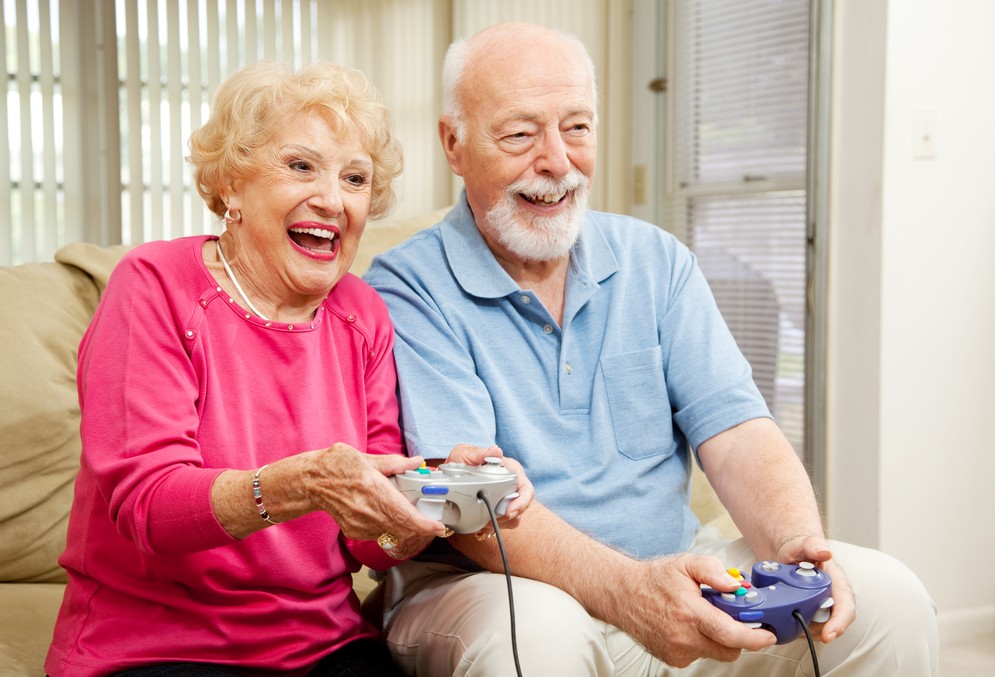
Video Games Tested as Stroke Rehab Alternative 

Published on Jun 18, 2013

A new study in Canada will look at the effects of playing physically interactive video games, like the Nintendo Wii, on people who have suffered a stroke and are in the process of recovery.

A new study in Canada will look at the effects of playing physically interactive video games like the Nintendo Wii on people who have suffered a stroke and are in the process of recovery. 140 stroke patients are expected to participate in the study that will compare the effects of playing video games with other game activities like playing cards or dominoes.

Previous research has shown that video games might be a promising rehabilitation treatment for stroke patients. Dr. Sean Dukelow, stroke specialist with the University of Calgary's Hotchkiss Brain Institute said: "I'm betting on the virtual reality... Certainly, what we've seen is viable. It enhances the recovery of the brain... We are actually re-wiring areas of the brain that died from a stroke."

Another project called Limbs Alive creates video games and controllers specifically designed as physical therapy for stroke patients. Limbs Alive has worked with researchers from Newcastle University to design games that provide a stimulating and challenging way to make rehabilitation more fun.

Standard YouTube License @ GeoBeats News 


Saturday Comics


For Better and For Worse
Lynn Johnston - 2008-08-28

"Iris?? Tell me the truth..."
Dilbert
Scott Adams - 2013-11-04

"Some jerk steals my cables and replaces them..."

Garfield
Jim Davis - 2013/11/05

"Modern technology is a wondrous thing!"

Betty
Delainey & Rasmussen - 2013/11/07

"The brain is like a muscle..."


*For Better and For Worse" is a serious topic of stroke but with a very nice cartoons. It is all about Grandpa Jim had a stroke and 88 further cartoon "strips" that happened to Grandpa Jim. See as well 
 the cartoonist Lynn Johnston.
** I tried to get low or free price at the people http://www.UniversalUclick.com/ for the images for the cartoons. It was too high for Stroke Survivors Tattler i.e. we are not a regular newspaper and our budget is very low. Fortunately, you will have to do only 1-click more to see the cartoon image, it is legit and it is free using GoComics.com and Dilbert.com.
*** Changed from "Pickles" to "Betty" -- "Betty" is a excellent cartoon and Gary Delainey & Gerry Rasmussen are authors/artists/cartoon-strips and they live in Edmonton.

Eclectic Stuff

Definition: Eclectic(noun) a person who derives ideas, style, or taste from a broad and diverse range of sources.


Video Games + Tennis Balls + Anger = Recovery

Peter G. Levine
Stronger After Stroke Blog
Friday, May 4, 2012

Recovery Badass
A great article in the British newspaper The Telegraph. The article is by a stroke survivor who recovered well after an ischemic (block) stroke. He's hit on some very core ideas. Here are the most important points (comments in red are mine):

  • "...nobody in the hospital was going to tell me how to get better ..."
  • "I had to get out of hospital and cure myself."
  • "...found that major strides had been made in America in treating stroke victims." (USA! USA! USA!)

Sunday Stroke Survivor ~ Video Games?

Jo Murphey
The Murphey Saga
Sunday, November 3, 2013

A new research study out of Canada is using video games for stroke rehab. I thought "Wow, that will be a challenge!" My second thought was, "How could I do it one handed?" My third thought was, "Doh! You old timer you."

The reasons my thought processes worked like this is I've long been a supporter of making rehab fun no matter what your age is. If something is fun then you are more apt to do it. In fact I've mentioned the computer/internet games that I "play" to rebuild my cognitive deficits. Those are easy with a click of the mouse, but video games?

Video Games Prove Best Therapy for Stroke Rehabilitation

Dean Reinke
Deans' Stroke Musing
Saturday, July 6, 2013

Is your doctor, therapist and clinic going to accept this research? Or are you going to be stuck with boring repetitive exercises? Unless YOU tell your clinic you want this stuff it will take years to trickle down your leg. http://israel21c.org/news/video-games-prove-best-therapy-for-stroke-rehabilitation/

Stroke victims play video games as an alternative
to traditional therapy because they’re more fun.
Photo via Shutterstock


New research from a Tel Aviv University study shows that people recovering from a stroke are more physically active during rehabilitation sessions when they play video games than those who rely on traditional motor therapy.

Occupational therapist Dr. Debbie Rand of Tel Aviv University’s Stanley Steyer School of Health Professions at the Sackler Faculty of Medicine, says her research shows that stroke victims who play video games in therapy make more movements overall than those in traditional motor therapy. In her study, players performed double the number of arm movements during each session compared to patients in traditional therapy, and all of their movements were purposeful or “goal-directed” and not just repetitive exercises.

Playing Games in Stroke Recovery?

Jeff Porter
Stroke of Faith
Friday, November 30, 2012

More potential tools for home recovery for stroke survivors. A Patient-Centered Outcomes Research Institute grant funds Ohio State researchers using Kinect for at-home stroke rehabilitation:
Lynne Gauthier, an assistant professor of physical medicine and rehabilitation, is leading the team creating a video game for the Microsoft Kinect that the team hopes could expand access to a specific kind of rehabilitation called constraint-induced movement therapy. The game would allow patients with mild-to-moderate upper-limb impairment to perform guided CI therapy in their homes. 
The game uses Microsoft Kinect’s motion capture technology to guide patients through a series of therapeutic exercises set in a river adventure theme, Gauthier said. Patients would visit a clinic for initial consultation and the game would act as a consultant to guide them through exercises at home. Patients would also be given a restraint mitt to encourage them to use their affected side more often in daily activities. 
“A lot of these kinds of rehab games are basically about just getting the person to move a lot,” she said. “But we’re trying to make it so that the game would stimulate what the therapist would do. Just as a therapist would make a task harder when the person improves, the game would do the same thing.”

See the original article:
in

Wiihab Revolution

Pamela Hsieh
Rehab Revolution
15 June 2010

I originally wanted to post about the yogic principle of mudita today, but since things often don't go as planned (at least in my reality), I thought I should speak a bit about something that came up today: an alternative, and usually a supplement, to the daily workout: the (in?)famous Wii. I'm beefing it up today with plenty of info, feedback, and suggestions, so get out your reading glasses and preferably your excitement.

Now, surely you have heard of the Wii. Revolutionary both to video games and rehabilitation, Wii's innovative adaptations to the gaming world has swept the world over, if not only out of curiosity.

But it doesn't come without its complaints. Gamers used to the solitary quality of previous and alternative consoles, like the Xbox360, often prefer the old-school solitude in single-user games (i.e., the stereotypical blow-everyone's-head-off war games like Call of Duty) or in any case, traditional multiplayer blow-everyone's-head-off games (Halo).

Wiihabilitation

Amy Shissler
My Cerebellar Stroke Recovery
Jul 24, 2012

When I was in the hospital, I used a Wii in occupational therapy.  You know the Wii, the video game?  I did bowling.  At the time, I was absolutely hating everything and everyone and didn’t appreciate the fact that I was playing a video game at all.  But now I do.  You can find almost any activity on a Wii.  It can be really helpful.  At first I could barely even hold the controller let alone play a game.  But I got better.  Now I can play the Wii normally.  Well I guess it’s not “normal” but it’s a ton better.  I like this article.  And this one.


See the original article:
in

How to Change Your Own Mind, Literally

Joyce Huffman
The Tales of a Stroke Patient
Sep 15, 2013

"You can't be too skinny or too rich," said my old college buddy back in the 60s. But now you know the truth. Skinniness sometimes is related to anorexia or bulimia. And you've heard stories about the deaths of lottery winners who blew their money on drugs or died from being poisoned. My friend got it wrong. She should have said, "You can't be too brainy."

The brain controls everything, like our emotional outbursts to pain, our nervous eating, our ability to pee regularly, our resistance to confront people, our neurotic tastes. But what was thought prior to the 1970s--that the brain was fixed and couldn't be changed after early childhood--was wrong. The brain can process new experiences, like having a stroke, by creating neural pathways to accommodate them. Welcome to neuroplasticity, the game changer.

There are four key truths about neuroplasticity: