Showing posts with label ▷ 2014 Sep 27. Show all posts

Saturday, September 27, 2014

Saturday News


Contents of This Week:

Definition: Running after Stroke

Running From Wikipedia, the free encyclopedia


See as well: Gait From Wikipedia, the free encyclopedia


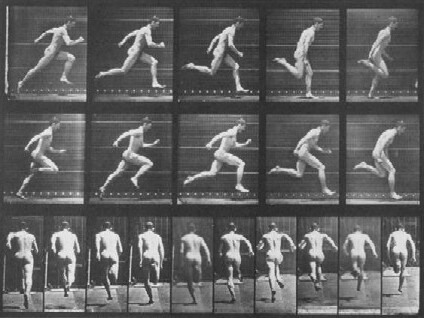
Eadweard Muybridge photo sequence
Running is a means of terrestrial locomotion allowing humans and other animals to move rapidly on foot. It is simply defined in athletics terms as a gait in which at regular points during the running cycle both feet are off the ground. This is in contrast to walking, where one foot is always in contact with the ground, the legs are kept mostly straight and the center of gravity vaults over the stance leg or legs in an inverted pendulum fashion. A characteristic feature of a running body from the viewpoint of spring-mass mechanics is that changes in kinetic and potential energy within a stride occur simultaneously, with energy storage accomplished by springy tendons and passive muscle elasticity. The term running can refer to any of a variety of speeds ranging from jogging to sprinting.

It is assumed that the ancestors of mankind developed the ability to run for long distances about 2.6 million years ago, probably in order to hunt animals. Competitive running grew out of religious festivals in various areas. Records of competitive racing date back to the Tailteann Games in Ireland in 1829 BCE, while the first recorded Olympic Games took place in 776 BCE. Running has been described as the world's most accessible sport.

History


Video: Running after Stroke

SSTattler:
It took me more than a year for Gait Rehabilitation (thanks from Avi - NeuroGym®) - I can now run, slowly, after my stroke. If you have a good physiotherapy ask them to train you to run and maybe you can do it as well...

Stroke Survivor Runs Ultra Marathon Kep 75km

Published on Jun 4, 2013

I survived a massive right hemisphere stroke 9 years ago aged 32. I was told I may never walk again and would definitely never run. I battled through years of recovery forcing my brain to relearn what Stroke had taken away, I still have some disabilities but I'm alive. I entered my first Ultra marathon in 2011 and this Ultra marathon Kep 75km was my toughest and longest Ultra so far. I am by no means a talented runner, I just enjoy a challenge. Stroke recovery is very hard but you have to fight for it and never give up........keep fighting.....

https://www.facebook.com/RunningFromStroke

Standard YouTube License @ Running From STROKE 


Daily Comics


For Better and For Worse
Lynn Johnston

Canada Family Events
Dilbert
Scott Adams

Dilbert Office Events

Edmonton Journal
Malcolm Mayes
Politics Views from Canada

Doonesbury
Garry Trudeau

Politics Views from USA


** I tried to get low or free price at the people http://www.UniversalUclick.com/ for the images for the cartoons. It was too high for Stroke Survivors Tattler i.e. we are not a regular newspaper and our budget is very, very low. Fortunately, you will have to do only 1-click more to see the cartoon image, it is legit and it is free using GoComics.com, Dilbert.com and EdmontonJournal.com.

Eclectic Stuff

Definition: Eclectic(noun) a person who derives ideas, style, or taste from a broad and diverse range of sources.

Sunday Stroke Survival ~ Running After a Stroke

Jo Murphey
The Murphey Saga
Sunday, September 21, 2014

Confession time: I haven't ran in decades at least in the physical sense. Not since I had rods put in my back, a hip replacement, and knee replacement done. Is it any wonder?

After all those surgeries plus an Achilles tendon ankle repair, I did a rapid walk rather than running. Since my strokes I've graduated from snail speed to tortoise speed in two years. I'm doing grand.

People holding doors for me or needing me for something always tell me to take my time or in a parking lot with cars stopping for me. I respond back one of several comebacks...
  • "This is as fast as I can go."
  • " I'm at top speed."
  • " Whoosh! Did you feel the wind as I passed ya?"
  • "Patience is a virtue. Learn some." (When they roll their eyes or beep their horn)
  •  "I've givin' her all she's got, Captain!" (In my best Mr. Scott impression from Star Trek)

Marathon ad Nauseum

Barb Polan
Barb's Recovery
18th April 2013

Of course all of us have dwelled on the bombing at the Boston Marathon and have searched out far too much information, cried about stories of loss and of humanity. To stroke survivors, a marathon is different from other goals: other goals are within shot, but running again is/will be beyond what determination and hard work can do for someone with significant brain damage and a paralyzed half-a-body. I once asked one of my PTs if she had ever known of a stroke survivor who had been able to run after. "Of course - Tedy Bruschi." A couple of years later, I was on a treadmill and brought up the topic, including the previous PT's answer; my new PT snorted. Don't misinterpret me - I admire Bruschi about as much as any other player, and I did even before I had a stroke. I had read his book, "Never Give Up ..." long before I had a stroke. I would like to read it again to glean whatever more I can. One thing I do remember is a photo of Tedy and his wife, Heidi, leaving the hospital after the stroke; in it, Tedy has a hand resting gently on Heidi's forearm as he walks out the door. Now, obviously, I can't win a competition with him, but by contrast, I went home in a wheelchair - a chair I was expected to use to get around. I had been taught how to take a wheelchair "out into the community" and how to board a wheelchair van. I had an AFO and cane,and could walk, though, so that's what I did. Tedy and I clearly had very different strokes, which is what had made my PT snort at the other PT's answer. Before I took up rowing, I used to run - a couple-three miles every day. Three was my limit, I was convinced. Occasionally, though, I imagined running the marathon. In addition to the physical challenge, the time that would have to be spent training was daunting. Both reasons made it out of the question. Plus there was my three-mile plateau that I had not been able to overcome. The other night, I had a dream in which I ran. It was a day or so after the marathon. In the dream I was walking on a sidewalk with two faceless female friends. We walked faster and faster until I and one other were running. In the dream, I was not watching myself, but in my body, taking each stride, and feeling my feet hit the sidewalk evenly, arms pumping. It felt glorious, and I decided that I will be able to run again eventually. Not a marathon, but I would be grateful for 50 yards, I decided in the dream. Seriously?


See the original article:
in

Running

Amy Shissler
My Cerebellar Stroke Recovery
Apr 27, 2013

I can’t run.  I walk pretty well but when I speed up and try to break into a run my brain is like “uhh no you’re not doing that, sorry.”  This sucks because I used to like to go on long runs before the stroke.  Now it’s long walks.  That’s a good thing though because I couldn’t take my dog with me on my runs.  I can certainly take my strokey dog on my strokey walks.  When I try to run it looks pretty f’in funny.  It makes me crack up.  Although I laugh at myself all the time so that’s not saying much.  I wonder if I’ll ever be able to run again.


See the original article:
in

Promoting Health:
         Interval vs Steady Running vs Strength Training

Bill (William) Yates, M.D.
Brain Post
23rd September 2010

The optimum physical exercise regimen for promoting health is a key public health issue.  Aerobic exercise can be obtained via running either using a steady pace or an interval-based approach.  Interval approaches typically includes high intensity exercise over shorter bursts of time.  Additionally, strength training provides a variety of health benefits and it’s role compared to aerobic exercise is unclear.

A Danish study was designed and recently published to compare the health benefits of interval training, prolonged steady paced running and strength training.  The key elements of the three interventions were:
  • Interval training: 5 minute warm-up followed by 5 two minute intervals at near-maximal running with heart rate above 95% maximum (3 times per week)—total exercise time over 12 weeks approximately 480 minutes
  • Steady running: one hour of continuous running three times per at 80% of maximum heart rate—total exercise time over 12 weeks 1800 minutes
  • Strength training: progressive heavy-resistance strength training primarily in lower extremities for one hour twice a week—total exercise time over twelve weeks 1500 minutes

The Day Before My Self-Elected, Drop Foot Surgery

Joyce Hoffman
The Tales of a Patient
Jul 13, 2014

My grandmother, on my father's side, was born in Russia, circa 1884. She escaped to Paris for 6 months to avoid the Russian pogroms, primarily aimed against the Jews, in the late 1800s. And then, when she found a ship going anywhere but Russia, she settled in Canada. If you asked my grandmother about her nationality, given that there were a few choices, she always said that she was French because she learned the language or, at least, enough to get by.

Sarah Bernhardt
While in Paris, my grandmother saw Sarah Bernhardt, known as "The Divine Sarah" for her flamboyant roles, on the Parisian stage a few times when Grandmom was very young. That's where my father got the idea, from his mother, that as a teenager, I was the dramatic Sarah Bernhardt, as he addressed me, complete with exaggerated expressions, dramatic entrances and exits, and sullen moods. As nicknames went, it wasn't so bad.

Anyway, I outgrew the extreme behavior patterns at twenty, right on schedule, not being a teenager any longer, and my life went on. I had a stroke in 2009, and the Sarah Bernhardt-isms returned, less dramatic but still there, like this picture I posted in Facebook about my operation tomorrow.

Everybody said I was brave and/or out of my mind to have an operation that would correct my drop foot. And that got me thinking: I was brave, but was I out of my mind?

I used to be a runner, and like most runners everywhere, I dreamed of running the Marathon. The drop foot surgery, if successful, would allow me to rotate the foot and ankle, where now, my foot always hangs there, like it's lost the fight. It might take me a year or more and a tad of money for a trainer, but the Marathon is on my bucket list, and so are square and round dancing and taking lengthy strolls. So "out of my mind"? I don't think so.

I’m in Training

Robin
Rocky Mountain Stroke Survivor
May 10, 2013

I realized last week that if I had taken the same amount of effort I’m putting into my therapies now and applied it to a training program before the strokes, I would have been able to complete a triathlon.

I’ve decided that if I continue to put in the same level of effort long term, I will eventually be transitioning from walking in the water, trying to speed up to something resembling a run, and riding a stationery bike for a few minutes…to actually doing the real activities (swimming, running, biking)…to working on increasing speed and endurance on those activities.  There are training plans to get you “Couch to 5K” in a certain number of weeks.  Well, if you work on this for years, shouldn’t you be able to get “From Stroke to Sprint“?

Even if I don’t ever complete a triathlon (which I think would be really exciting to actually do), I do know that I have as rigorous a training schedule as if I was actually planning on a sprint this summer.  Maybe someday I’ll actually complete a race… I’m going to work hard enough now to maximize my chances of doing it someday… but even if I don’t, I know that stroke recovery is an intense training program!


See the original article:
in

Walking - Yes, It Can Lower Stroke Risk

Jeff Porter
Stroke of Faith
Thursday, February 27, 2014

Photo from U.S. Centers for Disease Control and Prevention


As you might know, I'm a believer in exercise.

Here's the latest research that shows moderate exercise cuts stroke risk as much as strenuous activity:
The women who reported engaging in moderate physical activity in the 3 years before enrollment in the study were 20% less likely to suffer a stroke, compared with women who reported no activity. 
Prof. Wang says she was surprised that the link to reduced stroke risk was strongest with moderate physical activity. 
"More strenuous activity such as running didn't further reduce women's stroke risk," she adds. "Moderate activity, such as brisk walking appeared to be ideal in this scenario."


See the original article:
in

Running Post-Stroke

Dean Reinke
Deans’ Stroke Musing
Wednesday, June 4, 2014

This is one of my long term goals. I know it's possible because others have done it already. Your PT should know all about these and have protocols to give to accomplish that goal. But since your PT won't have a protocol you'll have to cobble something together on your own.

My seven guides and instructors are:
  1. Tommye K. Meyer, author of Teaching Me to Run. I had to buy this book because library use is not long enough.
  2. Ida Dempsey,  Writer of  blog - Dream Run.
  3. Krissy, writer of blog - Not Fast Just Fabulous.
  4. Robert B Martinez - Stroke Survivor/Marathon Runner.
  5. John Murphy - STROKE: John Murphy's Story.
  6. Nelson Graves - After a Stroke, Running a Half-Marathon.
  7. There was a guy in a stroke survivor group in Minneapolis who told me about starting running again, 50 yards to begin with.
Wait, wait, there is an APTA report:
See here for Action observation of walking/running.


See the original article:
in

‘To See the World’ or ‘For the World to See You?’

Kate Allatt
Stroke Recovery Tips
July 23, 2014

…. a great quote I read on Twitter recently, don’t you agree?

Truthfully, I was so proud of what I personally did to recover, against all the medical odds in hospital and beyond, for a few months back in 2011/12 that for a while I unhealthily ‘believed my own Kate Allatt press’.

However, I have to say that still during that period I very much harnessed that global media attention to voluntarily (and very cheaply) build my international & credible internet-based stroke charity – Fighting Strokes.

All my back-to-back press interviews,TV & Radio appearances surrounding the launch of my 1st book - Running Free - made it possible to launch my global charity ‘all-in’ for less than £480!

So was that all bad?

I am absolutely passionate about stroke recovery and locked in syndrome, (to the point my own loved-ones have never understood it, though increasingly they seem to now.)

Worldwide there has been so much positive progress for others touched by Fighting Strokes, since January 2011.

Exercise. Energy. Recovery.

Peter G. Levine
Stronger After Stroke
Sunday, February 24, 2013

There are good reasons for muscle strengthening after stroke, of course. But therapists know these reasons well. For instance, the muscles on the affected side, even the ones that are the most spastic and seem overwhelmingly strong, are usually no more than half as strong as the unaffected side. Because spasticity is such an issue after stroke, some clinicians believe that strengthening "tight" spastic muscles will exacerbate spasticity. Research has shown that this is untrue; exercising muscles does not increase spasticity. It is important to focus on the muscles that are the weakest, of course. For instance, most stroke survivors have no problem at all bending their elbow, but extending their elbow is often very difficult, especially at the end of the range of motion. In this case it would be wise to work the triceps because it is the weaker of the two muscle groups.

The other form of exercise that therapists focus on is cardiovascular. Unfortunately stroke survivors get a double whammy: They are in half as good cardiovascular shape as age-matched couch potatoes, but everything they do takes twice as much energy. A good example is walking. Before stroke, walking takes very little energy. Most of the energy is expended in small bursts of muscle power, perfectly timed to use momentum forces and gravitational pull. After stroke, gait loses its subtlety and coordination. The gait that is typically left in the wake of stroke uses twice as much energy as prior to the stroke.

So cardio and muscular strengthening are important, but viewed as more of a "pre-process" than the process itself. In fact, many of the leading-edge treatment options (i.e., repetitive practice, CIT, forced use) are considered "intensive." They require that the survivor "hits the ground running" and be able to withstand the rigors of the intensity right from the get-go. In this regard there is a necessity for the survivor to be in pretty good cardiovascular and muscular shape prior to the initiation of treatment. Once the survivor has the stamina, the focus comes off the body and shifts to the brain.


See the original article:
in

[Guest Article] Rerun

Pamela Hsieh
Rehab Revolution
03 November 2011

I met Michael Leitson through this blog, as he’s another young stroke survivor who sustained his injury at age nineteen. He’s been gracious enough to share his story about learning how to run again — something I still haven’t done yet (but will — it’s really from lack of trying). I am excited to offer a new perspective from another survivor to inspire the rest of us!

To our healing,


Running, like walking, is a luxury that many of us take for granted. Admittedly, even I paid little thought to the ability to run prior to a couple years ago. Obviously, I cannot remember the first time I learned to walk, likely around the age of eighteen months, wanting to show off to my parents. I can imagine the joy that parents feel when their toddler starts to walk. I hope I can experience that joy someday. However, little did I know that I would re-experience the joy of my parents seeing me learn to walk again.

From playing T-ball in pre-school, to playing a couple of seasons of soccer, and just plain old running around with the neighborhood kids, I was an active child, a true kid at heart. When I watch home videos of those days, I feel nostalgic and happy for my childhood.

But as the middle school years approached, I stopped running around. These days were filled with video games, Yu-gi-oh, and schoolwork. Needless to say, I became a bit chubby during this time. But I did participate in the neighborhood swim team each summer, as I liked swimming and became decent at the sport.

May El-Khalil: Making Peace is a Marathon

Published on Aug 16, 2013

In Lebanon there is one gunshot a year that isn't part of a scene of routine violence: The opening sound of the Beirut International Marathon. In a moving talk, marathon founder May El-Khalil explains why she believed a 26.2-mile running event could bring together a country divided for decades by politics and religion, even if for one day a year.


Standard YouTube License @ TED

A Little About Susan

September 21, 2014

SSTattler look at as well: SSTattler Extra ... ▶ Stroke Class with Susan.

Susan Ehler is a Physiotherapist with over 25 years experience working with individuals with neurological disorders with a special interest in stroke survivors. Recognizing the need for ongoing access to rehab services once individuals were discharged from hospitals and rehab centres, Susan started a community-based exercise program over 20 years ago.

This program has grown over the years and has been able to meet the needs of many different levels of stroke survivors. One of the main goals of the program has been to strive to increase class accessibility to as many people as possible.

“Research shows that exercise is an important part of stroke recovery, so StrokeClass.com is merely a tool to help as many people as possible live a full life after a stroke”

– Susan Ehler


If you have any questions feel free to send an email to susan@strokeclass.com

Attn: Susan Ehler, PT
10 Carnaby Cresent
Dartmouth, Nova Scotia
B2V 2R4

Copyright © 2014 · StrokeClass.com · All Rights Reserved


See the original article:
in

Twenty Years & Still Going Strong

Diane
The Pink House On The Corner
September 19, 2014

Tuesday was our 20th wedding anniversary, and I asked Bob what he wanted to do to celebrate. Last year, we skipped our anniversary as he was still recovering from his second foot surgery. The year before I took him to the Dali Museum. It's always hard to think of something to do for a celebration, as Bob can't eat (feeding tube) or dance! So the usual celebration stuff is just not possible.  Anyway...

This year, we have The Bobmobile and can go anywhere! Anytime! Which is really liberating, to say the least.

So Bob decided he wanted to go antiquing. Of course, he didn't actually say "antiquing", he said "shopping!" and I said, "shopping for what?" and he said, "you know!" and you know, I figured it out.

Bob at the Antique Mall
Antiquing was something we used to do frequently and haven't done since the stroke. Mostly we haven't done this as it's hard to schedule a shopping trip with the transport service, I mean, you had to give them exact times for pickup and how does one really know how long you'll spend at an antique store? Then, we used to "shop hop", you know hit a bunch of shops in an afternoon, which is impossible to do with the transport. Also, so many antique shops/malls are just not wheelchair accessible, with stairs and small spaces...

But I called around and found an antique mall that opened up in 2011 (after Bob's stroke) and they told me on the phone that they were wheelchair accessible.

Lost Your Car Keys Lately?

Jackie Poff
Stroke Survivors Tattler
After a meeting several days ago, I couldn't find my keys.  I quickly gave myself a personal Pat Down.

They weren't in my pockets.  Suddenly I realized I must have left them in the car. Frantically, I headed for the parking lot. My husband has scolded me many times for leaving my keys in the car's ignition.

He's afraid that the car could be stolen. As I looked around the parking lot, I realized he was right.

The parking lot was empty. I immediately called the police. I gave them my location, confessed that I had left my keys in the car, and that it had been stolen.

Then I made the most difficult call of all to my husband: "I left my keys in the car and it's been stolen."

There was a moment of silence. I thought the call had been disconnected, but then I heard his voice. "Are you kidding me?" he barked, "I dropped you off!"

Now it was my turn to be silent. Embarrassed, I said, "Well, come and get me."

He retorted, "I will, as soon as I convince this cop that I didn't steal your damn car!"

Welcome to the golden years...