Showing posts with label ▷ 2013 Mar 23. Show all posts

Saturday, March 23, 2013

Tai Chi & Qigong


SSTattler: 1) Tai Chi and Qigong are very close specially about health and for stroke survivors this is the most important aspect. Martial applications as well important but we will not discuss in this article. We will discuss (partly) Tai Chi but we will ask you to read it for Qigong if you want to.
2) The last 2 videos by Dr. Lam is 10 minutes & 45 minutes long but it is worth it.

T'ai Chi Ch'uan From Wikipedia, the free encyclopedia.
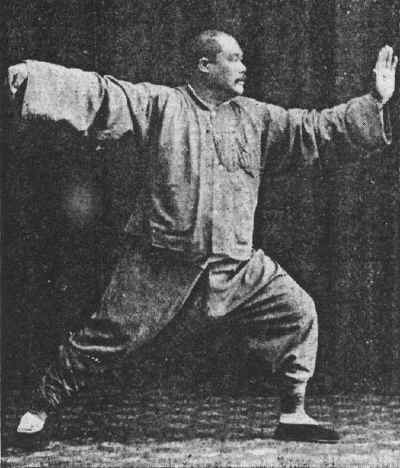

Yang Chengfu in a posture from the Yang-style
t'ai chi ch'uan solo form  known as Single Whip c.1931
T'ai chi ch'uan or Taijiquan, often shortened to t'ai chi, taiji or tai chi in English usage, is an internal Chinese martial art practiced for both its defense training and its health benefits. It is also typically practiced for a variety of other personal reasons: its hard and soft martial art technique, demonstration competitions, and longevity. As a result, a multitude of training forms exist, both traditional and modern, which correspond to those aims. Some of t'ai chi ch'uan's training forms are especially known for being practiced at what most people categorize as slow movement.

Today, t'ai chi ch'uan has spread worldwide. Most modern styles of t'ai chi ch'uan trace their development to at least one of the five traditional schools: Chen, Yang, Wu (Hao), Wu, and Sun.

Overview

The term "t'ai chi ch'uan" translates as "supreme ultimate fist", "boundless fist", or "great extremes boxing". The chi in this instance is the Wade-Giles transliteration of the Pinyin jí, and is distinct from qì (ch'i, "life energy"). The concept of the taiji ("supreme ultimate"), in contrast with wuji ("without ultimate"), appears in both Taoist and Confucian Chinese philosophy, where it represents the fusion or mother of Yin and Yang into a single ultimate, represented by the taijitu symbol. T'ai chi ch'uan theory and practice evolved in agreement with many Chinese philosophical principles, including those of Taoism and Confucianism.

T'ai chi ch'uan training involves five elements, taolu (solo hand and weapons routines/forms), neigong & qigong (breathing, movement and awareness exercises and meditation), tuishou (response drills) and sanshou (self defence techniques). While t'ai chi ch'uan is typified by some for its slow movements, many t'ai chi styles (including the three most popular - Yang, Wu, and Chen) - have secondary forms of a faster pace. Some traditional schools of t'ai chi teach partner exercises known as tuishou ("pushing hands"), and martial applications of the taolu's (forms') postures.
.....

Since the first widespread promotion of t'ai chi ch'uan's health benefits by Yang Shaohou, Yang Chengfu, Wu Chien-ch'uan, and Sun Lutang in the early 20th century, it has developed a worldwide following among people with little or no interest in martial training, for its benefit to health and health maintenance. Medical studies of t'ai chi support its effectiveness as an alternative exercise and a form of martial arts therapy.

It is purported that focusing the mind solely on the movements of the form helps to bring about a state of mental calm and clarity. Besides general health benefits and stress management attributed to t'ai chi ch'uan training, aspects of traditional Chinese medicine are taught to advanced t'ai chi ch'uan students in some traditional schools.

Some other forms of martial arts require students to wear a uniform during practice. In general, t'ai chi ch'uan schools do not require a uniform, but both traditional and modern teachers often advocate loose, comfortable clothing and flat-soled shoes.

The physical techniques of t'ai chi ch'uan are described in the "Tai chi classics", a set of writings by traditional masters, as being characterized by the use of leverage through the joints based on coordination and relaxation, rather than muscular tension, in order to neutralize, yield, or initiate attacks. The slow, repetitive work involved in the process of learning how that leverage is generated gently and measurably increases, opens the internal circulation (breath, body heat, blood, lymph, peristalsis, etc.).

The study of t'ai chi ch'uan primarily involves three aspects:
  • Health: An unhealthy or otherwise uncomfortable person may find it difficult to meditate to a state of calmness or to use t'ai chi ch'uan as a martial art. T'ai chi ch'uan's health training, therefore, concentrates on relieving the physical effects of stress on the body and mind. For those focused on t'ai chi ch'uan's martial application, good physical fitness is an important step towards effective self-defense.
  • Meditation: The focus and calmness cultivated by the meditative aspect of t'ai chi ch'uan is seen as necessary in maintaining optimum health (in the sense of relieving stress and maintaining homeostasis) and in application of the form as a soft style martial art.
  • Martial art: The ability to use t'ai chi ch'uan as a form of self-defense in combat is the test of a student's understanding of the art. T'ai chi ch'uan is the study of appropriate change in response to outside forces, the study of yielding and "sticking" to an incoming attack rather than attempting to meet it with opposing force. The use of t'ai chi ch'uan as a martial art is quite challenging and requires a great deal of training.
......

Modern T'ai Chi Ch'uan


Outdoor practice in Beijing's Temple of Heaven.
T'ai chi ch'uan classes with purely a health emphasis have become popular in hospitals, clinics, and community and senior centers in the last twenty years or so, as baby boomers age and the art's reputation as a low-stress training for seniors became better known.

As a result of this popularity, there has been some divergence between those that say they practice t'ai chi ch'uan primarily for self-defense, those that practice it for its aesthetic appeal (see wushu below), and those that are more interested in its benefits to physical and mental health. The wushu aspect is primarily for show; the forms taught for those purposes are designed to earn points in competition and are mostly unconcerned with either health maintenance or martial ability. More traditional stylists believe the two aspects of health and martial arts are equally necessary: the yin and yang of t'ai chi ch'uan. The t'ai chi ch'uan "family" schools, therefore, still present their teachings in a martial art context, whatever the intention of their students in studying the art.

Qigong vs T'ai Chi Ch'uan

Qigong involves coordinated breathing, movement, and awareness used for exercise, healing, and meditation. While many scholars and practitioners consider t'ai chi ch'uan to be a type of qigong, the two are commonly distinguished as separate but closely related practices, with qigong playing an important role in training for t'ai chi ch'uan, and with many ta'i chi ch'uan movements performed as part of qigong practice. The focus of qigong is typically more on healing or meditation than martial applications.

Health Benefits

Before t'ai chi ch'uan's introduction to Western students, the health benefits of t'ai chi ch'uan were largely explained through the lens of traditional Chinese medicine, which is based on a view of the body and healing mechanisms not always studied or supported by modern science. Today, t'ai chi ch'uan is in the process of being subjected to rigorous scientific studies in the West. Now that the majority of health studies have displayed a tangible benefit in some areas to the practice of t'ai chi ch'uan, health professionals have called for more in-depth studies to determine mitigating factors such as the most beneficial style, suggested duration of practice to show the best results, and whether t'ai chi ch'uan is as effective as other forms of exercise.

Chronic Conditions


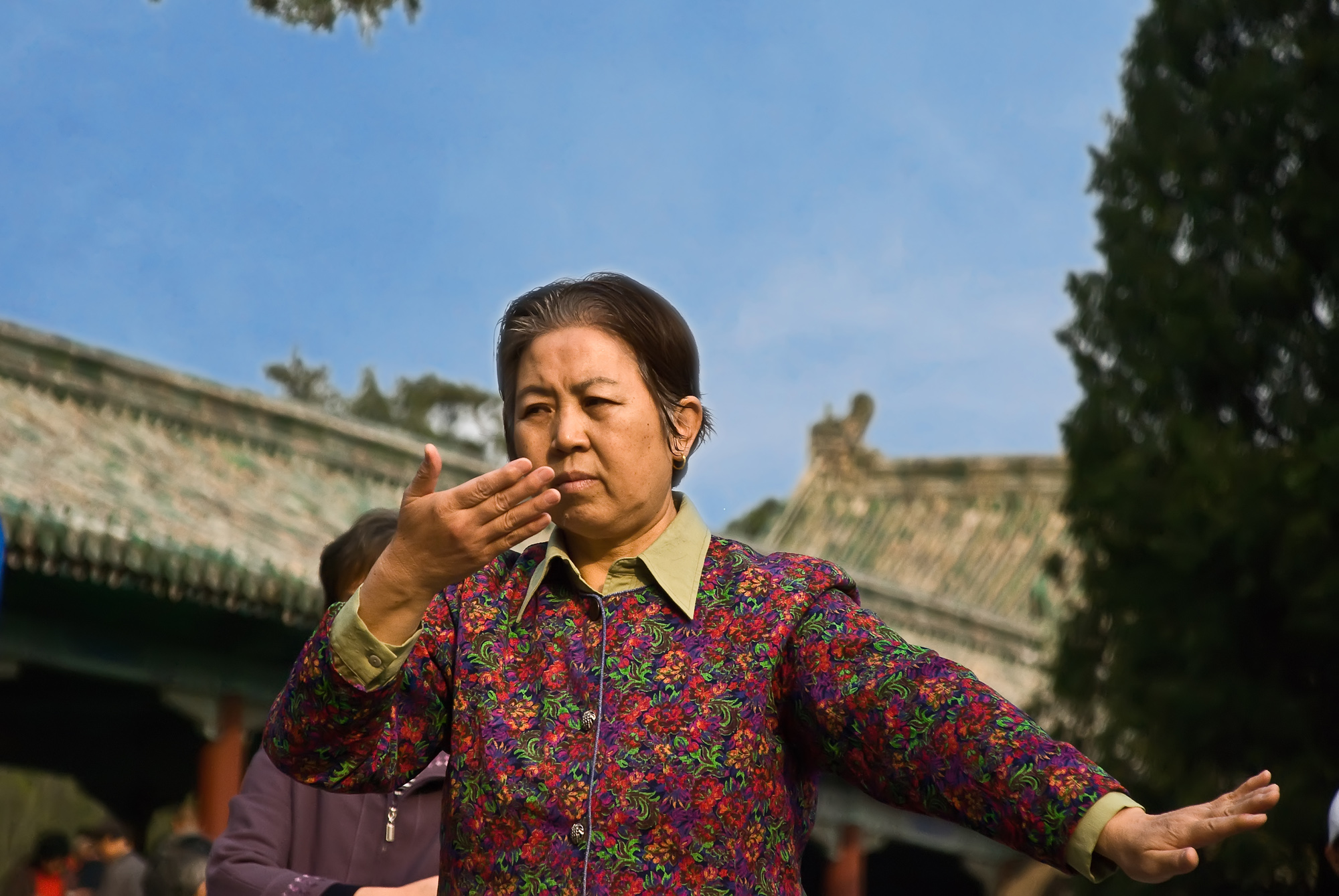
A Chinese woman performs
Yang-style t'ai chi ch'uan
Researchers have found that intensive t'ai chi ch'uan practice shows some favourable effects on the promotion of balance control, flexibility, cardiovascular fitness, and has shown to reduce the risk of falls in both healthy elderly patients, and those recovering from chronic stroke, heart failure, high blood pressure, heart attacks, multiple sclerosis, Parkinson's, Alzheimer's and fibromyalgia. T'ai chi ch'uan's gentle, low impact movements burn more calories than surfing and nearly as many as downhill skiing.

T'ai chi ch'uan, along with yoga, has reduced levels of LDLs 20–26 milligrams when practiced for 12–14 weeks. A thorough review of most of these studies showed limitations or biases that made it difficult to draw firm conclusions on the benefits of t'ai chi ch'uan. A later study led by the same researchers conducting the review, found that t'ai chi ch'uan (compared to regular stretching) showed the ability to greatly reduce pain and improve overall physical and mental health in people over 60 with severe osteoarthritis of the knee. In addition, a pilot study, which has not been published in a peer-reviewed medical journal, has found preliminary evidence that t'ai chi ch'uan and related qigong may reduce the severity of diabetes. In a randomized trial of 66 patients with fibromyalgia, the t'ai chi intervention group did significantly better in terms of pain, fatigue, sleeplessness and depression than a comparable group given stretching exercises and wellness education.

A recent study evaluated the effects of two types of behavioral intervention, t'ai chi ch'uan and health education, on healthy adults, who, after 16 weeks of the intervention, were vaccinated with VARIVAX, a live attenuated Oka/Merck Varicella zoster virus vaccine. The t'ai chi ch'uan group showed higher and more significant levels of cell-mediated immunity to varicella zoster virus than the control group that received only health education. It appears that t'ai chi ch'uan augments resting levels of varicella zoster virus-specific cell-mediated immunity and boosts the efficacy of the varicella vaccine. T'ai chi ch'uan alone does not lessen the effects or probability of a shingles attack, but it does improve the effects of the varicella zoster virus vaccine.

Stress and Mental Health

A systematic review and meta-analysis, funded in part by the U.S. government, of the current (as of 2010) studies on the effects of practicing t'ai chi ch'uan found that,
"Twenty-one of 33 randomized and nonrandomized trials reported that 1 hour to 1 year of regular t'ai chi significantly increased psychological well-being including reduction of stress, anxiety, and depression, and enhanced mood in community-dwelling healthy participants and in patients with chronic conditions. Seven observational studies with relatively large sample sizes reinforced the beneficial association between t'ai chi practice and psychological health."
There have also been indications that t'ai chi ch'uan might have some effect on noradrenaline and cortisol production with an effect on mood and heart rate. However, the effect may be no different than those derived from other types of physical exercise. In one study, t'ai chi ch'uan has also been shown to reduce the symptoms of Attention Deficit and Hyperactivity Disorder (ADHD) in 13 adolescents. The improvement in symptoms seem to persist after the t'ai chi ch'uan sessions were terminated.

In June, 2007 the United States National Center for Complementary and Alternative Medicine published an independent, peer-reviewed, meta-analysis of the state of meditation research, conducted by researchers at the University of Alberta Evidence-based Practice Center. The report reviewed 813 studies (88 involving t'ai chi ch'uan) of five broad categories of meditation: mantra meditation, mindfulness meditation, yoga, t'ai chi ch'uan, and qigong. The report concluded that "the therapeutic effects of meditation practices cannot be established based on the current literature" due to the fact that "scientific research on meditation practices does not appear to have a common theoretical perspective and is characterized by poor methodological quality."

See the full article: 
     T'ai Chi Ch'uan From Wikipedia, the free encyclopedia.


Seated Tai Ji: Strengthening Mind & Body

Uploaded on Sep 4, 2009

Dr. Zibin Guo, a UCONN and Harvard trained medical anthropologist and highly regarded Tai Ji master, is developing and refining new specialized programs for people with limited mobility. These programs are already being applied with great success to many of the problems typically associated with physical rehabilitation, back and shoulder pain, stroke, heart attack, sedentary ailments, aging, diabetes, and arthritis.


Standard YouTube License @ Wadel Media


Brain Exercises -Tai Chi for Parkinson's, Stroke, MS

Uploaded on May 29, 2008

www.brain-workshop.com - Brain Exercise DVD, Brain Workshop™ Mind and Movement Exercises for Brain Health, shows how it is possible to change the structure and function of the brain, reverse age-related changes in the brain, to rehabilitate and regain lost function after stroke or brain injury. Integrate these ancient Tai Chi principles to maximize any exercise for improving brain health and brain function and to maximize mind-body connection. Two-volume set $34.95 at www.susanamatthews.com.


Standard YouTube License @ susanamatthews


What is Tai Chi, Really? George Xu Answers

Uploaded on Dec 31, 2008

In What is Tai Chi, Really? Master George Xu, with Susan Matthews assisting, discusses and demonstrates internal principles while performing selected Chen and Wu Style postures. They give the viewer a better idea of what to look for when practicing. Both Master Xu and Sifu Matthews demonstrate a section of the form, then discuss internal aspects. Master Xu demonstrates with Susan how power comes from utilizing internal principles of tai chi.

What is Tai Chi, Really? is for anyone wanting to learn internal principles of taijiquan. The information it contains can benefit beginner or advanced practitioners, whether you focus on health or fighting. Even non-internal martial arts practitioners can use the information to incorporate into their particular style of practice.

Filmed at Shanti School of Taijiquan in Durango, Colorado. 46-minutes. $19.95 www.susanamatthews.com/taichi-secrets.htm.


Standard YouTube License @ susanamatthews


Susan Matthews Introduction to Qigong Practice

Uploaded on Feb 23, 2008

Susan Matthews shares internal secrets for practicing Qigong. Detailed instruction on "Energy Gathering and Blood Circulation Qigong" DVD contains essential principles for cultivating qi, for training mind to move qi anywhere in the body for self healing, and for training the internal movement of energy. www.susanamatthews.com.


Standard YouTube License @ susanamatthews


New Creation Tai Chi - Qigong for All Abilities

Published on May 20, 2012

Clip from Anna York's New Creation Tai Chi-Qigong: For seniors, multiple sclerosis, Parkinson's, stroke, arthritis, diabetes and much more. Seated and standing. Full version: Seven 15-minute segments. Inspiring Seven Days of Creation narrative. For more information: http://www.annayork.com

Amazon.com
Doctors are recommending Tai Chi and Qigong classes for a variety of conditions and diseases, and research is proliferating on the benefits of these ancient Chinese arts for balance, coordination, respiration, relaxation and much more. Finding a good Tai Chi or Qigong class near where you live may not be easy though, especially if you are a senior or have physical challenges. New Creation Tai Chi-Qigong for All Abilities gives you an opportunity to take charge of your health and rejuvenate your energy with exercise that is especially designed for you.

Tested. New Creation Tai Chi-Qigong has been tested in hundreds of classes in hospitals, rehabilitation centers, sports centers, support groups and community groups, as well as in-service trainings for doctors, nurses and therapists. People of all abilities have benefitted, including those with multiple sclerosis, Parkinson's, stroke, diabetes, heart disease, arthritis, cerebral palsy, and COPD. Seated and standing versions make the movements accessible for everyone.

Certified teacher. Anna York, a certified Qigong teacher, teaches the movements that helped her recover from severe disability caused by multiple sclerosis. Her experience gives her unique insight into the power and practice of Tai Chi-Qigong for those with disabilities. Her warm heart and engaging style encourage everyone to overcome life's impossibilities and to thrive in body, mind and spirit.

Classroom setting. You will become part of the New Creation class, along with others who are coming together to have a healthier life. Here are some of the real people you will meet on the DVD:

  • Jeff has significantly restored function after a stroke he had over 30 years ago!
  • Yosel, a nationally-known yoga teacher and bodyworker, is doing Qigong to fight multiple sclerosis.
  • Carmen, who has Parkinson's, helps maintain her active life as a wife, mother and community worker by doing Tai Chi-Qigong.
  • Annette and Ernest maintain a strong, healthy senior life by regular participation in class.
  • Anna York, who has recovered from severe disability caused by multiple sclerosis, teaches the ancient Chinese art that helped her find healing.

7-Day Healing & Rejuvenation Plan

New Creation Tai Chi-Qigong provides one 15-minute segment for each day, allowing you to customize the order and number of segments per day to meet your personal needs.

Seven Days of Creation Theme

Seven days of the week are matched with seven days of Creation for an uplifting experience that is easy to remember. Tai Chi and Qigong are most often taught from a Taoist or Eastern perspective that is good for many but foreign and uncomfortable for those who want to stay within their own philosophical and spiritual traditions. As an ordained Christian minister, Anna, authorized by her Tai Chi Master, developed a way of integrating the classical Chinese movements and archetypal nature imagery with a Genesis creation story narrative that is inspiring for those of any faith.
  • Day1: Beginnings
  • Day 2: Heaven
  • Day 3: Solar System
  • Day 4: Earth
  • Day 5: Growing Things
  • Day 6: Birds & Animals
  • Day 7: Rest & Rejuvenation
New Creation Tai Chi-Qigong helps participants discover how these ancient arts can be an essential part of their overall path to rejuvenation, healing and hope.

Amazon.com

About Anna York

Anna York has lived with multiple sclerosis since age 19 and was once severely disabled, using a wheelchair and electric scooter. Tai Chi and Qigong have been an essential part of her remarkable recovery. She now lives an active life and is a certified Qigong teacher, specializing in classes for those with disabilities. She does speaking and training for healthcare organizations and for support groups and community organizations. She is a Healthcare Educator and Ambassador for the National Multiple Sclerosis Society. Anna's book, Rising UP!, is available on Amazon and in many digital formats.

For more information or individualized instruction, go to: http://www.annayork.com.


Standard YouTube License @ Annasyork1's channel


Sheila From The Heart: Tai Chi Qigong For Stroke

Uploaded on Jul 11, 2011


A stroke survivor in rehabilitation speaks from the heart about her experience of recovery through Tai Chi and Qigong. She encourages viewers to do Tai Chi and Qigong and buy Anna York's book, Rising UP!: My Recovery from Multiple Sclerosis, Disability and Despair. The book is available in digital and print versions on Amazon and at Smashwords.com.


Standard YouTube License @ Annasyork1's channel


Tai Chi

Published on Jun 6, 2012

Laura demonstrating the 10 step Tai Chi that is helpful for those who is handicap, such as strokes. Billy, age 84 ,with a stroke in 1992, left side paralyzed will demonstrating the 10 step Tai Chi. Note the steps are modified to accommodate his handicap.


Standard YouTube License @ DesertBreeezeTaiChi


Project Somerset Tai Chi Registered Charity

Uploaded on Jul 20, 2011

Project Somerset Tai Chi is a registered charity. We raise money to enable volunteers to be trained - OCN Tai Chi Qigong Shibashi qualification - who then go on to deliver free Shibashi to elderly or disabled goups. Testimonies from the groups all provide evidence that this form of 'exercise' gives them many benefits.


Standard YouTube License @ Taichicourses's channel


Shibashi

Uploaded on Oct 14, 2008

Tai Chi Qigong Shibashi Instructors course DVD. This course is OCN accredited and available online from www.learnsomerset.co.uk. The gentle movements are suitable for use with all health groups and current students include cardiac rehab nurses, OT's, Tai Chi instructors and Complementary Practitioners, all who wish to use this gentle style for their clients. Visit www.shibashi.synthasite.com/ for more information


Standard YouTube License @ Taichicourses's channel


Stroke Recovery Exercise (Tai Chi)

Uploaded on Mar 31, 2010

A tai chi based exercise for the side effects of a stroke. Private tuition around Slough and Windsor. Class in Wooburn Green, Bucks. Contact 0793 112 5439 or kevinodwyer@yahoo.com and www.wooburntaichi.co.uk.


Standard YouTube License @ kdwyermedia


Dr Paul Lam Welcome Message for the Tai Chi Workshop 

       in Sydney 2012

Uploaded on Jan 20, 2012

Journey of Self Discovery By Dr Paul Lam

It is wonderful to see many friends coming back year after year, special welcome to Charlie who has not missed one single workshop, the last 14th years! Although last year got lost and went to the USA workshop instead, so it still counts. It is also very wonderful to meet many new comers; I look forward to working with you. A specially welcome our friends from far away, remote places, and overseas.

From the late 80's I started taking a group of instructors and students to the Beijing Institute of Sport. The top tai chi body then in China, almost all gold medalists and official sets are composed there. I did that for ten years, and we learned a lot. However challenges are that they don't quite understand Tai Chi for Health, safety and most importantly learner orientated teaching. Let me explain with some examples, student/teacher mismatched, poor organization and at the end not learning as much. We thought that we can do the training better in one week rather than two to Beijing. We aimed to create a friendly interactive place for all of us to learn, to network and to grow together. Experienced and learner orientated teachers to teach small individualized class. Our administration would be so seamless done that you would not be aware of the challenges of organization behind the scene.

When I share my idea with my colleagues, some don't believe it would work, they kept asking me "How do we get tai chi people to come?" Well you did! Year after year, by now together with the USA annual workshops, we have done 23 successful one week workshops!

The workshop became a great place to learn and or to improve your tai chi, to make new friends or renew friendship and to share this special tai chi spirit. When we get together we energize each other, and help each other to grow in physically and mentally health and spiritually! More importantly we are going to have a wonderful time! I can tell you on behalf of all the instructors how much we enjoy working with you, and how much you have inspired and taught us!

Let me share a tai chi chi principle with you. A tai chi principle is the reason that makes tai chi almost magical in improving health and wellness. Tai chi is the way of nature, in nature there is a natural tendency toward balance and harmony which brings about positive result. So it is only natural that tai chi brings about better balance and harmony to the internal energy.

The eye is the energy of the spirit - the window of the mind. Often you would notice people practice tai chi with eyes a little downcast, like this as I show you Chen style Single Whip movement. This would lower your internal energy. Now look at the way with the direction of the energy, you can feel your energy being stronger and more wholesome. The principle is to connect your vision with your internal energy.

Looking down is actually part of human nature. All of us at times feel unsure about ourselves, and that makes us to looking down which would lower our energy. It is easier to know but much more challenging to do this well. However, no matter what level of tai chi you are, if you are aware and focus on this principle, you will improve. When your visual direction is right, your energy is stronger, your tai chi, posture and feeling about yourself improved. Everyone is unique and valuable! Just like all our tai chi are different but unique and wonderful and it will become more valuable if you continue to focus and improve on the important principles such as this one. As your tai chi improves you will become more comfortable and happy with yourself. Like Jef Morris says: "Tai Chi makes you love yourself a little more". Every day as we learn and practice more tai chi, we become more comfortable and happier with ourselves. That would in turn improve your tai chi.

Let me demonstrate a couple movements in different styles: Yang Style and Sun style Single Whip.

I wish you a wonderful journey with tai chi, and in particular a fulfilling and fun time this week. Please let me know if there is anything I or my colleagues can assist you to this goal. I very much look forward to share the spirit and enjoy our tai chi journey together during this week.

Introducing the team of instructors.


Standard YouTube License @ Paul Lam


Tai Chi for Beginners - 8 Lessons with Dr Paul Lam

Uploaded on May 21, 2011

Tai Chi for Beginners

The ancient practice of Tai Chi Is clinically proven to be one of the most effective exercises to improve health, fitness and relaxation. Tai Chi consists of fluid, gentle and relaxed movements suitable for anyone and can be practiced almost anywhere. After an introduction about tai chi, the contents and the benefits you can gain from learning Tai Chi for Beginners, you will be taught four Qigong exercises for energy and relaxation and foundational movements designed to ease you into the tai chi set.

8 Virtual Lessons With Dr Paul Lam

Why not take the first step on your journey to better health and wellness by trying out the first lesson for free! You will soon discover how easy it is to learn from Dr Lam's virtual lesson format. In all the 8 lessons, he will guide you, step-by-step, through each movement. The forms will be taught from different angles — with close ups, repetitions and diagrammed illustrations. Each form will be divided into small sections so you can follow him with ease. Throughout the lessons, Dr Lam will explain the tai chi principles and how to use them to improve your tai chi.

At the end of the DVD, Dr Lam demonstrates the entire set with both front-on and back-on views.

Dr Paul Lam

An Australian family physician and tai chi expert, is a world leader in the field of tai chi for health. He has a deep understanding of tai chi principles and over 30 years of teaching experience. He has authored several tai chi books and produced numerous best-selling instructional tai chi DVDs. His Tai Chi for Health programs have impacted millions worldwide.

The Six Easy Steps

  • Step 1. Warming up exercises
  • Step 2. Gentle stretching exercises.
  • Step 3. Cooling down exercises
  • Step 4. Four Qigong Exercises
  • Step 5. Five Foundational Movements
  • Step 6. The Beginner's Set


Standard YouTube License @ Paul Lam

Saturday Comics


For Better and For Worse
Lynn Johnston - 2007-12-25

"Now..., shall I say grace?"
Dilbert
Scott Adams - 2013-03-22

"...fat leaders less favourably than athletic ones."

Garfield
Jim Davis - 2013-03-20

"They whisper happy thoughts to us!"

Betty
Delainey & Rasmussen - 2013/03/22

"... abandoned in snack aisle!"


*For Better and For Worse" is a serious topic of stroke but with a very nice cartoons. It is all about Grandpa Jim had a stroke and 88 further cartoon "strips" that happened to Grandpa Jim. (See as well 
 the author Lynn Johnston).
** I tried to get low or free price at the people http://www.UniversalUclick.com/ for the images for the cartoons. It was too high for Stroke Survivors Tattler i.e. we are not a regular newspaper and our budget is very low. Fortunately, you will have to do only 1-click more to see the cartoon image, it is legit and it is free using GoComics.com and Dilbert.com.
*** Changed from "Pickles" to "Betty" -- "Betty" is a excellent cartoon and Gary Delainey & Gerry Rasmussen are authors/artists/cartoon-strips and they live in Edmonton.

Eclectic Stuff & Articles

Definition: Eclectic(noun) a person who derives ideas, style, or taste from a broad and diverse range of sources.

My Tai Chi Exercises For Stroke Rehab

Dean Reinke
Deans' Stroke Musing
Friday, October 15, 2010

I took a tai chi class last year. A lot of the movements were too complicated for my abilities, all of the free swinging arm movements above my head were only possible in a compensatory way by using my right hand to grab my left and mimic the movement.

I was able to take some of the simpler moves and keep doing them after the class.

Elephant swing - hold both arms loosely at your side, rotate your body right and left letting your arms swing in front of and behind you. Due to the spastic left arm this looks rather stupid.

The wave - hold both arms at your sides, swing them forward and backward. I still can't do this, my brainpower is not enough to control two sets of muscles at once.

The bass drum - trace the outline of the rim of a bass drum clockwise and counter-clockwise in front of you. I clasp both hands together to do this.

The platter-trace the outline of the rim of a platter clockwise and counter-clockwise in front of you. I clasp both hands together to do this.

Natural stepping - stand on one leg and step forward and backward with the other one. I sometimes have to use my cane to stay balanced.

This is my personal exercise regime. Do not attempt any of these without checking with your medical providers.

See the original article My Tai Chi Exercises For Stroke Rehab 
                                       in Deans' Stroke Musing

Taoist Tai Chi™ in Edmonton

National Awareness Day 2005
on the steps of Edmonton city hall
Taoist Tai Chi™ classes have been offered in Edmonton for over 30 years. Our members enjoy opportunities to participate in a variety of workshops, intensives and social events as well as activities related to our Fung Loy Kok Shrine.

Questions? Contact Us

Fung Loy Kok Taoist Tai Chi™,  Edmonton Branch
15740 Stony Plain Road
Edmonton, Alberta, Canada T5P 3Z5

Phone:     (780) 489-4293
Toll-free: 1 888 TAI CHI1 (1-888-824-2441)
Fax:         (780) 484-8101

Taoist Tai Chi™ Classes

Beginner classes and practices are offered frequently throughout the year while Continuing level classes are available on an ongoing basis, year-round. For those with special needs, a Health Recovery program is maintained at our West End location.

See Class Schedules for details on classes in Edmonton as well as nearby Fort Saskatchewan, Sherwood Park and St. Albert.

If you are new to Taoist Tai Chi™ please visit the FAQ page for information on our class types and what to expect.

Class Locations

Fung Loy Kok Taoist Tai Chi™
       (West End) (map)
15740 Stony Plain Rd.
(780) 489-4293

Mill Woods United Church (map)
15 Grand Meadow Crescent (38th Ave & 61 St.)

Pleasantview United Church (map)
10672 62 Ave

Polish Veteran’s Hall (ballroom) (map)
9203-144 Avenue

Southminster-Steinhauer United Church (map)
10740 - 19 Ave

Strathearn United Church (map)
8510 - 95 Ave

History

In the fall of 1980, ten years after Master Moy Lin-shin founded the Taoist Tai Chi Society of Canada, one of his students, with the pioneering spirit often seen in our organization, moved to Edmonton and started teaching classes. In 1983, Master Moy made his first trip to western Canada. It was the first of many visits that led to a dramatic improvement in the level of instruction and gave a boost to the growth of the membership.

At first, classes were offered in a small building on Whyte Avenue on the west edge of Mill Creek Ravine. In 1988, we expanded and rented the upper level of our current west Edmonton location on Stony Plain Road. With an aim to having members better appreciate the rich heritage underlying the practice of Taoist Tai Chi™ and to be introduced to the spiritual dimensions of the training, a section of the practice hall was used to build a Fung Loy Kok high shrine. In June 1990, Master Moy and Mr. Mui Ming To, co-founders of the Fung Loy Kok Institute of Taoism, travelled to Edmonton to lead the opening ceremonies and enliven the shrine.

In December 1990, our lease came up for renewal and Master Moy suggested that rather than continuing to rent the second floor, we should simply buy the whole building. With Master Moy’s guidance and the efforts of many volunteers, that dream became a reality. Master Moy quickly contacted the other Taoist Tai Chi™ clubs to suggest they ‘send money’. And they did. Those interest-free loans, in combination with our savings and the financial support of member donations, allowed us to purchase the building outright. In November 1991, we celebrated the grand opening and were delighted to have Master Moy lead the first workshop in what was now our new building.

For Master Moy, a good kitchen was always an important aspect of clublife. In the mid 1990’s we renovated, expanding the temple space upstairs and moving the kitchen downstairs to a much larger area. Master Moy encouraged us to put in a full Chinese kitchen with three commercial-sized woks. At the time, it was hard to imagine us ever needing quite that much kitchen. Today our members continue to enjoy the community-building aspects of preparing and sharing meals together at workshops, between workshops and for special events such as our annual Chinese New Year Banquet, our Beginners’ Day Dinners and our Branch Christmas Party. We have also put all that kitchen to good use in helping others. A couple times each year since 2006 we have prepared and transported hot food to Edmonton’s Mustard Seed Church where we often serve over 300 meals a night to those in need.

Currently in Edmonton, we continue to offer Taoist Tai Chi™ classes from our main location on Stony Plain Road, as well as five part-time locations throughout the city. We also hold classes in the communities immediately surrounding Edmonton: Fort Saskatchewan, St. Albert and Sherwood Park. In addition, the Edmonton Branch supports classes in smaller centres such as Camrose, Lloydminster, Wetaskiwin, Whitecourt in Alberta and Yellowknife in the Northwest Territories.

© Taoist Tai Chi Society of Canada, 2006

See the full article Taoist Tai Chi™ in Edmonton
                               in Taoist Tai Chi™ - Canada Western Region 

Tai Chi: Making Moves to Help Stroke Survivors

TUCSON, AZ (Tucson News Now) -
Posted: Mar 07, 2013 4:24 PM MST
By Barbara Grijalva - bio

A University of Arizona study has found tai chi can help stroke survivors avoid falls, but that's not the only benefit. Tai chi is an form of exercise comprised of focused, flowing movements and deep breathing. It was developed in ancient China.

In today's world it's an inexpensive and readily available way to change the lives of stroke survivors. We attended a class in Tucson at Great Harmony Tai Chi Chuan, led by Jeff Zauderer who is called Sifu (SEE-foo).

Al Freitchen easily follows the movements. It's hard to believe this is a man who had a stroke in 2007. Doctors told Freitchen he would not experience much more improvement than he had. Therapy had helped him regain speech and some movement, but for him, it wasn't enough.
"I wasn't happy where I was at, so I started looking for ways of trying to get things working again," Freitchen says.
That's when Freitchen enrolled in a University of Arizona study we first told you about three years ago. UA researcher and College of Nursing Assistant Professor Dr. Ruth Taylor-Piliae became the first researcher in the United States to try to see if tai chi could help improve stroke survivors' balance and lower their risk of falling.

The results are in. Taylor-Piliae says,
"Stroke survivors fall up to seven times more each year than a healthy older adult of the same age."
Preventing falls is important because the effects of just one fall can cascade into even more problems.
"When they fall they suffer things like fractures. That could be an arm or a hip. Maybe that leads to a fear of falling. And when they're afraid of falling, then they stop moving and that leads to     disuse problems. That also leads perhaps to social isolation which then leads to depression," says Taylor-Piliae.
The four-year study put people into three groups. One group was enrolled in a beginning tai chi class. The second group exercised through the Silver Sneakers program for Medicare-eligible adults. The third group got what's called usual care.
"Those in the tai chi group were the only ones to have fewer falls. And the tai chi folks had about one-third the amount of falls the other two groups did," says Taylor-Piliae.
Other studies have shown tai chi reduces stress and improves quality of life. Freitchen says his improvement was gradual, and his friends noticed first.
"I was communicating better than I was before. People would see me walk around and my gait had gotten more regular," he says.
And something else changed too as he got better and better at tai chi and his coordination improved. Freitchen's self-confidence grew.
"The ability to do it. The feeling that I was capable of doing it meant quite a lot," Freitchen says. "I'm happier with me than I was a couple of years ago. We'll put it that way."
Dr. Taylor-Piliae wants to do more research to learn how Tai Chi works to lower the risk of falls. She hopes her studies will lead to ways to better target treatment of patients.

The study was funded by the American Heart Association and the Robert Wood Johnson Foundation.

Copyright 2013 Tucson News Now All rights reserved.

Chen Tai Chi 18 Form | Chen Taiji

Uploaded on Jun 2, 2010

http://drpaulinebao.com Traditional Chinese Medical Doctor and International Tai Chi Champion Dr. Pauline Bao Performs Chen Tai Chi 18 Form.
Avi Benartzi · Technion – Israel Institute of Technology -- PERFECT TIMING! What a LOVELY FLOW! I have been studying an array of masters. This is the one that feels most NATURAL. I wish to see more DVD's of Pauline in future.
SSTattler: She practised Tai Chi in Nelson, British Columbia (BC), Canada 250-505-8057.

Standard YouTube License @ Yang & Chen Tai Chi Forms

Sunday Stroke Survivor ~ Life is Like a MasterCard Commerical

Jo Murphey
The Murphey Saga
Sunday, March 17, 2013


I'm Irish by marriage so Happy St. Patrick's Day. Saint Patrick was the Apostle of Ireland and March 17th is the date of his death. He was purported to have driven all the snakes out of Ireland, but that's a myth. Ireland has never had any snakes. Betcha didn't know that!
As any self respecting Irishman would know. Even I who am Japanese and only Irish in name knows that. I lovingly call my DH (darling hubby) my leprechaun because now he stands five feet tall and he's a magical alien. But that's another story.

On today of all days, while I'm busily preparing cabbage rolls in Guinness gravy,  Colecannon, and chocolate-mint mini cupcakes in the shape of leprechaun hats, I look at another holiday that my stroke forever changed.

Leprechaun Hats
Cooking one handed is the pits. I make do, but as a trained chef, like I am, its ridiculous. Sure I have my rocker T knife and now an Ulu, and my cutting board has aluminum nails in it to hold the things I'm cutting, but compared to how I added little touches that added special touches...forget about it. I'm too pressed for time and energy to do it justice.

Savannah St Patrick's Day
I won't be cooking for a crowd again any time soon. It's hard enough cooking for just my husband and myself. All my children make the trek up to Savannah for the parade and the partying. Savannah is a huge St. Patrick's Day town. This year makes the 189th extravaganza and everyone gets involved. Not me, uh uh. I'm smart. I stay as far away as I can. Think of it like Mardi Gras in New Orleans. I'm just and old fuddy-duddy at heart. I have been for decades.

Is it worth all the effort to make corned beef stuffed cabbage roll and Colecannon for just the two of us? Some traditions die hard. The recipes are from my husband's great-great grandmother. That's a lot of years. So many holiday traditions fell by the wayside this year and I couldn't let this one. So yeah, I guess its worth to see the smile on my hubby's face and him roll his eyes back in sheer pleasure at first bite. It makes the now three days of prep time worth it.

That's the thing. Even handicapped by a stroke, some things of your old life are worth learning how to do it again. Granted it may nor be exactly the same process as before., It may take twice as long to accomplish. You might have to use adaptive equipment. But it is doable. But the key is having the heart to do it.

I think that's one of the reasons I recovered some things faster than others. I didn't focus on me. I used my husband's care issues as priorities. I rehabbed with my heart to motivating my brain.

It  sort of reminds me of a MasterCard commercial...

  • Stroke hospital bill $36,000
  • Rehab therapy and splints $9,600
  • Medication to prevent another stroke and treat this one annually $2,400
  • Seeing my husband smile....Priceless

The only thing holding you back is YOU!

8 comments:

Zan MarieMarch 17, 2013 at 1:08 PM Well, I am Irish and I'm thrilled you went to the effort for that smile. Love the Mastercard attitude, Jo!

J.L. MurpheyMarch 17, 2013 at 3:28 PM Zan Marie, I'm the luck of the Irish and Murphy's Law all mixed together. Love those MasterCard commercials.

LaraMarch 17, 2013 at 3:19 PM I'm hungry just reading about your feast! Enjoy your meal! :)

J.L. MurpheyMarch 17, 2013 at 3:32 PM Lara, We did. Since my stroke we have our big meal at noon and something light for supper. I run out of energy by late afternoon. It didn't turn out as good as I hoped but DH loves it especially the chocolate mint cake pops. He's eaten four of them already.

Debra GiuffridaMarch 18, 2013 at 1:57 AM A chef too? You are a woman of many talents! Loved the MasterCard reference too (the commercials are cute!).

J.L. MurpheyMarch 18, 2013 at 4:44 AM Debra, Yep a chef too. I've got more sheepskins than anymore has a right too.

Debra GiuffridaMarch 19, 2013 at 2:39 AM Frank Sinatra's singing "That's Life!" always comes to mind went I think of my careers...I too have been a chef, a marketing department coordinator, a XXX movie graphic artist (don't ask! The pay was great!), a bank teller, a technical writer, a disc jockey, I hot walked and groomed race horses and dressage horses and now I am a barn manager and a semi retired writer wanna be!

J.L. MurpheyMarch 19, 2013 at 6:12 AM Debra, I didn't know you were a chef too!For the intro of my new book I use the Americanized version of "Butcher, baker,Tailorman..." found here ) http://jomurphey.blogspot.com/2012/09/news-and-excerpt.html) Frank Sinatra's song fits me too. To explain some of the jobs I've held and the tip of the iceberg for my careers.

The History of Stroke Recovery

Peter G Levine
The Stroke Recovery Blog
Sunday, March 15, 2009

Introduction

This is the history of stroke recovery. This is a perspective that is uniquely my own; a simplified version of a narrative built up in my head over the years. It will be in multiple parts. How many parts? Well, answering that question would involve fancy-underpancy planning, of which I have an aversion.

Histories are important because they tie people, which is what people like to think about (generally), to events. In this case “events” refers to the ambling from there to here; from not knowing what a stroke was to understanding quite a bit about not only stroke, but recovery, too. Like most of our collective story, it all starts with cavemen…  I wrote an article about it. And there is a chapter in my book, about how cavemen might have handled stroke. (One editor suggested I change every “caveman” to “caveperson” which I didn’t do because, c'mon, really?)

Part I: Stroke Recovery, the Early Years 

Anyway… so it starts with our ancestors that lived in caves. More accurately, it wasn’t about where they lived, but how much they moved. They moved in hunter-gatherer tribes. These were small bands of individuals, begat (!) from our common Mom (or “CoMom”), Lucy. These folks walked and walked and walked, always on two legs. Two leg walking was good because allowed us to see more stuff (because we were taller), and use our hands to carry junk (because they weren’t doing anything else and we feared they’d dwindle into tiny T-Rex-style flippers with claws) and keep us cool in the Kalahari heat (because standing provides less surface area). As you can see, I’m no anthropomorficologist, but this is my story, so I’ll filter the facts the way I see fit thank you.

So we walked and roamed and found stuff and ate it. We were also really good at hunting because, although we're not the best sprinters, we were great at distances running and walking. So we would run after edible beasts at our own two-legged pace. Once we caught up to them, it was a 2 fer 1; They were too tired to run and/or fight, and they were so hot they were already half-cooked!

If an individual had a stroke, there would have been a general feeling that some sort of higher power was pissed. It was probably an omniscient female deity, because all of our deities were female back then. And no wonder. There is now a belief that our numbers shrunk to just a few thousand at one point, probably because of a severe drought. So anything that could give birth would be seen as (as Kung-Foo Panda would say) awesome and attractive. So once the ever-pregnant She-God decided you needed a smack-down, a smack-down smacked upon thee. And if She chose, she would give you a "smack upside the head", which is what cavefolk used to call a stroke. And as I mentioned in my article, there would have been a serious effort to get the stroke survivor on their feet and the “therapy” would have been focused and ferocious. And it would be directed not by a therapist, but by survival instinct. This instinct knows no rational bounds, and no stinkin’ stroke was going to stop us from surviving. The survival instinct is just not something we access much any more.

We’re now in the “fat and happy” part of evolution (anthropomorficologically speaking).

This is how I've put it earlier:
Early humans and hunter-gatherer tribes of today may have had one advantage over present-day humans: A capacity for hard work. These were rugged people who survived using extreme strength and physicality. They knew what hard physical work was and they knew no other lifestyle than that of survival. 
Intensity and frequency of post-stroke rehabilitation is one of the hot topics among stroke researchers. Research has shown that patients spend as little as 13 percent of their day (8 a.m. to 5 p.m.) involved in rehabilitation efforts within the first 14 days after the stroke while spending 78 percent of their time in bed or sitting next to their bed. Might the ability of our evolutionary cousins to couple their huge capacity for physical work with the natural demands of life in a hunter-gatherer tribe have some lessons for today's stroke survivor?
Modern-day researchers believe there are lessons. This belief is reflected in so many of the newer recovery options that involve so many more hours of work. "Intensive therapy" and "over-challenge" is the way researchers put it. We’re trying to get stroke survivors, by hook or by trick, to access their inner survival instinct.

Part II: the Greeks Add Their 2¢ 

And that’s the way it stood for 3 mill plus years. You’d get a stroke and you’d fight like hell to get back to where you once belonged.

Hippocrates showed up 2400 YEARS AGO and did something remarkable: he defined stroke. He wrote about stroke and aphasia and TIA’s (transient or “mini” strokes). He made up a word for it: Plesso. Which meant “Slapped upside the head by God.” 250 years later another Greek doc, Galen, said that he thought stroke was “thick and dense humors” built up in the ventricles of the brain. Which, you know, is a pretty good guess that sounds a bit like an ischemic (block) stroke. Galen was pretty interesting. He was the personal physician to Marcus Aurelius and Commodus, two of the characters in one of my fav flicks, Gladiator.

Then nada for a thousand years or so and then the Germans came up with the word “strAcian” whch loosely meant “bonked on the head with a kilo of Spätzle.” The derivative of this word is stroke. But Hippocrates’sess’s word, Plesso was the basis for the word apoplexy, which you still hear on old Andy Griffin episodes.

Part II: the Class Of 1950

Working in the early 1900’s, Sir Charles Sherrington was a colossus of all things neurological. Sherrington was a Nobel winner (1932, functions of neurons). It is hard to explain how ginormous this guy was. His ideas on what drove human movement were law. One of his hypotheses was called reflexology. Reflexology basically said that all control over muscles came from the spinal cord, and was just a series of reflexes. The brain got involved, sure, but just a filter for the prime mover: reflexes.

“Sherringtonian reflexology” was adopted by many of the most influential physical therapists that ever lived. Sherrington had a great influence on PT and OT as it related to stroke. His influence was especially strong from the 1950's to the 1990's. From the '50s to the '70s was when physical and occupational therapy was just beginning to address stroke-specific therapies. The problem is they had inaccurate tests, so it was difficult to determine if what they were doing was actually working.

They had another problem, as well. Some therapists took Sherrington’s reflexology and smeared it on every aspect of stroke recovery like a kid with hot toast and runny peanut butter. For his part, Sherrington disavowed the idea that it was all about reflexes (and accepted that movement was controlled and learned in the brain) by the late '40s. Hey, he was a bright guy and a true scientist; if new evidence comes to light, you change. If you want definitive answers, look to religion.

The problem was that a few influential therapists, most forcefully Berta Bobath, never got the memo that it is in the brain, not the spinal cord, that control resides. In her book Adult Hemiplegia (1970), Bobath began writing about, teaching and generally espousing that it was all about reflexes—which come from the spinal cord. Bobath also believed the way survivors naturally move after stroke was so bad that therapists should not allow the movement to take place. The way that survivors move is called synergistic movement. It is still believed, by many therapists influenced by Bobath to be movement so evil that Bobath and her followers set about separating stroke survivors from the only movement they had! Fast forward to 2000 and the Bobath Center (sorry, Centre), the British seat of all things Bobath. They issued the following statement: “While certain activities are not encouraged in some cases, the idea of stopping a client from moving, especially if they are motivated to do so, cannot be supported on financial, moral or scientific grounds.” But it has been difficult to let go of a core concept that had been a cornerstone of the Bobath approach for decades. For example, in 2008 an article (p.133) defending the Bobath approach wrote, "Abnormal/atypical patterns of coordination need to be suppressed and unwanted movements controlled..." Under this premise, you'd need someone with you during the entire arc of recovery. Otherwise you might move wrong.

Stroke survivors need the ugly movement to get to good movement. Imagine yelling to a baby, “Look at you, you duck-footed fool! Bend your knees and stop falling!!” Imagine telling someone who is learning a language (or instrument, or anything), “Stop making mistakes!” Learning requires mistakes. Mistakes corrected are learning.

Bobath’s therapy, called neurodevelopmental technique (NDT) is still very popular, but it’s not very scientifically-based. (See Here. Here. Here. Here. And a great non-scientific discussion here). My suggestion is to avoid therapists who say I’m a “this-based therapist, or a that-based therapists.” Instead, look for therapists who say something along the lines of, “I’m an evidence-based therapist. I consider the best science and meld it with my clinical experience.”

Weirdly, a contemporary of Bobath, Signe Brunnström, who also published her best known work in 1970, was clear right out the box: Use any movement, synergistic or not. We now know we need to encourage “ugly” movement to rewire the brain neuroplastically. Not only that, but Brunnström suggested really forward thinking concepts that are accepted by stroke-recovery researchers all over the world. Among them were Brunnström’s “6 stages of recovery.” Despite the fact that Hippocrates had defined stroke 2400 years before, Brunnström was the first person to fully delineate the predictable steps towards recovery. It turns out that her stages of recovery are so accurate that they can be correlated with brain-scanning technology like MRI (see Here and here). Just like Einstein, Brunnström predicted stuff and then waited for the world to catch up. The bad news was that Bobath’s NDT was wildly more popular than Brunnström’s techniques. Why was Bobath more popular than Brunnström? It may have been a simple issue of duration of message. Brunnström was diagnosed with Alzheimers and began to live in a nursing home in 1976. Bobath died in 1991.

Part III: Taub Bucks the Powers That Be

Edward Taub represents the full-on separation from the “reflexes rule” argument. He showed, through animal testing that, even when you get rid of reflexes (with an operation that cuts nerves to the spinal cord) you can still learn new movement. Repetitive practice movement drives changes in the brain. Those changes lead to better movement. This ushered in constraint-induced therapy, and other ideas that were as simple as pie: repeat a movement and that movement will get better.

Just like the cavefolk did.

Well duh. And it only took us forever to figure out what we already knew.

My daughter wants to to play soccer now. The End.

3 comments:

Dean March 30, 2009 at 2:18 PM said... It was rather depressing that my doctors seemed to follow this Hippocratic dictum that ‘It is impossible to cure a severe attack of apoplexy and difficult to cure a mild one’ from 2400 years ago.

seanpdineen May 8, 2009 at 1:03 PM said... My best friend Dr. Andrew Kramer was a pt in NJ for 70 years. Fought a jihad with Bertha Bobath and her cockied theory. He hated her business like approach and lack of compassion. Any movement said AJK, restores muscle strength, and psychological joy. She ended up putting posion in her husband's boose. Her ideas about bullying have screwed up the cp community as much as Bettleheim did for aspies. 

I am a college prof with cp, and am glad someone else understands her cooky religion disguised as rehab,

Joyce Hoffman September 20, 2010 at 10:02 AM said... I was employed at Cozen O'Connor, a huge, international law firm. I worked at the largest office in Philadelphia when I had my stroke.

It took me about a year to realize I could never go back there. It also took that long to realize I was disabled. But you simply can't go through life and allow pain and adversity to dictate your behaviour. I believe this thought to be true now, over a year later.

http://stroketales.blogspot.com


The Continuing Saga of the Condom Cath

Diane
The Pink House On The Corner
Sunday, March 17, 2013

Three years ago, if anyone had told me that I would one day be blogging on the internet to total strangers about condom catheters and penis sizes, I tell you, I would have thought that person quite deranged.

But alas, life is strange and here I am...

Because, for these past two weeks, I have been up to my ears in sample condom catheters.

This because, the first box sent were too small.

Sizing Gauge
Now you'd think the urologist, who ordered these, would know what he's doing.

He did, in fact, have Bob "try on" a few samples while we were in his office.

But when they began leaving an ugly red gash on Bob's you-know-what, I figured out that the doctor had ordered the wrong size. Especially, when he started to bleed!

Which was probably why the darn things were so frustratingly hard to get on. And to think, I struggled for two full weeks, wrestling with the fat worm, trying to squeeze poor Bob into them. Jeepers. But how was I to know? I mean, I've never done this before. And I was told, they are supposed to be "snug"... and of course, that home health nurse was absolutely no help in "teaching" me at all.... So here I am, once again, flying by the seat of my pants, trying to figure stuff out on my own.

But after the red bleeding gash appeared, I contacted the medical supply company who contacted the manufacturer who sent us some samples in the next two sizes up. Along with a sizing gauge.  Which was rather shocking to me. As there are only five sizes on it. And what's with that?

Because I know, and you know, and certainly almost every woman knows that men do NOT come in ONLY FIVE sizes.

So we started with the 30's which was "one size" up. But they still seemed too tight at the base. Then we tried the next size, 35's, which was a more comfortable fit and seemed the right one to order. Until we went out and about with it.

The first time, the whole darn thing slipped off. And there was Bob, happily peeing away, not even realizing he had become disconnected.
GA!

The second trial, when we got home, I discovered a huge sausage shaped balloon filled with pee between the bulb tip of the catheter and the catheter leg bag. And no matter what I did--shaking it this way and that--it wouldn't go down. Of course, I couldn't take it off him that way without a big mess.  So I'm shaking the sausage shaped balloon of urine, back and forth, trying to get the urine to flow down into the bag and then the darn thing decides to back flow, and it all squirts up out of the base of that condom.  So there I was with another mess on my hands. (And my arms, and Bob's legs, bed sheets and clothes.) GA!

Sizing Gauge #2
So I call the medical supply company again, and she calls the manufacturer who calls and tells me to try the 30's again, but this time, "cut it off" (meaning the base of the catheter, not Bob.)

So I try this, and it isn't easy. Imagine me, with sharp scissors, trying to carefully cut off the too tight base of the catheter while he is wearing it. Because that's the only way you can do it. These things have adhesive inside them. I tell you, Bob must trust me.

After I cut it off, the whole shebang just sort of glides off after an hour.

By then, I am truly beginning to wonder if this experiment is worth it.

So back with the medical supply company, and she decides to send me some different brands which come in different sizes.  Along with yet another sizing gauge, with different sizes, although, still only five of them.

Which makes one wonder, who the heck is running these companies? I'm thinking, it must be straight men without a lot of locker room experience...

So we tried "Freedom" and "Spirit" and "Liberty" (and why does this sound like a political campaign ad?)

We've had them too tight, too loose, and one too darn long--it got caught up and stuck in his pubic hair. So there I was, again, with sharp scissors in hand, aimed at Bob's private parts. Yikes.

We've had them too sticky--think, super glue here. And it's sticking to everything but what it's supposed to. And we've had them not sticky enough...

We've finally hit on one that I think/hope will work. It's called "Pop On".  Size 32. It's made of a soft silicone instead of latex. And you wouldn't believe how easy it is to get on! Though it's a bit of a dickens to get off.

And so far, so good!

I can't even believe I am blogging about this.

Life is, indeed, strange.


3 comments:

J.L. Murphey March 17, 2013 at 3:56 PM said... Ah the lighter side of frustration isn't it grand! Poor aphasic Bob, bet he couldn't find his words when you came at his privates with those scissors. lol

Actually I've been desperate enough to smear Noxzema on my hubby's nether region and shave him. It made the process a whole lot simpler. With my DH it's a problem with fit also. If it fits the head it's too big for the shaft. Been there, am there, and with you.

Anonymous March 17, 2013 at 7:34 PM said... I'm not embarrassed reading this. I find in it quite interesting. I mean we are all adults here and I think you are very brave to say what others only think. Those that would be offended wouldn't be searching out a blog like this anyway. Keep talking girl.

skba...

Anonymous March 18, 2013 at 1:55 AM said... I love your sense of humour in the midst of a very frustrating and messy situation. Again, your tenacity pays off with those numerous calls to the supply company to get answers to your questions and your efforts with the condom cath and the wiggly worm. It seems as if nothing in yours and Bob's life is simple any longer. My hat's off to you once again.

Hugs, Dan