Showing posts with label ▷ 2013 Mar 09. Show all posts

Saturday, March 09, 2013

Jill Bolte Taylor, Ph.D.


Definition: Jill Bolte Taylor From Wikipedia, the free encyclopedia.
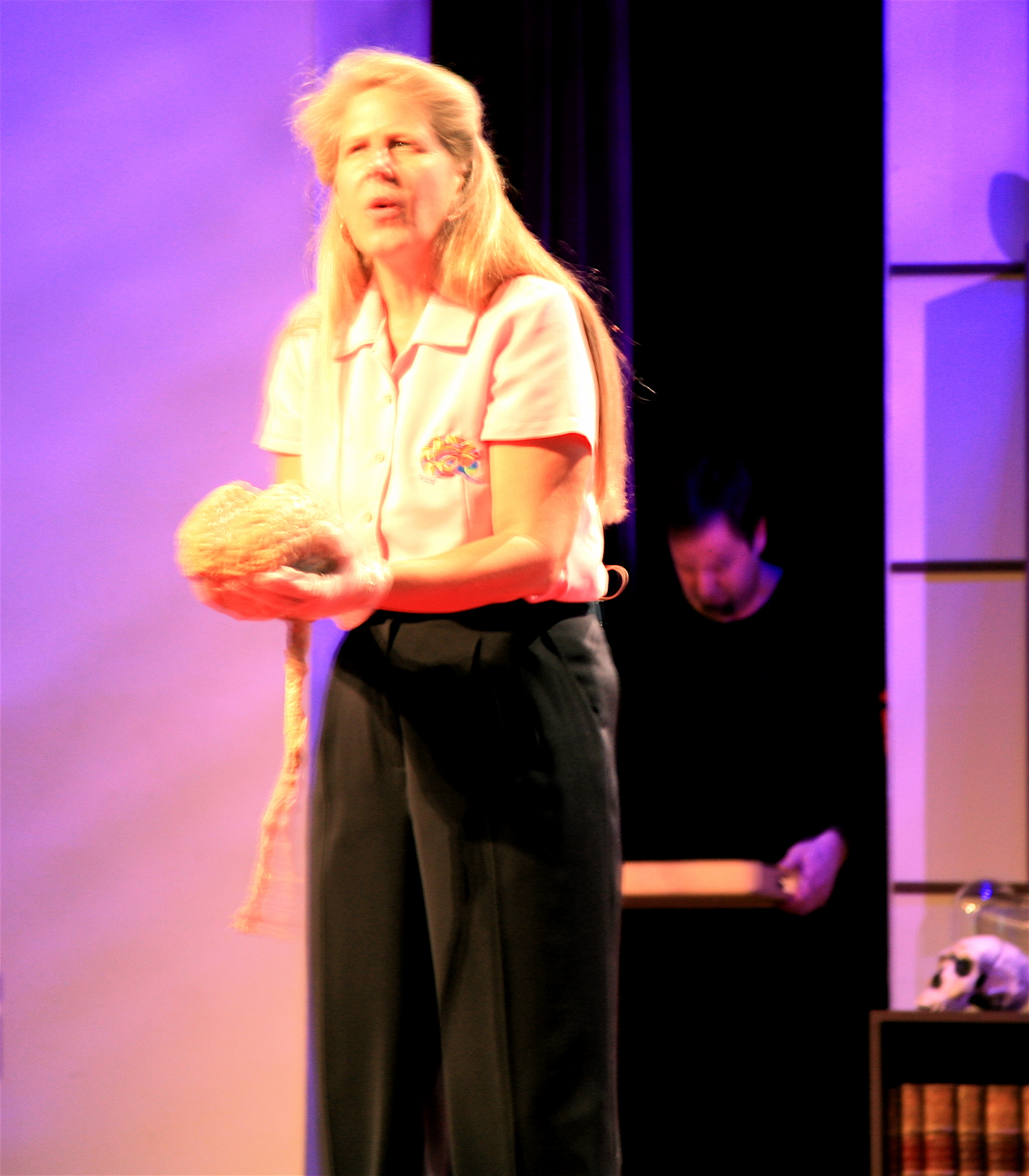
   Born 1959 Louisville, Kentucky
   Residence Bloomington, Indiana
   Alma mater Terre Haute South Vigo High School,
   B.A. Indiana University, 
   Ph.D. Indiana State University, 
   Postdoctoral studies at Harvard Medical School 
   (Depts of Psychiatry and Neuroscience)
   Known for Work in neuroanatomy.
Jill Bolte Taylor (born 1959 in Louisville, Kentucky) is a neuroanatomist - a brain scientist who studies the anatomy of the brain. Her training is in the postmortem investigation of the human brain as it relates to schizophrenia and the severe mental illnesses. She just started the Jill Bolte Taylor Brains, Inc not-for-profit and she is affiliated with the Indiana University School of Medicine and is the national spokesperson for the Harvard Brain Tissue Resource Center. Her personal experience with a massive stroke, experienced in 1996 at the age of 37, and her subsequent eight-year recovery, has informed her work as a scientist and speaker. For this work, in May 2008 she was named to Time Magazine's 2008 Time 100 list of the 100 most influential people in the world. "My Stroke of Insight" received the top "Books for a Better Life" Book Award in the Science category from the New York City Chapter of the National Multiple Sclerosis Society on February 23, 2009 in New York City.

Stroke of Insight

On December 10, 1996, Taylor woke up to discover that she was experiencing a stroke. The cause proved to be bleeding from an abnormal congenital connection between an artery and a vein in the left hemisphere of her brain, an arteriovenous malformation (AVM). Three weeks later, on December 27, 1996, she underwent major brain surgery at Massachusetts General Hospital (MGH) to remove a golf ball-sized clot that was placing pressure on the language centers in the left hemisphere of her brain.

Taylor's February 2008 TED Conference talk about her memory of the stroke became an Internet sensation, resulting in widespread attention and interest around the world. It became the second most viewed TED talk of all time.

Book

Following her experience with stroke, Taylor wrote the best-selling book My Stroke of Insight: A Brain Scientist's Personal Journey, about her recovery from the stroke and the insights she has gained into the workings of her brain because of it. Subsequently, Taylor appeared on The Oprah Winfrey Show on October 21, 2008. In her later commencement address at Duke University on May 10, 2009, Oprah Winfrey quoted Taylor's assertion that, "You are responsible for the energy that you bring" in encouraging the students to assume this same responsibility in their future lives. Taylor was the first guest featured on Oprah's Soul Series webcast on Oprah.com and Satellite radio show.

Amazon.com

After Taylor's representative, transmedia agent and attorney Ellen Stiefler, conducted an auction for worldwide publishing rights to "My Stroke of Insight," Penguin won the book and it was published in hardcover in May 2008, debuting near the top of the New York Times Non-fiction Hardcover Bestseller list. "My Stroke of Insight" spent seventeen weeks on the New York Times Bestseller Lists, reaching number 4. My Stroke of Insight also is available in paperback, large print, audio book, and kindle editions. The book will come out in 30 languages.


See the full article  Jill Bolte Taylor From Wikipedia, the free encyclopedia.


Introduction to "My Stroke of Insight" by Megan Castran

Uploaded on Oct 17, 2008

MY STROKE OF INSIGHT by Jill Bolte Taylor is a MUST read... not just for people who know people who have suffered a stroke, but for everyone interested in the spiritual side of life. Jill, a brain scientist herself, was in the rare position of being able to observe her own mind completely deteriorate to the point where she could not walk, talk, read, write or recall any of her life.

Standard YouTube License @ jewelChic


How It Feels to Have a Stroke

Uploaded on Mar 13, 2008

http://www.ted.com Neuroanatomist Jill Bolte Taylor had an opportunity few brain scientists would wish for: One morning, she realized she was having a massive stroke. As it happened -- as she felt her brain functions slip away one by one, speech, movement, understanding -- she studied and remembered every moment. This is a powerful story about how our brains define us and connect us to the world and to one another.

Standard YouTube License @ TEDTalks


Interview With Jill Bolte Taylor, 

       Harvard-Trained and Published Neuroanatomist

Uploaded on Aug 23, 2010

Known for her comprehensive study of her own stroke, Jill Bolte Taylor discusses how we need to look beyond the detail at the big picture, and use the right side of the brain.

One in a series of interviews carried out for 21:21 The Movie - released in the fall of 2010.

Presented by Learning Activist Patrick Newell, 21:21 exposes the failures of traditional schooling techniques in preparing our children for life in the 21st century, and then demonstrates the effectiveness of progressive teaching and learning methods, as applied in a number of classrooms all around the world.

The film also features a number of exclusive interviews with leading thinkers of our time - of which this is an extract.

See our Facebook page or http://www.21foundation.com for more information.


Standard YouTube License @ 2121TheMovie


Jill Bolte Taylor's Stroke of Insight - Oprah's Lifeclass

Published on Oct 21, 2011

When Harvard brain scientist Jill Bolte Taylor suffered a stroke in 1996, she lost her language, memories and ability to think about the future. What she gained was an entirely new perspective on life. Watch as she shares the lesson that changed Oprah's life: You are responsible for the energy you bring into a space.


Standard YouTube License @ OWN: Oprah Winfrey Network


Spiritual News about Jill Bolte Taylor

Uploaded on Sep 13, 2008

How she experienced Nirvana by stroke of left side of brain.


Standard YouTube License @ Joe Kohli


Jill Bolte Taylor on Time Magazine

Uploaded on Nov 20, 2008

Time magazine has named ISU alumna Jill Bolte Taylor to its 2008 list of the most influential people in the world. Taylor, who recovered from a stroke, was recognized for educating others about brain injuries and research into mental illness.


Standard YouTube License @ Indiana State University


T.E.D. - The Neuroanatomical Transformation of the Teenage Brain

Published on Feb 21, 2013

Our brain is made up of cells and every ability we have is the product of those cells. What is going on during our teenage years that accounts for the way teenagers feel, think and behave? This presentation will focus on the neurological transformation of the brain that occurs during the teenage years.


Standard YouTube License @ TEDxYouth


Jill Bolte Taylor and the Magic of the Right Hemisphere 

      by Tribal Jazzman's

Uploaded on Feb 27, 2011

Jill Bolte Taylor was a neuroanatomist (someone who studies the brain), who had a stroke and in the process of having the stroke was able to get a first-hand look at what happens when the left-hemisphere goes "offline." The experience led her to dedicate her life to teaching people about the implications of a culture which lives predominantly in the active, machinations of the linear, cognitive mind. I discuss the implications of her ideas for animistic thinking, tribal systems of thought, and our movement towards a more egalitarian future.


Standard YouTube License @ TribalJazzman's channel


Stroke & Transformation | Jill Bolte Taylor, Part 1 of 12

Uploaded on Jan 23, 2010

Oprah's Soul Series. On December 10, 1996, at age 37, Jill awoke with intense pain behind her left eye — a blood vessel had exploded in the left hemisphere of her brain and she was having a stroke.

The experience was life-changing. Not only did Jill face years of recovery after her stroke — and major brain surgery to remove a large blood clot in her brain—she also discovered a better quality of life through increased use of the right hemisphere of her brain. She's now an artist as well as a scientist, creating anatomically correct stained-glass replicas of brains that are sold as fine art. She's also published My Stroke of Insight: A Brain Scientist's Personal Journey . The book explains in scientific detail exactly what happened during Jill's stroke and how she recovered. It also takes a closer look at how the right hemisphere of the brain works and how Jill says people with normal brains can access it to find their own inner peace and improve their quality of life and the lives of others.

A few, of many, comments:
beenn15 Oprah doesn't realize that Jill's language isn't metaphorical... she's not talking jargon, she knows what she means when she said she's fluid. 
spangleJ The interesting part is not so much that she had these experiences, but her analysis on the TED talk of where the haemorrhage was and which areas were knocked out. As a scientist, she was able to scientifically examine her experience. Sure people can have drug trips but the bigger impact is to be able to know what exactly happens and why. That is knowledge and that is useful - to stroke victims and to science. 
Terry Leneave She knows her stuff!! I had an AVM hemorrhage twice on my cerebellum and a stroke. Flatlined 3 times, spent a month in the hospital. So yeah, I'm getting the book. These kind of instances are EYE OPENING. I want to read about her recovery. 
LoveLifeLoveFreedom I love this series! Very interesting. My husband had a massive hemorrhagic stroke on right side 3 years ago. Very different experience, but this story really helped me to be more sensitive and aware of strokes in general. 
alfiramara This video, all 12 parts of it is FANTASTIC. So inspired that this lady has shared her story... it will help many people. 
SSTattler: Many more comments on ChrisNYC2007's channel.


Standard YouTube License @ ChrisNYC2007's channel


Stroke & Transformation | Jill Bolte Taylor, Part 2 of 12


Standard YouTube License @ ChrisNYC2007's channel


Please click below for Part 3 / 12 to Part 12 / 12:

Saturday Comics


For Better and For Worse
Lynn Johnston - 2007/11/11

"Comfy enough, Jim?"
Dilbert
Scott Adams - 2013-03-07

"Lying is ... it's like a freakin' superpower!"

Garfield
Jim Davis - 2013-03-07

"... Mrs. Feeny with her poor cat in a leash."

Betty
Delainey & Rasmussen - 2013-03-07

"Do you like the vegetarian tofu curry?"   


*For Better and For Worse" is a serious topic of stroke but with a very nice cartoons. It is all about Grandpa Jim had a stroke and 88 further cartoon "strips" that happened to Grandpa Jim. (See as well 
 the author Lynn Johnston).
** I tried to get low or free price at the people http://www.UniversalUclick.com/ for the images for the cartoons. It was too high for Stroke Survivors Tattler i.e. we are not a regular newspaper and our budget is very low. Fortunately, you will have to do only 1-click more to see the cartoon image, it is legit and it is free using GoComics.com and Dilbert.com.
*** Changed from "Pickles" to "Betty" -- "Betty" is a excellent cartoon and Gary Delainey & Gerry Rasmussen are authors/artists/cartoon-strips and they live in Edmonton.

Eclectic Stuff & Articles

Definition: Eclectic(noun) a person who derives ideas, style, or taste from a broad and diverse range of sources.

Sunday Stroke Survival ~ Dr Jill Bolte Taylor

Jo Murphey
The Murphey Saga

Sunday, March 3, 2013

When I first came home from the hospital, I started researching stroke recovery. Not that the hospital staff didn't give me loads of information to read, but I had read or knew all of that stuff. I was a retired nurse. I understand medi-speak and layman terms. Aren't I lucky? When my brain got too tired from deciphering letters into words, I would watch youtube in an attempt to garner more knowledge of what was going on with me.


I kept running across videos of this one doctor, Jill Bolte Taylor. I couldn't figure out why her name kept popping up so I watched a clip. I really didn't want to watch another doctor explain what a stroke was. Was was greeted by this woman with gray flowing hair reminiscent of the '70s. She spoke with such humor about her stroke giving a blow by blow description that I was fascinated.


She explained how the various hemispheres of the brain worked and she was diagnosing herself as did I when I had my stroke. That's the problem with being medically trained before your body goes haywire. You take the time to diagnose what's wrong. You rattle off the symptoms one by one, and try to figure out what exactly is going on. It doesn't help when your family asked what is going on, because then you start doubling your effort.


The only problem is that it's your brain that is affected impairing your decision making function. My mind kept screaming at me that it was my diabetes and I was arguing with myself that it was something else. She related the same thing in the video I was watching. I ended up watching all of them and realized she'd even written a book.


So I clicked my way over to Amazon and ordered a copy. Now I've read a bunch of stroke written by stroke survivors and their caregivers over the past nine months trying to get a firm handle on recovery from a stroke. The cover told me it was on the New York Times Bestseller list, if that really means something. It doesn't to me, even as an author. There a lot of books to the Times' bestseller list that I wouldn't pay two cents for. They just don't have a point of interest for me.

Personally, I'm glad I did. The same sense of humor and hippie vagueness she exhibited in the videos came across the pages. She wasn't writing a poor pitiful me book. It was educational, but I could laugh too. She describes her inner peace like I feel when dealing with day-to-day issues. While I didn't doubt she felt that way, I realized that we saw the source differently. That's okay, really it is. It just gives me a different point of view to chew on. I love opposing points of views because I learn so much. I love her style of story telling.

I just learned that Ron Howard wants to direct a movie based on this book. I'm there! While I usually do not like movies based on good books, it should prove interesting. I've liked Ron Howard since he was Opie on The Andy Griffith Show and Dennis the Menace way back in 1960s. The quality of his films speak for themselves. On top of that he wants Jodie Foster in it. I'm doubly there! But that was posted back 2010. I'm not sure what the when it will be filmed and in theaters.

Nothing is totally impossible. You just have to figure out a new way of accomplishing your goal.

See the original article Sunday Stroke Survival ~ Dr Jill Bolte Taylor
                                       in The Murphey Saga

Bleed Vs. Block: Who Can Expect Better Recovery?

Peter G Levine
The Stroke Recovery Blog
Friday, March 9, 2012

Survivors who have a hemorrhagic (bleed) stroke average better recovery than survivors who have an ischemic (block) stroke. But bleed strokes usually have more disability to begin with. In other words, “bleeds”  start out lower but end up higher. The difference has to do with the different ways these types of stroke affect neurons:

“Block” stroke: neurons die because blood flow is blocked. No blood, no O2.   No O2, neurons die.

“Bleed” stroke: much of the damage comes from the compression on the brain by the buildup of blood in the skull. Once the compression is resolved there is less overall neuronal damage.

Bottom line: The effect of efforts towards recovery can be expected to be less for ischemic vs. hemorrhagic stroke. Rehab strategies that work well for bleed stroke will typically have less rehab potential for survivors with a block stroke.

This is one of my problems with books about survivors who've had a bleed stroke.  Some of the  books give the impression that they a) had more will, b) are smarter, c) have come up with a new and special technique. Again, on average, they start out lower but end up higher. So the recovery process is scary and arduous, but ultimately more fruitful. And it is more fruitful because there is less brain damage.

Of course, the prime example of this fudging of the facts is Jill Bolte-Taylor's book My Stroke of Insight.  She had a bleed stroke on the left side of the brain.  Have a look at this video. Does anyone see any deficit in either the right arm/hand or in her speech?

Almost 90% of all stroke are blocks, not bleeds.

Want the science-y perspective?

"If 2 patients at the beginning of rehabilitation had the same basal neurological severity, same basal functional disability, same age, same sex, and same OAI, hemorrhagic patients showed better neurological and functional prognosis compared with ischemic ones."

And to be clear: Bleed strokes are terrible. You have a greater chance of dying from a bleed than a block. And recovery from any stroke is to be celebrated.

But beware of inflated expectations suggestions by survivors of a bleed stroke. What they suggest may work for them but it is clear: their recovery will usually be higher given the same amount of effort.

See 14 Comments ... and
see the full article Bleed Vs. Block: Who Can Expect Better Recovery?
                               in The Stroke Recovery Blog

Lab Notes: Stroke Recovery Loves Company

Dean Reinke
Deans' Stroke Musing
Tuesday, March 20, 2012

I know this is not what Jill Bolte-Taylor would say. Loneliness Not Good for Post-Stroke Progress. -- Deans' Stroke Musing

Companionship might be the key for better healing following a stroke, according to a preclinical study presented at the recent International Stroke Conference in New Orleans.

Mice that were socially isolated tended to have greater ischemic infarct volumes relative to mice paired with a stroke partner or a healthy partner. In addition, the solitary mice had significantly decreased levels of brain-derived neurotrophic factor (BDNF), a protein that helps support the survival of existing neurons.

Interestingly, the mice paired with healthy partners had significantly more BDNF than mice paired with a stroke partner. BDNF could be a marker for functional recovery, lead author Venugopal Reddy Venna, PhD, from the University of Connecticut in Farmington, Conn., told MedPage Today.

Venna said that post-stroke housing is critically important and should be considered in all patients, but especially in clinical studies evaluating various rehabilitative strategies.

See the original article Lab Notes: Stroke Recovery Loves Company
                                       in Dean's Stroke Musing

Finally, A Diagnosis That Makes Sense

Diane
The Pink House On The Corner
Wednesday, February 27, 2013

When Bob was hospitalized, I met Dr. K., a neurologist, who had been sent to see Bob by the vascular surgeon. Dr. K. is  new in town and I had never met him before. We talked about the stroke and he asked me about Bob's neck problem.

Those of you who follow this blog know that Bob's neck suddenly tilted and became sort of "stuck" on his shoulder last spring. Immediately, I had taken him see his neurologist who told us that, unfortunately, the CIDP (chronic inflammatory demyelinating polyneuropathy) had become active again and there was nothing we could do about it except get a neck brace and do PT, i.e. neck stretching exercises.

Bob's neck/head still stuck in this position....
I never did fully accept this doctor's diagnosis. As it didn't sense to me. It is true that when Bob had full blown CIDP, he could not hold his head up. Back then, his neck muscles were weak and his head dropped forward. He often wore a neck brace. But this is different. This is like his neck is "stuck" on his shoulder...  His muscles are tight and his head is tilted to the side. And wearing a neck brace is now too painful. Also, since the CIDP disappeared post-stroke, I have not seen any other evidence of this dread disease. There has been no "nerve tingling" pain or weak muscles on his unaffected side, which he had pre-stroke. In fact, his left arm is now very strong. Stronger than it ever was. And then there's this problem with Bob's toes on his unaffected side. Which have been curling inward and making it horribly difficult to practice walking. And the neurologist said that, too, was from CIDP. But Bob certainly didn't have a problem with his toes pre-stroke.

Bob's toes
This is not the first time I've disagreed with Bob's neurologist. After the CIDP vanished, post-stroke, I did some reading about this phenomena and found that CIDP does often go into remission, and does sometimes completely disappear. No one knows why this happens but it does happen. Bob's neurologist and I argued about this. He told me that, in so many words, I was nuts. That CIDP will only become "quiet" but never totally go into remission and certainly it does not ever completely disappear. And Bob will have CIDP for the "rest of his life".

Since then, Bob has gotten a variety of different diagnoses on his neck problem. Everything from it's all my fault for keeping the head of his bed elevated too high at night to a brachial plexus injury. To the onset of scoliosis to a side effect from Lyrica. None of these, however, explained what's happening with Bob's toes. Also, nothing I have done, from neck stretching exercises to lowering the bed and repositioning him at night to taking him off Lyrica has seemed to help.

Then in walks a new neurologist, Dr. K. Who tells me that this neck/toe problem is most definitely not from CIDP.  That CIDP would cause the neck muscles to weaken, and Bob's muscles are not weak, but tight. He also says the magic words: CIDP does sometimes just go away and not come back.

At the hospital, Dr. K. gave me his business card. He told me that he'd like to look into Bob's case, do some tests and consult with another neurologist on his team.

We went to see Dr. K. on Monday. We met with both Dr. K. and another doctor on his team. The consensus of both neuro doctors is that Bob's neck and toe problem are both the result of "dystonia".  Dystonia happens when a certain portion of the brain is damaged from a stroke or other brain injury. Afterwards, that area of the brain attempts to heal itself and somehow, in the healing process, the "wires get crossed" and that's when muscles spasm and contract and "get stuck".

And that explains why these symptoms didn't show up until a year or more post-stroke.

Bad news is there is no known cure for dystonia.

Good news is there is treatment.

The best and usual treatment for dystonia is botox injections in the affected muscles followed by physical therapy. Botox is said to paralyze the tightened muscles, thus loosening them up. The problem with botox injections in the neck is that they have been known to also paralyze the larnyx. Doctors said there was about a 20% chance of this happening in the "average" population and of course Bob is nowhere near "average".  If this happened, it would exacerbate Bob's swallowing problems and make him even higher risk of aspiration. He may, in fact, choke on his own saliva. It would also make it even harder for him to speak. Then, because of the warfarin issue, a "hematoma" could form at the injection site.  Both doctors told me to "think about it", weigh the pro's and con's, risks vs. benefits, as Botox is the best treatment available and usually works and any bad side effects would disappear in 3 months or so. But I don't know, all of this sounds risky and scary to me.... so I'm not sure if this is the way to go.

Bob's regular neurologist had previously told me that botox to the neck could be "fatal" to someone on warfarin and so I asked these new doctors what they thought, but they said it would not be "fatal" but might cause a hematoma which would "uncomfortable" and the biggest issue is the swallowing concerns....

So I am really not sure what to do. Lord, I hate making decisions like this.

There was also talk about two different medications we could try. One a very slow acting oral medication that "might" help. The other being some kind of "intrathecal" medicine--which the doctors want to do some more research on, i.e. see if it would be safe in Bob's case.

Right now, the thought was not to do anything drastic until Bob completely recovers from lung pleurisy.

We did leave with a prescription for Zanaflex, a stronger muscle relaxant than the Baclofen that Bob has been taking.  I am supposed to start him on a very low dose and see how he responds before increasing it.

We see Dr. K. again in a month.

Oh, and I asked Dr. K., before we left, "How would we know if the CIDP had returned?" And he said, the first sign would be overall muscle weakness and pain.

I tell you, my Bob has one darn strong left arm and hand. So I really doubt the CIDP has returned. And I am thinking that we finally found a doctor who actually knows what he's talking about....

5 comments:

J.L. Murphey February 27, 2013 at 12:30 PM said...
Diane, 
    Happy you found a reasonable explanation for Bob's neck. It makes sense to me. 
I am on a combination of zannaflex, baclofen and valium for my muscular tightening. A word of warning about zannaflex...it can drop or raise his blood pressure, so keep a watch on it. I also do the Botox injections. You'd think I would have muscle spasms with all of that in my system, but still it is an issue. 
Have you discussed Phenol with your neurologist? It might not affect his larynx so bad.
Diane February 27, 2013 at 2:15 PM said...
Thanks Jo, for the info on Phenol. I just googled it and see if was used before Botox for dystonia. I will definitely ask about it.
Rebecca Dutton February 28, 2013 at 6:11 AM said...
When a physician starts descibing the symptoms I actually have I always feel reassured.
Anonymous February 28, 2013 at 7:02 PM said...
Dr K sounds like a winner for you and Bob. I believe it's best to take his suggestions slow and easy for the treatment of the dystonia. Use what is available that has the lowest risk, and move on from there, with a lot of research involved too. 
Great picture of Bob!! 
Hugs, Dan
GirlWithTheCane March 1, 2013 at 6:21 AM said...
My friend Pamela writes a blog on dystonia. I don't know that it's the same type that Bob has, but if nothing else maybe her links will be useful... http://dystoniamuse.com/
Glad that you're finally getting some answers.
See the original article Finally, A Diagnosis That Makes Sense
                                       in The Pink House On The Corner

Reading Cartoons Good for Your Health

Dean Reinke
Dean's Stroke Musing
Tuesday, March 5, 2013

Enhance your cognition with this Dana Foundation blog Reading Cartoons Good for Your Health. One line, I'm sure your doctor will have you perusing the Far Side. “Cartoons are great brain enhancers,” said Restak, because they make heavy demands on the organ. -- Deans' Stroke Musing 

John C Anderson
Stroke Survivors Tattler
SSTattler: This is the full article "Reading Cartoons Good for Your Health" in Dana Foundation blog.  (I think there is no copyright so I copied directly to SSTattler (I hope)). This article is very important about stroke survivors who read SSTattler Comics - "For Better and For Worse" by Lynn Johnston and have a little giggle from "Dilbert", "Garfield" and "Betty". Please, continue have fun & lots of humour, if necessary!


Reading Cartoons Good for Your Health


We know when something is funny, but can we attribute that recognition of humour to a specific part of our brain? “Analyzing humour is like dissecting a frog. Few people are interested and the frog dies of it,” said neurologist and Dana Alliance member Richard Restak, M.D., quoting writer E.B. White at Sunday night’s Rubin Museum event, which also featured notable New Yorker cartoonists. More to the point, there is no humour centre of the brain, said Restak.

That doesn’t mean we know nothing of how the brain processes humor, though. When looking at a funny cartoon, Restak said, we engage our cerebral cortex for linguistic and visual congruity, and the subcortical areas provide pleasure and emotional aspects of appreciation. “Cartoons are great brain enhancers,” said Restak, because they make heavy demands on the organ.

Researchers are also making some progress in identifying areas of the brain activated by humour. While at Stanford, Dean Mobbs, Ph.D., now a professor in the psychology department at Columbia University, identified brain activation in the mesolimbic rewards system of people who viewed funny versus unamusing cartoons–the former resulting in mirth. A paper he co-authored presents the imaging evidence they found.

With this information in mind, New Yorker cartoonists Paul Noth, David Sipress, and Zach Kanin set out to enhance our brains and activate our mesolimbic rewards systems with examples of their work, a discussion about inspiration and work process, and even some on-the-spot cartoon creations.

Cartoonist Zack Kanin shares one of his many kid-centric cartoons.
(Credit: Michael Palma for The Rubin Museum of Art)


One of the cartoons shown by Noth that drew appreciative laughter from the sold-out audience of 155 was a revisit with 80s book icon Waldo, of Where’s Waldo fame. The caption read, “Nobody ever asks, ‘How’s Waldo?’” and featured a rather drunk and forlorn Waldo sitting at a bar. As a child who owned two Where’s Waldo books, I have to admit, I never once gave any consideration to Waldo beyond finding him in the crowd.

To come up with that one good idea, the artists said, they often must filter through several bad ones. And they go through a lot of ideas. Each week, they submit ten to fifteen cartoons to The New Yorker: “A lot of ideas and a lot of rejection,” said Sipress. To crank out ideas, Sipress will often create a list of words and then give each one about ten minutes of brainstorming before either moving on or committing to a creation.

Knowing that made the on-the-spot cartoon challenge posed to the cartoonists even more suspenseful. Audience members chose three words from three separate columns that the artists had to incorporate into a cartoon–and the results were impressive. Given “monk,” “torture chamber,” and “Florida,” Kanin drew upon his personal experience that “New Yorkers love it when you crap on Florida,” and came up with a drawing of a man being tortured by a Catholic monk on a beach, with the caption, “We were going to torture you for your heresy, but heck, you’re already in Florida.” He knew his audience, because his cartoon was met with loud applause and laughter.

Brainwave runs through April and there are many opportunities to catch other great discussions and films, including The Memory Palace next week. The Rubin Museum is a Brain Awareness Week partner, and The New Yorker Cartoonists event was partially funded by the Dana Foundation.

To learn more about Brain Awareness Week (March 11-17) and to find events in your area, visit www.dana.org/brainweek. In New York City, you can find public brain-y events for all ages on the official braiNY website. On Twitter, search #brainweek and #BebraiNY.

--Ann L. Whitman

Central Pain Syndrome

Central Pain Syndrome: Lives in Constant Pain

Published on Nov 5, 2012

Let's put our brains together to prevent brain disease. Visit CureBrainDisease.org. ABF, Neuro Film Festival, American Brain Foundation, AAN, neurology, and film festival.


Standard YouTube License @ MrsPattiG1


Central Pain Syndrome: I Am One Among 100,000

Published on Jan 13, 2013

This film has been entered into the 2013 Neuro Film Festival from the American Brain Foundation at www.NeuroFilmFestival.com. Let's put our brains together to cure brain disease. Visit CureBrainDisease.org.


Standard YouTube License @ MrsPattiG1


Central Pain Syndrome: Lifestyle Changes

Published on Nov 14, 2012

Patients view of CPS and lifestyle changes.


Standard YouTube License @ MrsPattiG1

Canes Do More Than Help You Walk

Rebecca Dutton
Home After a Stroke
June 2, 2011

You know how people start talking to a dog and then realize they should talk to the human holding the leash?  Strangers also talk to stroke survivors who have pretty canes like Barb and I do.  I've stopped counting the number of times strangers have said to me "That's a pretty cane."  This gives me a chance to smile and say "Thank you, I like it too."  Little girls can't keep their eyes off my cane with purple flowers as I walk past.  They have a look in their eyes that says "how can I get one of those." Their too young to realize it's an ambulatory device instead of a toy or a fashion accessory.

However, I use a more substantial ambulatory aid when I go to the bathroom at night and when I shower in the morning.  When I got home after my stroke I initially used a walker to go to the bathroom.  I live alone so I couldn't empty a bed-side commode.  When I got better I used a quad cane with four little feet to go to the bathroom at night.  Now I use a heavier, single-point cane to go to the bathroom at night.  Heavier ambulatory devices slow me down, but I don't mind when I'm half awake.  One bad fall in the bathroom convinced me that speed isn't as important as safety.

It is hard to transport small objects when my sound hand is busy handling the cane.  At first I put things in a small paper gift bag.  I held my cane and the bag's string handles in my sound hand.  The bag would swing and repeatedly hit my cane so I didn't feel safe when I was walking.  Paper gift bags also fall apart with repeated use.  I found an attractive small nylon bag at Barnes and Nobles bookstore.  To keep it from swinging I attached self-stick Velcro to my cane and the bag (see the white line in the photo).  The Velcro on the bag eventually comes lose so I use a stapler to attach it more firmly.  So canes encourage socialization, prevent falls, and transport objects.

Posted by Rebecca Dutton at 8:18 AM

4 comments:

Glynis Jolly June 2, 2011 at 1:06 PM
On those days when my balance is off and I'm afraid to walk around the house without assistance, I use a walker that has a seat and a basket when I want to carry something. The walker comes in handy for those big trips at the store too because I do have a place to sit and rest.
Grace Carpenter June 3, 2011 at 4:34 PM
Sometimes I think my canes is too girly for me, but my little girl says, "but *I* love your cane!"  
I probably don't need a cane a lot, I've found that it's a good visual cue for other people. If I'm slow, my speech is funny, etc., they don't rush me because they see the cane.
Linda June 19, 2011 at 3:31 AM
My 21 year old daughter bought me my pretty paisley cane saying just cause I use a cane was no reason not to be fashionable! lol  
I use the cane mainly outside the house. My big issue is my balance and I am relying very heavily on visual cues to keep track of which direction up is. I still need the walker if it is dark or odd lighting conditions or I get too tried.
Rebecca Dutton June 19, 2011 at 1:28 PM
I keep every ambulatory aide I buy so I can deal with different situations like the ones you mentioned.
See the original article Canes Do More Than Help You Walk
                                        in Home After a Stroke

RYNO Motors vs Segway?

SSTattler: See as well Segway PT (Personal Transporter).

RYNO Motors Full Story

Published on Mar 15, 2012

This is a great story on the early days of RYNO Motors. See our latest creation pre-production show bike at our web-site and don't forget to buy a Tee Shirt: http://rynomotors.com/ryno-tee-shirts/


Standard YouTube License @ RYNO Motors


Ryno Motors Invents World's First One Wheel Electric Scooter

Uploaded on Feb 22, 2011

After more than three years in the business, Vancouver-based start-up Ryno Motors has nearly finished its third and final design for a one-wheel self-balancing motor bike that's worthy of RoboCop. It's a sleek and sporty machine that, most importantly, stays upright and drives with ease.

This electricity powered motorcycle has a range of about 30 miles and can hit a top speed of 25mph. Powered by LiFePo4 batteries, the motorcycle is expected to cost about $3500. The motorcycle features high capacity dual DC motors and controller boards, advanced solid-state motion sensors to maintain constant control of balance loop. All the electronic components inside have been sealed to prevent damage due to shocks.

But now the Vancouver start-up faces a new, more daunting challenge: funding! "We're stuck right now," said founder Chris Hoffmann, a mechanical engineer with 15 years of experience in the automobile industry. "Investors love the idea but they don't know who the market is."

Hoffmann has so far invested about $25,000 of his own money engineering and building the prototype motorcycles with a mishmash of abundant, cheap parts scrounged from the robotics industry. That focus on systems integration, instead of designing his own specialized components, was the key to keeping his initial production costs low.

A variety of software has been included to continuously monitor a set of feedback systems to warn the rider or take control of the bike if it exceeds its maximum performance limits. An auto balance system will prevent the rider from exceeding the max-rated speed and tilt angle by automatically interacting with the rider through a cascading set of warnings before temporarily taking control of the bike.

The battery monitoring system will trigger yellow and red warning lights when the battery level registers 25 percent and 5 percent to full charge. Moreover, an auto kill switch has been included that stops wheel rotation if the rider is dislodged from the bike or the bike tilts outside of its normal operating parameters.

Looking for funding can be a wild, emotional ride that saps an entrepreneur's creative energy and attention, Hoffmann said. If he focuses too much on attracting investors, Hoffmann is worried that the passion for his invention, the lifeblood of his business, is likely to suffer. "Forget the angel investors," Hoffmann tells his team, "let's just build some bikes."


Standard YouTube License @ 1337041071

Best Friends

Monty Becker
Stroke Survivors Tattler


Best Friends


Pilobolus Dance Theatre "Shadowland"

Jackie Poff
Stroke Survivors Tattler
Uploaded on Apr 30, 2011

Dream Worlds That Live in the Shadow
of the Empire
(from German: Traumwelten im Schattenreich wetten dass vom)

laura200901 1 month ago How could anyone give this a "thumbs down"?? What's wrong with you?

allison thesupernova 14 hours ago Just absolutely stunning! What music coupled with stunning choreography! Thank You so much form sharing this marvellous video. Hugs hugs for toy. Xxoxo Allie

Jean Sheldon 22 hours ago Astonishing... The human body and eye working together to produce illusion and magic...

.... and 265 more comments in http://www.youtube.com/watch?v=STK7AZ_Zs_E


Standard YouTube License @ Moin Ihr Nasen ;-)

A Story of Canadian Art

John C Anderson
Stroke Survivors Tattler

The Art Gallery of Alberta presents: 
A Story of Canadian Art
As told by the Hart Art Collection
Saturday, Mar 9 – Monday, Jul 1, 2013

Location: Art Gallery of Alberta 
          (2 Sir Winston Churchill Square)
City:     Edmonton
Venue:    Art Gallery of Alberta
Details:  Historic collection of Canadian art
Category: Museums / Attractions, Performing 
          Arts / Culture
Cost:     Gallery Admission
Tickets:  At the door.
Link:     www.youraga.ca …

This unique exhibition features highlights of the historic collection of Canadian art that began in the first half of the 20th century at Hart House at the University of Toronto. Artists include: A.Y. Jackson, Emily Carr, David Milne and Lawren Harris. This exhibition showcases key works that tell us about particular critical junctures in the history of how this singular collection of Canadian art was built and will also provide glimpses into how the history of art in Canada has been written.

AY Jackson's Radium Mine, painted after he was a guest of the mine's owner in 1937.

---------