Showing posts with label ▷ 2013 Jun 15. Show all posts

Saturday, June 15, 2013

Visual Art


Art From Wikipedia, the free encyclopedia.
SSTattler: We will include {Art + "Stroke Disability"}, other than that it is Art, 2D or 3D, but not include music, drama, ...!
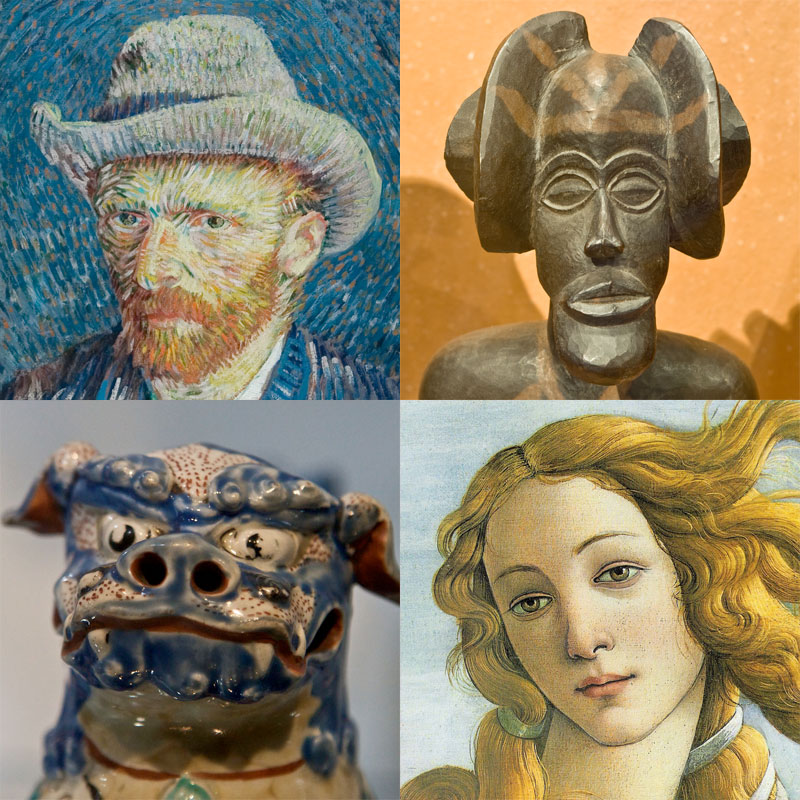

Clockwise from upper left: a self-portrait from Vincent van Gogh,
 an African Chokwe statue, detail from the Birth of Venus 
by Sandro Botticelli and a Japanese Shisa lion
Art is a diverse range of human activities and the products of those activities; this article focuses primarily on the visual arts, which includes the creation of images or objects in fields including painting, sculpture, printmaking, photography, and other visual media. Architecture is often included as one of the visual arts; however, like the decorative arts, it involves the creation of objects where the practical considerations of use are essential—in a way that they are usually not for a painting, for example. Music, theatre, film, dance, and other performing arts, as well as literature, and other media such as interactive media are included in a broader definition of art or the arts. Until the 17th century, art referred to any skill or mastery and was not differentiated from crafts or sciences, but in modern usage the fine arts, where aesthetic considerations are paramount, are distinguished from acquired skills in general, and the decorative or applied arts.

Art has been characterized in terms of mimesis, expression, communication of emotion, or other values. During the Romantic period, art came to be seen as "a special faculty of the human mind to be classified with religion and science". Though the definition of what constitutes art is disputed and has changed over time, general descriptions mention an idea of human agency and creation through imaginative or technical skill.

The nature of art, and related concepts such as creativity and interpretation, are explored in a branch of philosophy known as aesthetics

Creative Art and Fine Art


Works of art can tell stories or simply express an aesthetic truth or feeling. Panorama of a section of 
A Thousand Li of Mountains and Rivers, a 12th-century painting by Song Dynasty artist Wang Ximeng.
By a broad definition of art, artistic works have existed for almost as long as humankind: from early pre-historic art to contemporary art; however, some theories restrict the concept to modern Western societies. The first and broadest sense of art is the one that has remained closest to the older Latin meaning, which roughly translates to "skill" or "craft." A few examples where this meaning proves very broad include artifact, artificial, artifice, medical arts, and military arts. However, there are many other colloquial uses of the word, all with some relation to its etymology.

20th-century Rwandan bottle.
Artistic works may serve practical functions,
in addition to their decorative value.
In medieval philosophy, John Chrysostom held that "the name of art should be applied to those only which contribute towards and produce necessaries and mainstays of life." Thomas Aquinas, when treating the adornment of women, gives an ethical justification as to why: "In the case of an art directed to the production of goods which men cannot use without sin, it follows that the workmen sin in making such things, as directly affording others an occasion of sin; for instance, if a man were to make idols or anything pertaining to idolatrous worship. But in the case of an art the products of which may be employed by man either for a good or for an evil use, such as swords, arrows, and the like, the practice of such an art is not sinful. These alone should be called arts." Aquinas held that art is nothing else than "the right reason about certain works to be made," and that it is commendable, not for the will with which a craftman does a work, "but for the quality of the work. Art, therefore, properly speaking, is an operative habit." Aristotle and Aquinas distinguish it from the related habit of prudence.

The second and more recent sense of the word art is as an abbreviation for creative art or fine art and emerged in the early 17th century. Fine art means that a skill is being used to express the artist's creativity, or to engage the audience's aesthetic sensibilities, or to draw the audience towards consideration of the finer things.

The word art can refer to several things: a study of creative skill, a process of using the creative skill, a product of the creative skill, or the audience's experience with the creative skill. The creative arts (art as discipline) are a collection of disciplines that produce artworks (art as objects) that are compelled by a personal drive (art as activity) and convey a message, mood, or symbolism for the viewer to interpret (art as experience). Art is something that stimulates an individual's thoughts, emotions, beliefs, or ideas through the senses. Artworks can be explicitly made for this purpose or interpreted on the basis of images or objects. Although the application of scientific knowledge to derive a new scientific theory involves skill and results in the "creation" of something new, this represents science only and is not categorized as art.

Often, if the skill is being used in a common or practical way, people will consider it a craft instead of art. Likewise, if the skill is being used in a commercial or industrial way, it may be considered commercial art instead of fine art. On the other hand, crafts and design are sometimes considered applied art. Some art followers have argued that the difference between fine art and applied art has more to do with value judgments made about the art than any clear definitional difference. However, even fine art often has goals beyond pure creativity and self-expression. The purpose of works of art may be to communicate ideas, such as in politically, spiritually, or philosophically motivated art; to create a sense of beauty (see aesthetics); to explore the nature of perception; for pleasure; or to generate strong emotions. The purpose may also be seemingly nonexistent.

The nature of art has been described by philosopher Richard Wollheim as "one of the most elusive of the traditional problems of human culture". Art has been defined as a vehicle for the expression or communication of emotions and ideas, a means for exploring and appreciating formal elements for their own sake, and as mimesis or representation. Art as mimesis has deep roots in the philosophy of Aristotle. Goethe defined art as an other resp. a second nature, according to his ideal of a style founded on the basic fundaments of insight and on the innermost character of things. Leo Tolstoy identified art as a use of indirect means to communicate from one person to another. Benedetto Croce and R.G. Collingwood advanced the idealist view that art expresses emotions, and that the work of art therefore essentially exists in the mind of the creator. The theory of art as form has its roots in the philosophy of Immanuel Kant, and was developed in the early twentieth century by Roger Fry and Clive Bell. More recently, thinkers influenced by Martin Heidegger have interpreted art as the means by which a community develops for itself a medium for self-expression and interpretation. George Dickie has offered an institutional theory of art that defines a work of art as any artifact upon which a qualified person or persons acting on behalf of the social institution commonly referred to as "the art world" has conferred "the status of candidate for appreciation". Larry Shiner has described fine art as "not an essence or a fate but something we have made. Art as we have generally understood it is a European invention barely two hundred years old.”

See the full article (huge!): 
      Art From Wikipedia, the free encyclopedia.


Stroke Recovery through Art

Uploaded on Dec 14, 2009

http://www.veria.com/

In this Art Therapy Video from Veria Living, for artist Gary Bachers, art is truly life-affirming. A former doctor, Gary suffered a crippling stroke, which took from him much of his speech as well as the use of his right hand. Not content to sit around feeling sorry for himself, Gary learned to draw with his left hand. In his art, Gary has found a way to heal himself. Stroke Recovery through Art.


Standard YouTube License @ Veria Living


Gary Bachers.... Artwork

Uploaded on Jul 26, 2011

A view of Gary Bachers' inspiring works over the years....


Standard YouTube License @ Gary E. Bachers: Art and Soul


Richard Creme Art Event

Published on May 3, 2012

Legendary Manchester style guru Richard Creme's art exhibition featuring 25 pieces of art launched on 2 May 2012 at Manchester Metropolitan University. He produced these works after having a stroke in 2007.


Standard YouTube License @ Stroke Association


The Susie Hulks Memorial Award for Art

from The Stroke Association UK

In memory of Susie Hulks, who received the Life After Stroke Artistic Award in 1996. This award is presented to someone who has had a stroke and has learnt to express themselves creatively in the visual arts.

Winner – Peter Bull, Sheffield.

Peter had a stroke in May 1999 aged 38. Peter’s stroke affected his right side, including his mobility, and also left him with severe aphasia. Prior to his stroke Peter worked as printer – a job involving speed and dexterity as well as the ability to deal accurately with words. He sadly lost all these skills as a result of his stroke and therefore has been unable to return to his job. Peter was also a talented musician and songwriter.

After his stroke Peter returned home to live with his mother as he had very little speech and struggled with cognitive issues and depression. He has found it hard emotionally to come to terms with his stroke and often becomes very low in mood. Although his speech has improved over the years, he still finds it hard to follow conversations and struggles with reading and writing, which make living independently difficult, but Peter is determined to live on his own.

Finding it hard to express himself, Peter tried painting as a means of communication. His pictures clearly show how he felt about himself following his stroke. Peter has said that painting was the only way he could express himself and relieve some of the pain following his stroke. More recently, a lot of his work shows stairs leading nowhere, doorways that don’t open and tricks of light, as well as shadowy places, as he starts to carve out a new life.

The judges for this award were impressed with the originality of Peter’s work, which expresses his personal experiences. Peter has found a new talent and has been able to use this to help himself through some difficult times, as well as inspiring others.


The Susie Hulks Memorial Award for Art from The Stroke Association on Vimeo.


John - Life After Stroke Awards 2011

Uploaded on Jun 7, 2011

John is the winner of our 2011 Susie Hulks Memorial Award for Art.


Standard YouTube License @ Stroke Association


Art Award - Angus Igwe

Published on Jun 22, 2012


Standard YouTube License @ Stroke Association


Kathryn Thompson - Life After Stroke Awards 2010

Uploaded on May 25, 2011

Kathryn is the winner of our 2010 Susie Hulks Memorial Award for Art - Quilting.


Standard YouTube License @ Stroke Association


Art - New Stroke Rehabilitation Treatments Making a Difference.

Published on Jun 18, 2012

St. Luke's Magic Valley is improving the lives of stroke victims by providing cutting-edge treatment and technology that helps victims get back to their lives and minimize any disability they may have. Dan Staples feared he would never return to his life as an artist after suffering a stroke. Dan was treated at St. Luke's Magic Valley and through the use of technology and therapies he has returned to art that he loves.


Standard YouTube License @ StLukesHealthSystem


Brain Aneurysm Stroke Survivor "The Man In The Mirror" 

       created by Alton Cooper

Uploaded on Nov 2, 2010

Acrylics paint on a glass mirror that is mounted onto a wood support. The painting has six coats of gloss. It stands over 6 FT. Tall and is very heavy. MAN IN THE MIRROR by Alton of AltonArtWork. One of my many MASTER PIECES. This one right here I am VERY PROUD of. THANK YOU.


Standard YouTube License @ Alton Cooper


Heart-Warming Art Therapy of a Japanese Tole Painting Artist Suffering Brain Stroke

Published on Feb 3, 2013

Rehabilitation diary consisting of pictures drawn by Japanese tole painting artist Keiko Mitsutomi, who has suffered from brain stroke on September 2, 2011. Since then, right half of her body has been paralyzed. But, she has been drawing more than 400 pictures by her left hand, which she has never used before the disease, since she was right handed. This picture diary consists of selected 50 drawings among 400s she's made since the day of the hospitalization until now, with beautiful original background music of her husband, who is a professional musician, composer/flutist.


Standard YouTube License @ toshiro mitsutomi


Grand Junction Glassblower Disabled by a Stroke

By Nancy Lofholm at The Denver Post

denverpost.com - Grand Junction Glassblower...


Doug Little creates a glass ornament
on a lathe in the garage of his home
in Grand Junction.
(Mahala Gaylord, The Denver Post)
GRAND JUNCTION — Glass was a functional scientific medium for Doug Little before a stroke destroyed part of his brain. Now, it is a thing of ethereal beauty.

Little was working for a Boulder firm making intricate glass pieces used in scientific research and medical devices when a major aneurism nearly killed him at the age of 36. It left him initially able to lift only his right index finger. Doctors predicted he would never walk or talk and would be profoundly debilitated. His insurance company wanted to warehouse him in a nursing home.

But grit and therapy at Craig Hospital brought Little, now 51, back to a functioning and independent life. He could no longer make glass tubes the size of needles, to specifications that had to be within .003 millimeters of accuracy. But he was able to devise a unique method of blowing and firing decorative glass on a lathe while propping his shaking hands on the base of the lathe.

"I never thought he would be able to do glass-blowing again," said his partner in D & L Glassworks, Mary Lou Doak, as she watched him bend the perfect glass hook on the top of his latest ornament.

To watch him at work on ornaments that will sparkle in sunny windows or turn Christmas trees into artistic displays, it is hard to believe that Little has a disability. He spins his lathe with steady concentration and wields a torch flame with steady precision. He puffs into a tube to expand the glass or sucks in air to shrink it. He dabs on and swirls colors in one-of-a-kind artistry, particularly for one who is color blind.

Some of his creations are multicolored spirals. Others, including one that won him a bronze medal in a national veterans' art show, are clear and look like cut glass because of the skillful way that Little has worked ridges on the inside of the ornaments.

"Dust catchers,"

(Mahala Gaylord, The Denver Post)
Little likes to call all of them with a laugh.

Those who buy the ornaments at wine-and-hors-de-oeuvres home shows hosted by Little and Doak couldn't disagree more.

One Denver woman bought 25 ornaments at an early show. Another Denver area woman has ordered dozens of Little's clear ornaments to decorate her Christmas tree this year. Little is currently working on other special-order ornaments and recently was able to take a job doing his first scientific glass work since his stroke.

For information on Little's ornaments and Doak's handmade glass beads email dandlglassworks@bresnan.net.

Nancy Lofholm: 970-256-1957 or nlofholm@denverpost.com


Art Program Enables the Disabled

A program in Brunswick, Maine gives people of all abilities the chance to be creative and develop potential careers in the arts.


copyright @ www.citizen-times.com


Art Inspiration -- Art Therapy

Uploaded on Dec 14, 2009

http://www.veria.com/

What inspires you? Sometimes inspiration can be hidden right before your very eyes. In this Art Therapy Video from Veria Living, exploring Art Inspiration and spirituality through painting and art helps guide us on life's search for beauty and truth.


Standard YouTube License @ Veria Living


BBC Midlands Today Video Featuring Disabled Sculptor, Steve Eastwood.

Uploaded on Oct 6, 2009

Video recorded by the BBC Midlands Today broadcasting team showing the disabled sculptor Steve Eastwood who had a stroke.


Standard YouTube License @ eastwoodsculpture

Saturday Comics


For Better and For Worse
Lynn Johnston - 2008-06-05

"April's here to see you, Jim."
Dilbert
Scott Adams - 2013-06-14

"I'm beating the system by..."

Garfield
Jim Davis - 2013-06-14

"You're a 45 RPM record..."

Betty
Delainey & Rasmussen - 2013-06-13

"I hate my face with..."


*For Better and For Worse" is a serious topic of stroke but with a very nice cartoons. It is all about Grandpa Jim had a stroke and 88 further cartoon "strips" that happened to Grandpa Jim. (See as well 
 the author Lynn Johnston).
** I tried to get low or free price at the people http://www.UniversalUclick.com/ for the images for the cartoons. It was too high for Stroke Survivors Tattler i.e. we are not a regular newspaper and our budget is very low. Fortunately, you will have to do only 1-click more to see the cartoon image, it is legit and it is free using GoComics.com and Dilbert.com.
*** Changed from "Pickles" to "Betty" -- "Betty" is a excellent cartoon and Gary Delainey & Gerry Rasmussen are authors/artists/cartoon-strips and they live in Edmonton.

Eclectic Stuff & Articles

Definition: Eclectic(noun) a person who derives ideas, style, or taste from a broad and diverse range of sources.


The Evolution of An Artist, Post-Stroke

Diane
The Pink House On The Corner
Monday, May 27, 2013

In June, The Stroke Survivors Tattler will be featuring artists who are also stroke survivors. I was asked by the editor to contribute an article about Bob and his artwork. Here it is:


One of Bob's cartoons, pre-stroke
Since childhood, Bob wanted to be an artist. He used to tell the story about when he was 6-7 years old and saw the "Draw Winky" advertisement for an art school in the back of a magazine. He drew Winky (a deer) and showed his mother his handiwork. His mother thought he had traced it. She even held it up against the window to see if he did.

His dream was to go to art school. A dream that kept getting put off because of finances and responsibilities, including a diasterous early marriage that ended in divorce. Soon after the divorce, at the age of 32, he finally fulfilled his dream and, two years later, graduated with a degree in                                                                                       Commercial Art/Graphic Design.

Bob's Pen & Ink Pointillism
pre-stroke
He loved working with pointillism, a drawing technique using little dots. He loved cartooning.

Mona Lisa's Cat
pre-stroke
Bob and I met while he was going to college and we began dating shortly after his graduation. He told me he wanted to be a cartoonist. He loved "The Far Side" and had an idea for a single panel off-beat cartoon sort of like that. I encouraged him to give it a try and he did put together a portfolio of cartoons and sent them off to the syndicates. We also worked together on a children's book: me writing the text and him illustrating.

He made most of his money drawing company logos and t-shirt designs. He did a lot of freelance work including work for Florida Blood Services and Taco Bell.

Page from our children's book
In 2003, he suffered his first stroke, which was minor but did leave him with right hand coordination problems. He was right -handed. He did not draw again after that. He didn't think he would be good enough. He was always a perfectionist.

In 2010, he suffered a second, and much more severe, stroke which left his right hand/arm completely paralyzed, his right leg partially paralyzed and totally blind in the left eye and with vision problems in the right eye, severe aphasia and a feeding tube. He is now, for all intents and purposes, mostly bedbound though he can transfer into a wheelchair with the aid of a slideboard and walk with assistance at the parallel bars.  After four weeks in Acute Rehab, the hospital wanted him sent to a nursing home. I brought him home instead.

Early post-stroke drawing.
Untitled
While in Rehab, the occupational therapist tried to coax Bob into drawing again. But he refused. Once, the OT took a sheet of paper and proceeded to draw a picture of a flower. It was a terrible drawing, it looked like something a 5-year-old might draw. She showed it to Bob. She then asked Bob to draw her a flower and told him she knew he could draw a better flower than the one she had. He took the pencil in his left hand and, with a sly smirk on his face, drew an exact replica of the flower the OT had drawn.

Attempt to draw a bat.
post-stroke
It was then I knew there was hope.

Though when I coaxed him to draw, he still refused.

The next Christmas, when my parents asked what they could buy for Bob, I told them to buy him a professional artist sketchbook and graphic pencils. I thought, perhaps, if he had some good quality professional supplies it might incite him to draw again.

First complete drawing post-stroke.
He called it Aphasia Mind.
At first, he only took the pencil in his left hand and wrote his name over and over in the sketchbook. I told him the sketchbook was for drawing, not practicing his signature. He told me, "I'm progressing."

Obstacles
And progress he did. His first drawings were very sketchy and simple and strange. His only attempt to draw something realistic was a bat which he gave up on before completion.

He turned then to drawing haunting and surrealistic landscapes which had an other-worldly quality, such as the one he called "Obstacles".

His artwork continued to evolve. Getting more and more detailed.

Portrait of Diane
Two things have just amazed me. The first is that being right-handed and now using his left hand, his handwriting is horribly shaky.  Yet, he can draw such fine lines, steady details, perfect shading.

VooDoo
The second thing that amazes me is how everyone sees something different in his drawings. And how people actually search the drawings for hidden symbols and messages and objects. Some of his drawings are strangely mesmerizing and I find people staring at them, transfixed, in a bit of a state of awe.

He is still a perfectionist when he draws, often working on a project for weeks and, then, simply tossing it out if he deems it "not good". When he is finished with a work, he indicates to me how he wants it cropped and/or centered when I scan his drawing into the computer. He also comes up with the titles for his drawings.

It can take him two to three months to complete a drawing. He works mostly in the mornings, while I do chores around the house or blog.

Brain Block
He draws in bed, with a sketchbook clipped to a clipboard and propped on his knee.  This is no small feat as the sketchbook will wobble under the weight of his pencil and he cannot move his other hand to steady it. He is always very relaxed and content when he draws. He starts drawing in the middle of the page, completely shades and finishes that little section and then works outward, one little bit at a time. He never uses an eraser. If he makes a mistake, he'll trash the whole thing, or he'll work around the "mistake" and incorporate it into the drawing.

This is very different from the way he used to work, which was a meticulously planning out a project before starting it: he used angled rulers, graph paper, a light table and he completely mapped out the proportions then sketched an outline before filling in the details.

Brain Rewired
As Bob cannot communicate well, I do wonder what his artwork means and if they are brief glimpses into the mind of an aphasic artist. I do think he's trying to communicate through his pictures, trying to tell me something. His latest works seem to be saying that "everything is connected", at least everything in the pictures, indeed, are connected...

Or maybe he's just trying to tell me that he is still in there. Even though his brain is damaged and his body crippled and he cannot speak very well. He's still in there. He's still the man, the artist, I met and married and deeply love.

For that, I am glad.


7 comments:
oc1dean May 27, 2013 said... Diane, check out my latest post

Anonymous May 27, 2013 said... Great story. I have always been amazed and in aw of his drawings that you have posted. I sincerely hope he continues drawing. Thanks for sharing.

Lots of hugs and prayers, Dan

J.L. Murphey May 28, 2013 said... Inspiring! His artwork is now more introspective and yes, he is trying to communicate.

I haven't been brave enough to try drawing left handed. A lot of it has to do with the perfectionist's attitude you mentioned.

I see a nonfiction post stroke book in your future. You writing and him drawing again.

Rebecca Dutton May 28, 2013 said... I love pointillism too. Since I grew up in Chicago I had the good fortune to see Georges Seurat's Sunday Afternoon many times at the Art Institute of Chicago. Bob's pen and ink drawing is amazing.

Barb Polan May 28, 2013 said... I think of myself as an artist: when I'm writing, I am like Bob, perfectly content and absorbed. All sense of time vanishes and I am blissful. I hope that's where Bob is.

Jenn May 28, 2013 said... Oh Diane! Your article is grand! Well done. Well done, indeed! Naturally I had a hearty laugh at Mona Lisa's cat! I'm so glad you wrote! Bob is fascinating!

SSTattler May 31, 2013 said... I bought a reproduction of pictures by "M.C. Escher - Drawing Hands" years ago - it shows 2D & 3D simultaneously - weird but beautiful. Bob's drawing is 3D e.g. "Obstacles" (and all his drawing)! Bob, keep drawing and it will get better and better ... 

See the original article:
      The Evolution of An Artist, Post-Stroke
      from The Pink House On The Corner

Sunday Stroke Survival ~ Visual Art Therapy I Don't Qualify For

Jo Murphey
The Murphey Saga
Sunday, June 9, 2013

I've watched some pretty amazing videos this week of stroke survivors drawing and painting. I even been encouraged by Diane's husband, Bob, in attempting to draw after his stroke took that aspect of his life away. So is there hope for me to ever publish more of my children's series of books... possibly. And possibly means hope.

Currently I'm having a rough enough time trying to write a grocery list. My left hand refuses to draw straight lines and close circles. In OT we were working on that a year later. The idea of painting and drawing again is part of who I was as a cartoon artist. Perfect for the children's books I wrote. Remember I have six books completed and waiting on me to do the illustrations.

Although my stroke and aphasia took away a lot of things I could do, I was left with the ability to creatively write with difficulty and read, also with difficulty. Being able to express myself verbally is challenging, but given time, I can make my point known. There is a big difference between doing something with difficulty and not being able to do it at all. I'm so much luckier than others who have survived strokes. I can finally say it and that's a huge step forward for me to make.

I wonder if my writing and drawing could have been recovered earlier with an art class in my early transitional therapy? Possibly, but there wasn't the time, money, or transportation to get to any of these and still isn't. Therapies focus on what you can't do first of basic ADLs. These other things are side bar activities for severely aphasic stroke survivors and I'm not severely handicapped enough...thus another gray area or crack that I fall through in the floor. Those classes are reserved for aphasics with problems communicating and mine would be for just gaining my old life back. Big difference therapy wise.

I guess I could buy an end roll of newspaper paper from the newspaper printing company and some finger paints to start. I did this for my children as a deterrent from coloring on my walls. Now there's a workable idea. Start my own studio for me, but I'm no artist or therapist. Yes I could compare earlier works from current works to judge my progress, but I couldn't tell what I was doing wrong and how to make it right.

In my life before, I painted pictures and murals on walls, drew cartoon figures, illustrated books, and enjoyed it as another creative outlet. Now the effort frustrates me. That's the last thing I need is more frustration...maybe next month or year. I focusing this year on getting my left arm, wrist, hand, and fingers functioning again.

There's nothing like a picture to speak a thousand words. For me, I'll see a picture and type a thousand words...maybe, if I can think of a thousand words to string together. Maybe I can convince one of the local artists to start a class for my stroke group. I do know quite a few of them. Now there's a better idea. If I keep writing like this I'll have a whole program outlined.

Nothing is impossible with determination.

5 comments:

Zan Marie June 9, 2013 said... Here's another reason to cheer, Go, Jo, Go! That's the way to work through frustration to find a workable solution. I do hope the local artists will help your stroke group. It's got such a positive vibe to me. ; )

Hilary Melton-Butcher June 9, 2013 said... Hi JL .. you will improve in some direction over time .. relax and maybe try one thing .. without stretching the brain too much?! Difficult I know - because you're a great thinker .. good luck and all the best -Hilary

J.L. Murphey June 9, 2013  said... Zan Marie, Thanks. Currently, I am looking for an artist or group of artists with their own studios, AND a yoga instructor.

Hilary, I'd thought about one thing at a time but I've never been wired that way.

Lara Lacombe June 9, 2013 said... Does your community center offer art classes? That might be another option to explore.

J.L. Murphey June 10, 2013 said... The only art classes are for the YMCA and college as continuing education. No community center.

See the original article:
      Sunday Stroke Survival ~ Visual Art Therapy I Don't Qualify For
      from The Murphey Saga

Art Improves Recovery from Stroke

Dean Reinke
Deans' Stroke Musings
Sunday, March 18, 2012

I don't think this is a valid conclusion at all, they didn't dig deep enough into why those persons recovered. A superficial research project that should never have been approved. See Punjab Newsline - Art Improves Recovery from Stroke

Patients who appreciate music, painting and theatre have better chances of recovery from stroke than patients who do not, says a new study.Stroke is the third cause of death or disability in the Western world. More and more older people are having strokes and undergoing recovery.
"We know that every six seconds there is a person affected by stroke in the world," said study co-author Ercole Vellone, assistant professor in nursing science at the School of Nursing, University Tor Vergata, Rome, Italy.
"Identifying strategies to improve stroke recovery and patients' quality of life represent a priority for the healthcare system and art exposure seems to be promising," added Vellone, according to a university statement.
For the research, 192 stroke survivors (average age 70 years) were asked if they liked or did not like art (music, painting, theatre). Quality of life was compared for patients interested in art (105) and patients not interested in art (87).

Patients interested in art had better general health, found it easier to walk, and had more energy. They were also happier, less anxious or depressed, and felt calmer.

They had better memory and were superior communicators - speaking with other people, understanding of what people said, naming people and objects correctly.
Vellone said: "Stroke survivors who saw art as an integrated part of their former lifestyle, by expressing appreciation towards music, painting and theatre, showed better recovery skills than those who did not."
The research was presented at the 12th Annual Spring Meeting on Cardiovascular Nursing, in Copenhagen, Denmark.(IANS)

See the original article:
      Art Improves Recovery from Stroke
      from Deans' Stroke Musings

I'm a Spaz

Grace Carpenter
My Happy Stroke
Saturday, June 8, 2013

When I was in junior high, whenever a friend did something clumsy, awkward, or funny, we would laugh and say,
"Don't be a spaz!" 
I think I vaguely knew that the word "spaz" came from "spastic," but I had no idea what spasticity actually meant. Until, of course, I was afflicted with this uncomfortable condition myself.

Looking back, one of the people who probably suffered from spasticity was a kid in my class who had spina bifida, or maybe cerebral palsy. He used crutches and his legs looked like they hadn't grown enough. Other than noticing his awkward gait, I didn't think about him at all. My top--and only--priority in junior high was to fit in.

There was also an adult in our neighborhood who probably had spasticity. He walked into the town center every day with a lopsided gait. I'm guessing that he also had Tourette's syndrome, because he also used to mutter curses, and jerk with uncontrollable tics. "He's harmless," my mother would reassure me, if I encountered him on my walk home.

A few weeks ago when I was walking, I had a good view of my shadow. I was trying to walk fast, which makes my spasticity more noticeable. I was swinging my right arm, and with each step I could see my shadow arm moving in jerky, awkward movements, like a wind-up toy losing steam.

At first I was amused by my spastic shadow. I was even tempted to spew curses, just to see reactions of passers-by.

Then I thought: please god, help me walk normally before my children start junior high.

(For the record: I believe I also have apraxia, which contributes to the awkward look of my movements. Like many stroke survivors, I have a cluster of conditions.)

4 comments:

J.L. Murphey June 10, 2013 said... Grace, the term spaz was initially used for spasticity and then picked up by teens to mean idiotic antics, or mental case (brain dead).

With a stroke you are a spaz in both cases, as am I. We have uncoordinated movements, behave with some idiotic antics and are brain dead. The good news is that term isn't used anymore. At least it wasn't when my girls were teenagers (1990s onward to 2006).

But a funny revelation.

Grace Carpenter June 10, 2013 said... I hope I didn't offend people by talking about this outdated word. 

I don't like my spasticity, but I can deal with the occasional looks from passersby. But I have so much remorse for the times when I used that word without thinking about how hurtful it can be--especially for younger people who are struggling with building their self-image.

Barb Polan June 10, 2013 said... I HATE watching my shadow - except when the sun's really low so that I look skinny. My shadow is like having a magnifying glass showing all of my mistakes.

BTW, I think "spaz" went the same way as "retard."

Rebecca Dutton June 10, 2013 said... I'm not self-conscious about my arm in the winter because it hidden by a sleeve. When warm weather comes it takes about a month for me to stop feeling self-conscious. If people stare at me it often helps to smile at them. They either smile back or look away because they know they were being impolite.

See the original article:
      I'm a Spaz
      from My Happy Stroke

Stroke Network Leads to Better Outcomes

Jeff Porter
Stroke of Faith
Thursday, June 06, 2013

A story worth following - a stroke network leads to better outcomes:
Stroke care networks save lives and reduce the need for long-term care, a study of one of the largest and longest operating networks confirmed. 
The networks are designed to integrate the delivery of stroke treatment across regions to optimize the chances that patients will receive timely, evidence-based therapies even if they don't live near a designated stroke center. 
"After the stroke network was introduced there were clear improvements in the quality of stroke care," Kapral told MedPage Today. "More patients were treated with optimal stroke care interventions, such as thrombolysis, including clot-busting drugs, and stroke-unit care."
Here in the U.S., I've seen too many examples of uncoordinated care.

1 comment:

J.L. Murphey June 6, 2013 said... Jeff, A stroke network does many things. You are not alone in your struggle. You keep informed because as you say treatment varies.You also see/meet others who are worse off than you to keep you focused. You can communicate your needs and want, and receive positive feedback from others who have traveled in your shoes.

See the original article:
      Stroke Network Leads to Better Outcomes
      from Stroke of Faith

Problems with Goals

Marcelle Greene
Up Stroke
Sunday, June 2, 2013

In January I set three goals to be finished by the end of June. I'm not going to achieve any of them.

The first goal was something I thought I should do but realized I didn't want to do. I crossed it off my list. The stroke has taught me not to waste time on things I don't want to do.

I put the second goal on hold because another project came along that is equally important, but more time sensitive. Pre-stroke my solution to having multiple projects was to try harder and work longer. Post-stroke I don't have the stamina. Deadlines are now guidelines; stuff comes up, priorities shift.

My third goal was to re-learn how to ride a bicycle in preparation for an upcoming trip. I added training wheels to my bike and practiced pedaling at the gym. I improved, but I'm not ready. I now realize there is nothing I could have done to get the result I wanted in the timeframe allotted.

Expecting to regain a particular function within a particular period of time goes against my experience of stroke recovery. Muscles heal only so fast. Nerves grow only so fast. It's important to have goals. They get me out of bed and into action. But I need to be smart about the goals I set. When my goal is specific, I need to avoid deadlines. When there is a deadline, I need to frame the goal broadly, allowing for a variety of solutions.

The better goal for me is: By the end of June, figure out how to join my fellow travelers as they cycle through the French countryside.

Oh yeah — and, some day, learn to ride a bike … if I really want to.

12 comments:


Theory of Beauty & 100 Artists

Denis Dutton: A Darwinian Theory of Beauty
Uploaded on Nov 16, 2010

http://www.ted.com TED collaborates with animator Andrew Park to illustrate Denis Dutton's provocative theory on beauty -- that art, music and other beautiful things, far from being simply "in the eye of the beholder," are a core part of human nature with deep evolutionary origins.


Standard YouTube License @ TEDtalksDirector


Shea Hembrey: How I Became 100 Artists
Uploaded on Jun 14, 2011

http://www.ted.com How do you stage an international art show with work from 100 different artists? If you're Shea Hembrey, you invent all of the artists and artwork yourself -- from large-scale outdoor installations to tiny paintings drawn with a single-haired brush. Watch this funny, mind-bending talk to see the explosion of creativity and diversity of skills a single artist is capable of.


Standard YouTube License @ TEDtalksDirector

Darts and Coffee Klatch - Taking a Summer Break

Carrie Lewis
Stroke Survivors Tattler
Note from the Captain of Ad hoc Darts: 

Darts and Coffee Klatch

For both the Darts and Coffee Klatch Meetings, we are taking a Summer Break.  Perhaps, at a later date, we will reschedule and can once again ask you to visit our meeting groups.  If you feel the need for conversation over a Coffee / Tea, please send an email to Carrie Lewis.

One never knows what can be started, 
Stay Tuned In!

Moose Shower

Monty Becker
Stroke Survivors Tattler


If you listen really close in the audio you can hear the woman who is recording this trying to keep her kids quiet in the background so as not to frighten the moose and chase them away. 

===> I hope you all enjoy it! 


Get the Undertaker

Jackie Poff
Stroke Survivors Tattler

An old man and a woman were married for many years. Whenever there was a confrontation, yelling could be heard deep into the night. The old man would shout,
"When I die, I will dig my way up and out of the grave and come back and haunt you for the rest of your life!" 
Neighbors feared him. The old man liked the fact that he was feared. To everyone's relief, he died of a heart attack when he was 98. His wife had a closed casket at the funeral. After the burial, her neighbours, concerned for her safety, asked
"Aren’t you afraid that he may indeed be able to dig his way out of the grave and haunt you for the rest of your life?" 
The wife said,
"Let him dig. I had him buried upside down… and I know he won't ask for directions..."

RMR: Portrait Rick and Mendelson Joe

Uploaded on Mar 12, 2010

Rick gets his portrait painted 
by Mendelson Joe. 
(originally aired: March 28, 2006)


Standard YouTube License @ The Rick Mercer Report

---------