Saturday, January 21, 2012

Saturday Comics - January 21, 2012


For Better and For Worse  by Lynn Johnston /2006-09-28  
(This a serious topic of stroke but with a very nice cartoons. It is all about Grandpa Jim had a stroke and 88 further cartoon "strips" that happened to Grandpa Jim [3 of the series stroke of 88 -- every week])
Click Me!

 "What happened exactly?"   


Dilbert               by Scott Adams / 2012-01-18
(Pick The Best Of The Week for your good humour)
Click Me!
"Is it my imagination or ..."


Garfield            by Jim Davis / 2012-01-17
(Pick The Best Of The Week for your good humour)
Click Me!
"I think I look good ..."


Pickles                 by Brian Crane / 2012-01-14
(Pick The Best Of The Week for your good humour)
Click Me!
"Where've you been, Opal?"


* I tried to get low or free price at the people http://www.UniversalUclick.com/ for the images for the cartoons.  It was too high for Stroke Survivors Tattler i.e. we are not a regular newspaper and our budget is very low.  Fortunately, you will have to do only 1-click more to see the cartoon image, it is legit and it is free using  GoComics.com and Dilbert.com.

Thursday, January 19, 2012

The Quality of Stroke Care in Canada / 2011

by the Canadian Stroke Network

Stroke is a leading cause of death and adult disability. Of all chronic diseases in Canada, stroke is among the most impactful. Sixty per cent of people who have a stroke report that they need help afterwards and 80% have restrictions to their daily activities. In 2005, the Canadian Stroke Strategy set out to ensure every province in Canada was organized to deliver the best possible stroke care. Over six years, progress has been achieved nation-wide.

Despite the impact of stroke on Canadians and the progress to date, there has never been a comprehensive pan-Canadian report on the quality of stroke care. For this reason, the Canadian Stroke Network collected data representing 38,210 patients admitted with stroke from 295 hospitals across Canada over the period 2008-2009. This data, supplemented with data from national health databases, resulted in The Quality of Stroke Care in Canada. The purpose of this report is to describe the quality of stroke care being provided to Canadians and to make recommendations on how it may be improved. Key findings and recommendations from are described on the web: Quality of Stroke Care in Canada.

Sunday, January 15, 2012

Isolation is Harmful to Your Health

Isolation and having very few friends are harmful to your health.   Lack of social relationships with other people may actually hasten death. Over two decades ago (1988), after reviewing five studies on social support and health,  sociologist James S. House concluded that “Social relationships, or the relative lack thereof, constitute a major risk factor for health—rivaling the effect of well established health risk factors such as cigarette smoking, blood pressure, blood lipids, obesity and physical activity” (House, Landis, and Umberson; Science). Recently, in Bowling Alone, Robert Putnam noted that the quantity social relationships in the United States have steadily declined since the  1960’s. Trends reveal more mobile, dual-career families with less time and fewer social ties to friends and communities.   In some studies, up to 20% of people are isolated and lonely.

A recent (2010) analysis of  142 studies on the effects of social relationships and death discovered a 50% increased likelihood of survival for participants with stronger social relationships. This finding remained consistent across age, sex, initial health status, cause of death, and follow-up period. The strongest association for survival was social integration.  The entire study is online if you would like to read it.

---------

Wednesday, January 11, 2012

One Handed Shoelace Knot

Here's the ideal way to tie shoelaces with one hand: Lace the shoe with the bottom end permanently tied off, then secure the top end with a simple loop knot.

NOTE: The following lacing diagrams are upside-down compared to the other Lacing Methods on this site, as they are drawn from the perspective of tying the shoe.

Step 1:
Start by tying the shoelace onto one of the eyelets nearest the toe (top left in the above diagram). Lace the shoe similar to Straight (Easy) Lacing until the lace is fed into the last eyelet (bottom left in the above diagram).


Step 2:
The loose end (yellow) is now fed across and back out through the opposite eyelet (bottom right in the above diagram). This second pass of shoelace through the eyelet keeps this knot nice and tight.

NOTE: When loosening the lacing to remove the shoe, don't pull this lace all the way out, as it's difficult to feed in each time.


Step 3: 
Create a loop with the loose end (yellow)  ...

Read the full article ....

One Handed Lacing

As an alternative to the One Handed Shoelace Knot, this way of lacing eliminates the need to even tie a knot by leaving one end loose. The friction of the eyelets is sufficient to keep the lacing fairly tight.

Knot sits behind top
right eyelet
Lacing Technique:
1. Take a lace that's slightly shorter than usual and begin by tying a knot in one end.
2. Feed the un-knotted end of the lace from inside the top right eyelet and pull it through until stopped with the knot snug against the eyelet.
3. Zig-zag the lace through the eyelets down to the bottom of the shoe similar to Shoe Shop Lacing.
4. The loose (blue) end can simply be tucked into the lacing to keep it from being stepped on.


Read the full article ....

Tuesday, January 10, 2012

Saturday Comics - January 14, 2012


For Better and For Worse  by Lynn Johnston /2006-09-26  
(This a serious topic of stroke but with a very nice cartoons. It is all about Grandpa Jim had a stroke and 88 further cartoon "strips" that happened to Grandpa Jim [2 of the series stroke of 88 -- every week])
Click Me!

 "Yes, could you send someone right away ..."   


Dilbert               by Scott Adams / 2011-12-27
(Pick The Best Of The Week for your good humour)
Click Me!
"Congratulations! I'm naming you project leader ..."


Garfield            by Jim Davis / 2011-12-26
(Pick The Best Of The Week for your good humour)
Click Me!
"I'm not going to bite you ..."


Pickles                 by Brian Crane / 2012-01-02
(Pick The Best Of The Week for your good humour)
Click Me!
"I am like a lioness in the grass, waiting for ..."


* I tried to get low or free price at the people http://www.UniversalUclick.com/ for the images for the cartoons.  It was too high for Stroke Survivors Tattler i.e. we are not a regular newspaper and our budget is very low.  Fortunately, you will have to do only 1-click more to see the cartoon image, it is legit and it is free using  GoComics.com and Dilbert.com.

Monday, January 09, 2012

One-Handed Techniques for a Guitar

Playing the guitar doesn't always require two hands. Learn about one-handed techniques for a guitar with help from a music instructor in this free video clip.

Read the full article ...

With One Arm: Special Techniques, ...

... and Tools and Equipment to Fit Your Needs 


Anna Cathryn Yost, Department of Consumer and Family Economics
Bonnie Sherry, Rehabilitation Home Economist, Harmarville Rehabilitation Center, Pittsburgh

A person with the use of one arm can adopt special work methods and adapted tools and equipment to make homemaking tasks easier. They can learn to do almost all household tasks with the help of special techniques and devices. Suggestions for these techniques and devices that are helpful are included in this guide. Use these ideas to devise your own equipment and methods — find a way that works best for you.

People with the use of one arm as a result of a stroke have additional limitations. They may have difficulty remembering how to perform simple tasks that they have done for years. Speech or hearing problems, limited peripheral vision, impaired judgment and lack of arm and leg control may also result from stroke.

Special Tools, Devices, and Equipment ...

Read the full article ....

Sunday, January 08, 2012

Learn to Shuffle/Cut Cards with One Hand.

With the apparent growth in popularity of poker I thought it might be useful to provide some instructions for a couple of simple shuffling flourishes to impress your friends and potential victims with. With enough practice you should be able to absentmindedly shuffle and cut a deck of cards with one hand while sorting your chips with the other. It's also a useful flourish for those interested in card tricks, and just generally for those interested in manual dexterity games.
"Especially you have one-hand disability!" --  SSTattler
Read the full article ....

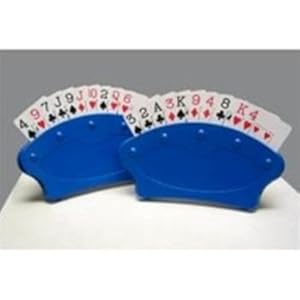
Playing Cards One handed with a “Device”


Card Holder disks

Lightweight, plastic, spring-loaded discs make it easy for individuals with limited hand function to hold cards.
9436 Card Holder Discs $12.99  at pattersonmedical.com


Card Rack


Walnut-stained fiberboard card rack holds all the cards needed for any game. Grooves are slanted and rack is tiered for good visibility.


Kids Playing Card Holders
Kids hold all the cards, with these neat-and-easy playing card holders! 


Playing Card Shuffler
1 to 4 Deck(s) Automatic.


One Handed for Carrying and Diapering Infants


One Handed Techniques for Carrying and Diapering Infants
Reviewed July 2010
Author: Kylene Canham , MOT, OTR/L
Occupational Therapist
Rehabilitation Institute of Chicago Day Rehab Center - River North

Lifting and placing an infant into a side carrier and performing diapering can be done using one hand. This handout provides a guideline for these activities.

Read the full article ...

---------

Saturday, January 07, 2012

A Real-Life Experience -- Lynn Johnston

Many storylines in For Better or For Worse are snapshots of real events in Lynn's life. Several years ago, Lynn's mother-in-law, Ruth, had a stroke in her home. Ruth was standing at her stove, and was in the kitchen with her husband Tom, her son Rod, and Lynn. She turned to face them, said nothing and simply slid down to the floor. Lynn's recollection of Ruth's stroke has been told through Grandpa Jim.

Because the story about Grandpa Jim's stroke was so true to life, there was not a lot of room for fiction. It was important to research the facts. What resources are available for stroke sufferers? What is a probable diagnosis for Jim and what should be his path for maximizing his quality of life?

Read the article Lynn Johnston drawing comics For Better or For Worse for her Grandpa Jim.


Saturday Comics - January 7, 2012


For Better and For Worse  by Lynn Johnston /2006-09-26  
(This a serious topic of stroke but with a very nice cartoons. It is all about Grandpa Jim had a stroke and 88 further cartoon "strips" that happened to Grandpa Jim [1 of the series stroke of 88 -- every week])
Click Me!

 "Dad! You're scaring us!! Dad? Dad!! .... "   


Dilbert               by Scott Adams / 2011-12-27
(Pick The Best Of The Week for your good humour)
Click Me!
"Good news, Alice. I've decided to be your mentor ..."


Garfield            by Jim Davis / 2011-12-26
(Pick The Best Of The Week for your good humour)
Click Me!
"Run Liz! ..."


Pickles                 by Brian Crane / 2012-01-02
(Pick The Best Of The Week for your good humour)
Click Me!
"At least we're older but wiser, eh ..."


* I tried to get low or free price at the people http://www.UniversalUclick.com/ for the images for the cartoons.  It was too high for Stroke Survivors Tattler i.e. we are not a regular newspaper and our budget is very low.  Fortunately, you will have to do only 1-click more to see the cartoon image, it is legit and it is free using  GoComics.com and Dilbert.com.


(NEW) Comics -- Every Saturday Morning.

I used to read good Dilbert comics then I will publish on the Stroke Survivors Tattler; mostly other Dilbert is rather dull and so I'll just ignore/not publish.  After this Christmas, people told me the comics For Better and For Worse has more than 60 "strips" starting in 2006 about the topic stroke -- it will tell the story "Grandpa Jim" had has a stroke,  went to the hospital, he has physiotherapy, and what happens to him to go home, and many more details; lots emotional problems, lots of love, and lots many people help Grandpa Jim to get better.  I read the whole strips, and I am one of the stroke survivors, and I was convinced for the usefulness of comics.  Lynn Johnston is a Canada author for For Better and For Worse and she is very serious about stroke topic and specially with comics.  So, I will publish:
  1. Friday, Dec/30, an article about Lynn J. wrote For Better and For Worse comics for stroke. She will tell you the details to make a "strip" for the stroke.
  2.  On Saturday, Jan/7, I will publish the first "Grandpa Jim Has Had a Stroke".  Every week Saturday in the future,  I will publish the "strip" what happens to Grandpa Jim.  It will take it more than 88+ weeks but I think you will like it.
  3. As well, I will publish every week:
    • Dilbert - the best "strip" that week - lots of people with a, sometimes weird,  job, personality, bizarre boss, ...
    • Garfield - the best "strip" that week - a cat Garfield with human thoughts, a dog Odie, some people Jon, Liz, ...
    • Pickles - the best "strip" that week - senior humans, kid humans, ... 
  4. If you want other comics, e.g.  I love "Peanuts",  just tell me and I will add every Saturday.  You want to look at various comics then click to GoComics.
  5. I asked the people at http://www.UniversalUclick.com/ for free or low cost for the cartoons image.  Unfortunately, the price is too big for Stoke Survivors Tattler  so we stick to the regular direct blog link to GoComics.com and Dilbert.com. See The letter from Mary Suggett at amuniversal.com for details.

Cheers  / John A.
E-Mail: SSTattler. 

Friday, January 06, 2012

Dietary Approaches to Stop Hypertension


Friday, January 6, 2012. U.S. News & World Report's Best Diets rankings chose the DASH diet as the best diet overall, best diet for healthy eating and best diet (January 4, 2012, November 1, 2011, and June 7, 2011: "Best diet overall" and "Healthiest diet") . Studies of the DASH diet demonstrate that it can lower risk of several types of cancer, heart disease, stroke, heart failure, kidney stones, and reduced risk of developing diabetes. If you have high blood pressure and cholesterol or diabetes it helps to lower blood pressure and cholesterol and stabilize your blood sugar.

The DASH -- Dietary Approaches to Stop Hypertension --  was originally developed to reduce high blood pressure or hypertension. It has been proven in studies sponsored by the National Institutes of Health to lower blood pressure. The low-salt diet provides additional benefits to reduce blood pressure because it is based on an eating plan rich in fruits and vegetables, and low-fat or non-fat dairy, with whole grains. It is a high-fiber, low- to moderate-fat diet, rich in potassium, calcium and magnesium.

For more about the DASH diet: http://dashdiet.org/


Sunday, January 01, 2012

Living With Aphasia: Carrie Lewis' Story

and many more articles by the Canada Stoke Network

"Carrie Lewis is a remarkable woman".

This isn’t because she lives in Edmonton, Alberta, or because she’s 49 years old, or even because she has lived with aphasia in the four years since her stroke; what makes Carrie instantly likeable is her sense of humour and obvious enthusiasm for life.

“I am feeling pretty good, now,” Carrie wrote when asked to talk about herself. “I like my independence, being able to walk and drive. Make things, do things like sports, games, talk, see new things, places, people.”

Stroke in Young Women Often Misdiagnosed

By Gail Johnson, 

Lisa Fitterman clearly remembers the Friday night 18 years ago when she woke up on the floor and had trouble dragging herself back to bed. The journalist, who was 26 years old and covering the legislature in Victoria at the time, felt out of sorts and couldn't move the right side of her body. She figured she had some sort of weird flu. By Sunday, she realized she wouldn't be able to make it to work the next day and went to call her office--but she couldn't remember the phone number. The next day, Fitterman got in her car and attempted to drive to the hospital. She didn't have the strength to put her foot on the brake pedal; she went through a stop sign and broadsided another vehicle. When police officers showed up, they were ready to take Fitterman to the drunk tank. Nobody, especially Fitterman herself, thought she had suffered a stroke.

New Year’s Resolution to Eat More Fruits and Vegetables!

Another reason to keep that New Year’s Resolution to Eat More Fruits and Vegetables

 See also:  Total Antioxidant Capacity of Diet and Risk of Stroke                      

High consumption of antioxidant rich food seems to lower stroke risk for women with no previous stroke and women who have had a hemorrhagic stroke.

In a brand new study in the journal Stroke, women with higher total antioxidant capacity had fewer strokes.  This study measured total antioxidant capacity, which considers all antioxidants and the synergistic effects between them, not just one antioxidant like Vitamin C, Vitamin A, or Lutein found in leafy green vegetables.

---------

Thursday, December 22, 2011

Shoes and Boots: Traction Devices.

Walking on non-technical snow or ice? These little gizmos slip easily onto your footwear to reduce the odds of slipping. They stow easily in your jacket or pack pocket when not needed. I used in the alley to throw garbage in the garbage bin but the alley in winter is covered with ice.  Instead of slipping or sliding on the ice, I walk easily using the little gizmos with confidence.
  • Natural rubber, wound with coils to create hundreds of biting edges to grip snow and ice.
  • Removable performance straps.
  • Provides traction through 360 degrees, for security when traversing gentle slopes.
Look at the devices at Mountain Equipment Co-op or Lee Valley (and many other stores have the same or similar product).


What is unilateral spatial neglect?

Left side neglect or unilateral spatial neglect (USN) is estimated to occur in 40% of stroke patients. Health professionals say unilateral spatial neglect is  "characterized by the inability to orient or respond to stimuli appearing on the side contralateral to the brain lesion". A more understandable explanation comes from the StrokEngine website:

GRASP - Graded Repetitive Arm Supplementary Program

GRASP - Graded Repetitive Arm Supplementary Program
by Janice Eng, PhD, PT/OT and Jocelyn Harris, PhD, OT
See: GRASP

Monday, December 19, 2011

Ad-hoc Darts and Friends and Acquaintances - A Christmas Party!


Hi Ad-hoc Darts and Friends and Acquaintances,

BRIANwaves December 2011


 BRIANwaves (Remue-MÉNINGES)


In This Issue -- December 2011:
Calgary Congress plans in gear
Provinces are using stroke report
results to drive change
iSCORE a useful tool for clinicians
Mr. Noodles wins 2011
Canadian Salt Lick Award
Life After Stroke website a valuable resource


Tuesday, December 06, 2011

Some therapists recommend splints and others do not.

Some therapists recommend splints and others do not.  There is conflicting evidence about  hand splints  Some therapists and research  say they reduce spasticity or contractures, but others say a splint doesn’t  do anything.  These are the links to  dueling articles—one says it works and one says it doesn’t:

Thursday, December 01, 2011

Christmas at Hilltop for Ad-doc Darts !


Prepare for Christmas !
Sharpen your Darts !
Tuesday December 6th @ 7:00 pm 
at the Hilltop Pub


Darts -- "Ad-hoc Darts"

     We are celebrating Christmas at the Hilltop!  Come out and play Darts! Or just come to Talk. Wear a Christmas Hat! 

There will be Prizes for the best Dart Game of:
  - Round the Clock,
  - The most Bulls eyes in a row,
  - Shanghai.
    (Instructions will be provided)

Parking or Bus:
  • Lots of parking -- absolutely free.
    • Ask for a ride from a friend!
  • Very efficient for the Bus #1 - it takes only 12 minutes:
    • Take the LRT to Bay/Enterprise Station,
    • Hop the Bus #1 going east,
    • Get off at Hilltop 8220 - 106 Ave,
    • Going home just take Bus #1 going west, 
    • Bus #1 leaves every 20 min. to 1:30AM (we are done usually 9:30PM).


View Larger Map

Saturday, November 26, 2011

Ad-hoc Darts at the Elephant & Castle


Ad-hoc Darts at the Elephant & Castle
Tuesday at 7pm on Nov 29, 2011.
Located in City Centre - downtown - 3rd floor near the Bay.
10200 102 Ave NW
Edmonton, AB T5J 4B7
(780) 424-4555
www.elephantcastle.com

We will examine the Elephant & Castle for Ad-hoc Darts group but we need to know:
  • Transport by LRT or bus is excellent and very close (1 block),  but how about the car - is there is park-aide close? cost? where is it?
  • You have some disability - escalator OK? elevator OK? where is it?
  • Pub meals - cost? good meal? choice?
  • Drinks - cost?  they have draft? they have Guinness??
  • We will go - every week? every month? frequent? never?
If you have an opinion please talk to either Carrie, Randy or John on Tuesday night. Opinions are much more valuable than silence - even a little opinion has great importance!


Friday, November 25, 2011

Tips for Improving Fine Motor Skills

Excerpted from "Fine Tuning: Tips for Improving Fine Motor Skills", Stroke Connection Magazine, September/October 2003 (Science review May 2008)
        Fine motor skills are small, precise, coordinated movements, like using your fingers to pick up a coin. Fine motor skills require integrating muscular, skeletal and neurological functions. Physical and occupational therapists can work with you to practice these skills after stroke.
       “The theory is that you can create new pathways in the brain to compensate for injured areas,” says occupational therapist Rondi Blackburn. “The key is to use your affected side as much as possible and to repeat activities several times each day.
       “At Baylor Institute of Rehabilitation ....
Read the full article.

Saturday, November 19, 2011

Elf -- Movie -- December 2nd at MacEwan!

Free Drop in Event at: 
         MacEwan  109 St. & 104 Ave.
Dive In Movies on Friday December 2nd:
      6:30 - Activities
      7:00 - Movie

Please come to the movie especially Stroke Survivors and friends!

780-497-5694
sewellg2@macewan.ca
www.MacEwan.ca/Recreation

Friday, November 11, 2011

“My Life is not a Tragedy” Players

From Edmonton:
There is a play at the Glenrose
Wednesday, November 23, 2011
at 7:00pm
At the Bill Black Auditorium - inside the Glenrose.

“My Life is not a Tragedy” Players.

Cost is free!  Everyone is welcome to come.

 Glenrose Rehabilitation Centre – 10230-111 Avenue
(North across from Royal Alex Hospital)

Come in the Front Doors, ask at the desk 
for the location of the Bill Black Auditorium.

Putting the Possibility in Disability

Jackie Poff
Stroke Survivors Tattler
by Jackie Poff

Some stroke survivors remember vividly their strokes and the events leading up to and around their strokes. I personally remember very little about my stroke – thankfully! 

It has been three and one half years since my stroke, which took place on a very cold morning in January 2008. But here is what I do know about that day. On January 22nd (the day before my stroke) I was taking advantage of my lunch hour at work by taking with me my daughter, Nicole, who I had had the great pleasure of hiring onto my staff. We headed out to start apartment hunting for her. I received a phone from my mother informing me that my grandfather, Jack, who I was named after, had passed away at ninety years old. 

That evening our family gathered at grandpa’s house in Tofield to discuss his passing. We arrived back home on our acreage near Spruce Grove much later than we intended. We all crawled into bed exhausted and I, as always, slept like a log. 

I did remember to set my alarm for 6:30 in order to give Michelle, our youngest daughter, then thirteen, a ride to school for an early morning handball practice. When the alarm went off, I stumbled out of bed and went to the bathroom to run a brush through my hair. My husband Larry, a light sleeper, followed me and asked me why I was up so early. As he questioned me, suddenly my words became gibberish and I started to fall over. Larry, wondering what the heck was going on, caught me and rushed me to our bed. I was not responding. Nothing I did or said made any sense. 

Larry recognized that I must be having a stroke. He managed to call our families and yell to the kids. He threw me in the car and got me to the nearest hospital, the Sturgeon Hospital in St. Albert.

SRAE Newsletter - November 2011

Wendy Pangrass:


Not only is Wendy Pangrass an accomplished speaker, speaking at the International Womans year in Ottawa, she has also been a member of many boards such as YWCA, Habitat for Humanity, Strathcona County Family Services Advisory Committee, as well as many others. On Father’s Day, June 15, 2008, when she suddenly developed numbness of her left side and the loss of her speech, she knew instinctively that something was wrong. “My son is a Firefighter/EMT and he has always told me to call 911, and if need be, always stay on the line” says Wendy. “I did and when they answered all I could do was grunt. They were not exactly sure of my need but told me to stay on the line until the paramedics arrived. In less than 10 minutes they were there and after a quick assessment I was off to the hospital.”

Saturday, November 05, 2011

Tie Shoes with One Hand !

If the stroke left you with the use of one-hand tie shoes can be a problem but you can:
  • get shoes with velcro straps or slip on,
  • get elastic laces,
  • learn to tie shoes with one-hand.
These videos will show you a trick to tie your shoes with one-handed.