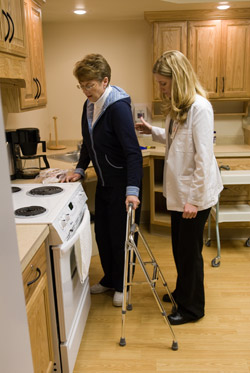
The role of an Occupational Therapy/Therapist is to work with a client to help them achieve a fulfilled and satisfied state in life through the use of "purposeful activity or interventions designed to achieve functional outcomes which promote health, prevent injury or disability and which develop, improve, sustain or restore the highest possible level of independence." A definition from Wikipedia and video clips from YouTube/Vimeo.
Occupational therapy (OT) is the use of assessment and treatment to develop, recover, or maintain the daily living and work skills of people with a physical, mental, or cognitive disorder. OTs also focus much of their work on identifying and eliminating environmental barriers to independence and participation in daily activities. Occupational therapy is a client-centered practice that places emphasis on the progress towards the client's goals. Occupational therapy interventions focus on adapting the environment, modifying the task, teaching the skill, and educating the client/family in order to increase participation in and performance of daily activities, particularly those that are meaningful to the client. Occupational therapists often work closely with professionals in physical therapy, speech therapy, nursing, social work, and the community.
History of Occupational Therapy
Early Therapy
The earliest evidence of using occupations as a method of therapy can be found in ancient times. In c. 100 BCE, Greek physician Asclepiades initiated humane treatment of patients with mental illness using therapeutic baths, massage, exercise, and music. Later, the Roman Celsus prescribed music, travel, conversation and exercise to his patients. However by medieval times the use of these strategies with people considered to be insane was rare, if not nonexistent.
In 18th-century Europe, revolutionaries such as Philippe Pinel and Johann Christian Reil reformed the hospital system. Instead of the use of metal chains and restraints, their institutions utilized rigorous work and leisure activities in the late 18th century. This was the era of Moral Treatment, developed in Europe during the Age of Enlightenment, where the roots of occupational therapy lie. Although it was thriving abroad, interest in the reform movement waxed and waned in the United States throughout the 19th century. It re-emerged in the early decades of the 20th century as Occupational Therapy.
Occupational therapists work in many different roles and settings. This short film will help you find out what a rewarding career you could have as an occupational therapist, helping people to live life their way.
Some people think OTs are the dressing or handwriting guys. Yet OT's official slogan is Living Life to Its Fullest ®. The disparity between what people think OT is and how OTs see themselves occurs because OT is like an iceberg. An important part of what OTs are trying to accomplish is hidden. There are three components of OT treatment, but you see only two in an OT session.
1.The Preparation.
Preparation addresses each client's individual deficits. Examples include exercises to open the hand while reaching, scanning strategies for visual neglect, learning what the parts of a memory notebook are for, and learning how to stop negative self-talk.
2.The I Shoulds.
Many people have the same shoulds. We all should get dressed so we can leave the house, do laundry so we have clean clothes, write legibly so we can sign credit card slips, and have good memory strategies so we get to appointments on time. OTs call "I shoulds" functional outcomes. Insurance companies will not pay for therapy if clients do not show some functional gains.
3.The I Want Tos.
"I want to" is personal, like petting a beloved cat. Valued activities occur outside of therapy so clients may not see how they are connected to OT. OTs need to make linking statements so clients understand the full value of OT. A linking statement might be "don a bra so I will not be embarrassed when I eat lunch with friends." I live alone so donning my bra enhances my social life. If a client wants to feel the sun on his or her face, pointing while saying "leg brace - patio" can make a client's face light up.
Preparation and functional training are essential but they do not sustain our commitment to action when we recover slowly. Practicing a tip pinch so I can zip my coat needs to be followed by "because I want to..........." Valued activities help us maintain the physical, cognitive, language, and social skills we work so hard to regain. Living life to the fullest does not mean going to Paris. It means satisfying deep human needs like feeling needed and having fun. It means turning "I should" into "I want to."
SOAP notes are what physical and occupational therapists call their daily notes. I don’t know if that’s what speech therapists call their notes. Every time you have a PT or OT appointment, the therapist will write a SOAP note. I don’t know if this information can be helpful in any way but here ya go. SOAP is an acronym for subjective, objective, assessment, plan. The subjective is whatever you say. So if I go into my OT appointment and say “I’m still writing really crappy,” she’ll write on her note “patient reports she is still writing crappy.” She’ll use the word ‘crappy.’ It’s whatever the patient says. I remember one time I wrote patient reports “I feel like Superman.” That boosted my ego a bit. Objective means whatever you did during the session. So when I’m in OT and put the pennies in the piggy bank 3 times, she’ll write that down – that I did that 3 times. It’s whatever you do during the session. Assessment is weird. It’s supposed to be how the patient did during the session but often it ends up being objective. A good assessment would be “due to decreased strength, the patient had trouble standing up today.” This is an assessment of the situation. Much better than “the patient had trouble standing up today.” That’s objective. Then plan is what you plan on doing next session. If you plan on adding an exercise, you write “add leg press” or whatever. If you plan on doing a re-evaluation, the therapist would write “do re-eval.” Ok that’s SOAP notes for you.
For the last two weeks I went to Spaulding everyday to try to recover more movement for my right hand. I did a program called Modified Constraint-Induced Movement Therapy (M-CIMT).
Warning: this post is much longer than usual. I wrote this summary since some stroke survivors I know were curious about this program, especially since the price is so reasonable.
The program
Every day from 1 - 3pm, five stroke survivors, including myself, gathered around a big table. After our occupational therapist (OT) led us in some stretching (both hands), we were asked to put our less-affected hand in our lap.
CIMT. Constraint-Induced Movement Therapy. This is a therapy technique in which a glove, mitt, or any kind of constraint is used to cover the unaffected hand at all times, which requires the forced use of affected hand. This should be done in conjunction with regular occupational therapy, which in theory should compensate for the inevitable poor form that will result from the forced use. It's also traditionally done with supervision, which makes it an even more challenging process, especially when you're by yourself.
Recently here in Chicagoland, an occupational therapist specializing in CIMT began a research project on modified CIMT practice. In this study, she had roughly twenty volunteer patients do CIMT for six hours per day for two weeks (I believe this to be called mCIMT, for modified). There is an activity log to fill out and a motor test right before and right after the program to test for results.
The CIMT program is promising because it forces your healing practice both by inducing your weaker side's movement and increasing your awareness of it (something that really fades over time), and by making you accountable to others. It's still a system in progress, and I've got a lot of feedback from the first time and current trial --
My OT & Physio had realised I spent far too many weeks simply sitting in the same chair in the same room all day and every day until being put to bed at night.
To break the monotony it was decided to give me a huge lift emotionally by arranging a trip in a car to a local forest tea room. The coffee shop and car park were disabled friendly enabling me to attempt such an outing.
After finding a table Jane, my OT, ordered our lunch and drinks and I was enjoying every moment of fresh air, people watching, listening to voices all around me, children running around in a near by play area. Jane cut my lunch up to manageable sizes so that I could eat with my left hand. This was something I had now grown quite used to and didn’t think anything of until noticing the faces of mothers around me, showing their shock, disgust even as they were doing the same for their toddlers and here was Jane doing it for a woman of her own age! This was the first of many uncomfortable emotions, that said four years on I don’t bat an eyelid.
I was exhausted after this trip and slept on the way back home but it had done everything Jane & Marianne had intended and more, it increased my confidence too.
However, the next uneasy feeling from that day which didn’t actually catch up with me until the following week, reduced me to tears in my fragile state. I was at that time fragile in every sense of the word. If I see the couple I am about to refer to, although I no longer feel upset, my emotions revert back to this occasion.
After my fabulous lunch I needed to visit the disabled toilets before returning to the car ( this reminds me of a time visiting the same with my mother’s help whilst I was in control of a disabled scooter, I got us all trapped inside, this is for another blog but until then visualise a Mr Bean sketch).
Many people with stroke have such devastating injuries that they feel blessed to be able to feed themselves. Cerebellar stroke is a little different. I can move everything, do everything…just in the wrong place and at the wrong time. And when I fatigue I can’t get messages through. It’s not that I’m weak…it’s that the communication between my brain and body is off.
Because of this quirk of cerebellar stroke, I simultaneously feel really guilty for complaining and also generally misunderstood. In general, the best therapy I can have at this point is to do coordinated movements over and over and over. Compared to someone with a more normal stroke, this is easy. Compared to how I was before, this is very, very hard work! Because I’m cognitively fine, I also find activities like tapping cups or cones (common occupational therapy) not only boring, but somewhat irrelevant. I learn tapping cups very quickly…but tapping cups isn’t what I need to fully function. Cognitively speaking, I can function as a doctor but I need to practice language and memorization and could probably due to improve my focus as well. Playing computer games just doesn’t do it for me.
A few weeks back I started an art therapy class at the local non-profit stroke center. It was an amazing experience! I have never been noted for my artistic ability. My mom’s infamous comment when we were sitting around doing an art project together as a family: “Well, dear…medicine is your art.” But no one at the therapy class cared about my abilities. It was all about learning to use my hand and being able to express myself in another way. I’m on a huge tree kick right now. I’m working on my third set of trees and have several more in my mind’s eye. Doing the art is exhausting! I hold my poor, tired hand in my lap several times during the class just to rest it and then need a nap when I get home. But it is so much fun and has been a huge help in using my hand.
I'm a fan of one of this blog's advertisers, Saebo. The two guys who started the company are brothers, both occupational therapists. (Find another set of brothers that are both occupational therapists and I'll send you a free copy of my book.) I like the culture that Saebo brings to stroke recovery. Everything they make has a commonsensical perspective engineered in.
Saebo makes the SaeboStretch. Unlike static splints which hold the hand in a static position, the SaeboStretch allows the fingers to flex when they need to (often to protect the joints of the fingers). The 'Stretch then slowly pushes the fingers back to the desired position.
My affected side has been very stiff and sore lately. My therapists tell me it’s because of the change in the weather. I live in Los Angeles and despite daytime temperatures this fall often registering above 80°F, there is a chill in the air at night.
I think about my stroke friends who live on the East Coast or in Canada and wonder how they contend with the snow and freezing temperatures. It's so much more than the dangers of walking or driving on ice, or the effort required to put on and take off extra layers. It's the way the cold settles into the muscles and makes them less effective and more painful than usual.
It reminds me how lucky I am to be where I am in dealing with life post-stroke. It's not just the weather — it's the depth of medical help available to me that isn't available to others. I know a Canadian survivor whose nearest neurologist is a two-hour drive away. From the rural Midwest, a reader of my blog contacted me with questions about how to help her husband regain functionality in his hand; the only occupational therapist within driving distance had dismissed her husband, saying there was nothing more to do for him.
I am not only geographically closer to my medical team, I have a choice whom to work with: I had the luxury of firing both my first occupational therapist and my first neurologist.
I hope that I’m not making survivors who are not located as beneficially as me feel bad. (If it makes you feel better, I’ve paid for it in traffic jams, air pollution and skin cancer.) I just wanted to point out that location is one more factor that has an impact on our recovery.
So I am almost to the point of looking for a position that more fits my training. My concern is I could be a bit delusional that I can still produce the same quality of work as pre-stroke. I just don't know. I know when I started my garden job that absolute crazy feeling in my head when my boss gave me run on instructions as in : Do This, Do That, Move This, Look for This, etc etc. I could feel my brain actually scrambling and freezing and locking... it did not know (or that part of my brain is "gone") where to put a series of quick instructions-- so it would just go blank and not remember any of them. My short term storage has been impacted, and it feels as though it has been misplaced. It is very wierd being in my head when it is missing something. You ever have that? It's like there is some sort of memory of what was, what I could do, but there is no way to touch it. I have a memory of being very competent and accomplished, but I feel kinda bumbling and floaty sometimes. I also cannot trust my "gut" as much, as I have discovered errors in my instincts--and I am a very "gut instinct" person! With work over 3 months my memory has changed & improved so that I actually can remember a string of instructions (at least the first 3 or 4). Last week I made a appointment with an occupational/speech therapist to work on memory. I also notice the muscles on the left side of my body have a different consistency than others. They are always very flaccid-loose-relaxed as if I just had a year long massage and they are jelly. I am not really complaining, just noticing. Pre-stroke I always loved learning new things, and new ways to see things. I thank the lovely heavens that my appreciation of the diverse ways we can navigate through a life is not diminished.
This is a brain. It is also the unfortunate outcome of a baby whose mother experimented with cocaine, resulting in a premature birth and a bleed in the baby's brain. A bleed in the brain means the baby had a stroke. Hey! Wait a minute! Babies and strokes don't go together, or do they?
Note: for all you baby-makers out there, I'm not trying to scare you from having kids. This post is just a dose of reality.
You probably don't know the name Duncan Guthrie. He started a charity in 1952 for his daughter, Janet, who had polio, and he was determined to find a cure for the disabling disease. With money funded by the charity, research, in time, led to the first oral polio vaccine which wiped out new cases of polio in the UK. Now called Action Medical Research, the charity encompasses so many other afflictions, and that leads us to babies and strokes.
In 2009, Action Medical Research estimated at least one baby out of 2,300 in the UK born full-term were victimized by a stroke. These strokes often were unexpected at the time of birth or before, i.e. some developing babies had strokes in utero. The researchers didn't know if the babies, who are now barely three years old, had trouble using language because they hadn't matured to the point where anybody could tell the difference between a three year old saying gibberish or not.
Photo from the University of Wisconsin School of Medicine and Public Health
Stroke is the leading cause of permanent disability in the United States. So many people need physical, occupational and speech therapy to recover. I recently read about research that might lead to better tools to help stroke patients to recover.
A new interventional therapy that uses a brain–computer interface appears to change brain activity in patients with stroke, new research has shown.
The therapy alters specific areas of the brain that correlate with both the affected and unaffected hands. The activation of these areas of the brain appears to correspond to executed and imagined tasks of the affected hand, and may represent neuroplastic recovery.
"Brain activity fed back to the patient is key for the therapy," explained Vivek Prabhakaran, MD, director of functional neuroimaging in radiology at the University of Wisconsin in Madison.
Success today took the form of a small yellow ball at occupational therapy. As I was lying down, OT Stephanie had me put my hands on either side of it and push it toward the ceiling until both arms were fully extended, then lower it to my chest and/or abdomen, then up again. To do it, I recruited every arm muscle I could remember looking at in Dr. Netter's atlas of human anatomy. Up, down, 10 times, then 10 more. When she asked me how that felt, I said,"Like my right arm was doing most of the work."
"Your left arm was working, too, though, or it would have flopped back down, which it didn't," she said. "How did it feel?"
It occurred to me that my left arm - that stupid recalcitrant one - had finally successfully accomplished something. Instead of my OT asking me to do something and having my left arm fail, my arm did it! How did that make me feel? I burst into tears; she patted me on the shoulder and asked me whether I was getting any counseling to help me with my ordeal. I said no, because I thought I was all right dealing with the whole thing. Given, though, how fragile I have become for being such a strong person, she had a good point and I'm thinking that next week I'll look into my counseling options.
Using non-invasive electronic stimulation, coupled with occupational therapy, researchers say they are hoping kids can increase hand function.
At Gillette Children's Clinic in Burnsville, Maddy Evans of Lakeville puts on the cap she wore during her electric brain stimulation therapy two years ago. On the table is the cast that was put on her dominant hand for two weeks so she would be forced to use the hand that was affected by the stroke. She credits the therapy for helping her make better use of both hands: i.e. the ability to put on a cap with two hands instead of relying on the one dominant hand.
Photo: Richard Tsong-Taatarii, Star Tribune
Is it possible to experience elation putting in your own ponytail or firmly shaking hands with a stranger?
Just look at Maddy Evans' beaming face for the answer. Maddy, 16, completed a study at the University of Minnesota and Gillette Children's Specialty Healthcare, using a combination of brain stimulation and occupational therapy to help children who have had a stroke increase their hand function. Maddy now buttons her coat with both hands, can put in her own ponytail and, yes, reaches for a stranger's hand with her right one. She never used to use her right hand.
Here is a little video I made today on the subject of memory and remembering. The ability to remember words, phrases and sentences is crucial for those with aphasia. However one has to begin at basic levels when helping someone speak again. In this video and the one that will be published next week, I will discuss how remembering names has some similar methods to remembering words for those with aphasia. In these two video blogs, I will give you tips and fundamentals for memory. I hope you enjoy! Please share with friends and other Facebook sites where there are people who would greatly benefit from this INFORMATION. Do not hesitate to contact me should you have any questions or concerns.
Yesterday, at therapy, the PT was trying to get Bob to squeeze his right hand. Now, most of you know, Bob has had no movement what-so-ever in that right hand/arm/shoulder since the stroke. So, I'm sort of sitting there, rolling my eyes, because man, we've done this a million times with about a million other therapists with no luck. And I, too, have tried this a million times...
So imagine my surprise when the PT states that he has felt Bob squeeze his hand! I tell you, I didn't believe him. So the PT had me take Bob's hand and he asked Bob to squeeze it.
And to my amazement, I felt a squeeze. A little squeeze. But a squeeze! It felt like an "inner squeeze" sort of coming from inside his hand. I couldn't believe it, I really thought I just imagined it, because I didn't see Bob's hand move, only felt this little squeeze. Then, Bob did it again, on command.
All I can say is "WOW!" After four years of no movement, this is nothing short of a small miracle!
The technique the PT used was this: He had Bob lean back as far as he could in the wheelchair, hold his head as upright as he could, shoulders back -- this position, the PT says, "opens the nerve pathways to the brain". He told Bob to visualize energy flowing from his brain and "zapping" his right hand. Then, he also had Bob visualize the actual activity of squeezing his hand. Here's a video I took after that first, phenomenal, squeeze:
A recent study adds an important element in potential mechanisms for the beneficial effects of the Mediterranean diet.
Marta Crous-Bou and colleauges from Harvard University and the University of Washington published a study of the Mediterranean diet and chromosome telomere length.
This analysis used the large Nurses' Health Study cohort, blood samples and dietary questionnaires. Blood samples were analyzed for chromosome telomere length.
Chromosome telomere length has emerged as a biomarker of aging. DNA chromosome telomere lengths decline with age and shortened telomere lengths are associated with shortened life expectancy.
The natural process of telomere shortening appears accelerated by inflammation and may be modified by lifestyle behaviors including dietary composition.